Inscription Process
 Accueil > Discover >
 The World Heritage Nomination: A Major Project Engaging an Entire Territory

Driven by the ambition of inscription on the UNESCO World Heritage List →, the Forteresses royales du Languedoc undertook a nomination process that brought together elected officials, experts and local residents around a shared goal: to protect, enhance and pass on this exceptional heritage.
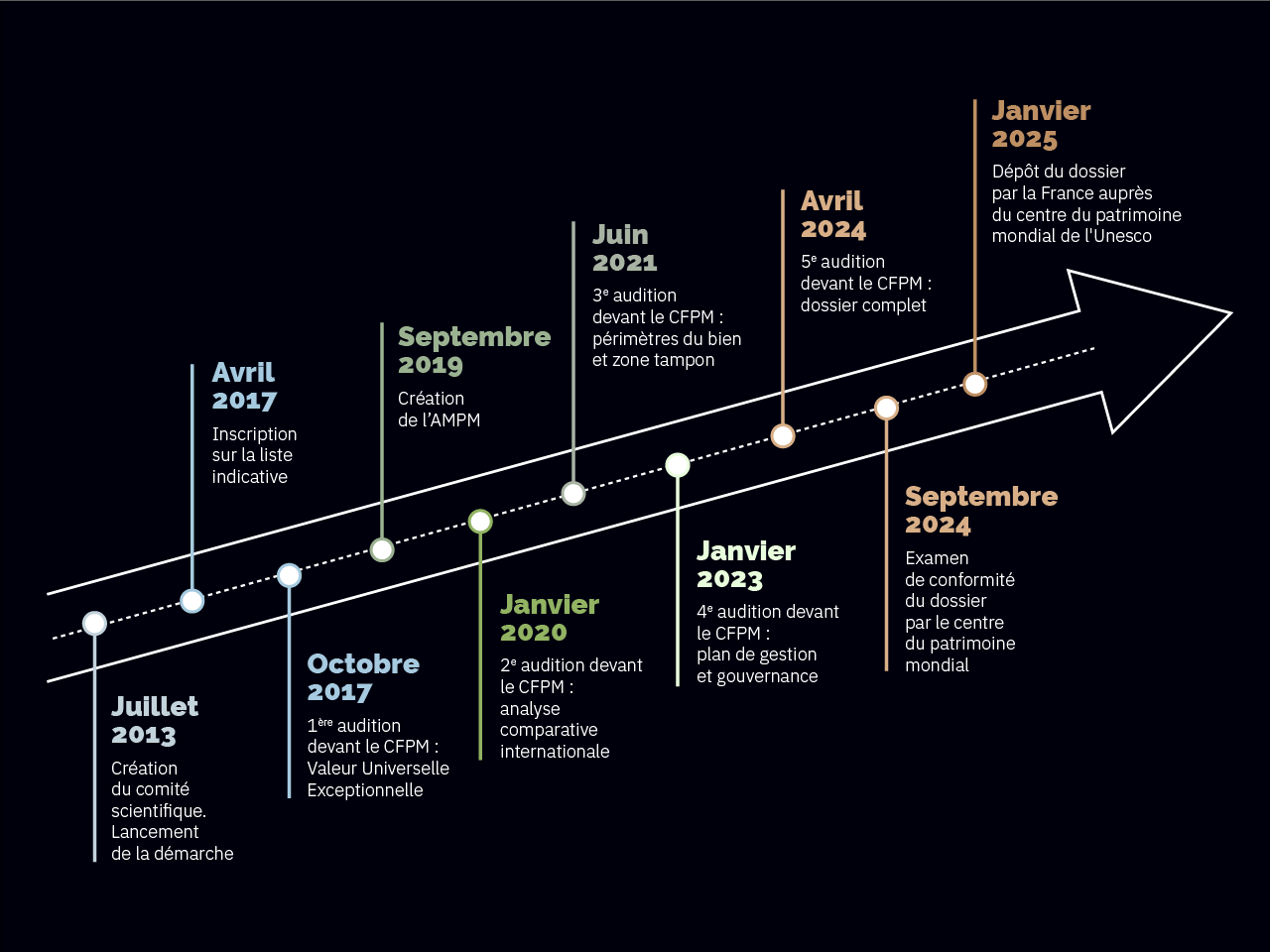
The project began in 2013 at the initiative of the Aude departmental council with the creation of a scientific committee tasked with studying the rich medieval military heritage of Aude and defining the most relevant approach for its inscription on the World Heritage list. This rigorous work led specialists to select seven fortresses which, combined with the ramparts and castle of Carcassonne, form an unparalleled example of a territorial defensive system from the 13th and 14th centuries built according to the principles of Capetian military architecture.
This process led to the inscription of the Forteresses royales du Languedoc on the UNESCO World Heritage List in 2026, recognising their Outstanding Universal Value.
“This is a project for an entire territory that demonstrates both our ambition and our expertise.”
Hélène Sandragné, President of the Aude Departmental Council: “Their history has spanned centuries; they permeate the environment in which they are erected as much as they are influenced by it. Standing proudly on rocky peaks or at the top of steep cliffs, they are recognizable from afar and bear witness to an entire segment of human history. And beyond that, they are the pride of an entire population, from Aude and Ariège. These are the fortresses of Languedoc, conquered by the Kingdom of France after the Albigensian Crusade at the beginning of the 13th century, built upon the remains of ancient seigneurial castles in this defiant and recalcitrant territory.
Once a symbol of royalty seeking to assert its authority over a newly conquered people, they will tomorrow become assets for a rural land in constant motion.
To list them as World Heritage is to recognize the prowess of their builders and their role in the unique history of the construction of the French state. But above all, it is to give them a far more important role in a territory made up of willing women and men who see in these castles far more than ruins to be protected. They are projects to be brought to fruition and values to be passed on.
By a fitting turn of history, these fortresses that once broke the rebellious fervour of the people of Languedoc will tomorrow give them fresh impetus.”

A Multi-Stage Process
After defining the Outstanding Universal Value (OUV) of this serial property, the dossier was presented to the State, which agreed in 2017 to include it on its Tentative List, meaning the inventory of properties that France intends to propose for World Heritage inscription.
From that moment on, state services (Ministry of Culture, Ministry of Ecological Transition and Territorial Cohesion) supported the project leaders through a series of hearings conducted by the French World Heritage Committee, which marked the major steps towards the compilation of the final dossier.
The first hearing in 2017 validated the OUV, the chosen criteria, and the comparative analysis. Following this, it was recommended to the Aude Departmental Council to provide the nomination with its own governance structure involving all project stakeholders. The World Heritage Mission Association (AMPM) was therefore created in 2019. In 2020, a second hearing confirmed the good state of integrity and authenticity of the monuments and approved the method for defining the protection perimeters, the definitive boundaries of which were formalized during a third hearing in 2021. In 2023 and 2024, the management plan and the governance system of the property were studied. This final stage allowed for the dossier to be considered complete and ready for submission to the World Heritage Committee in January 2025. View the Dossiers and Annexes →
Evaluation by international bodies
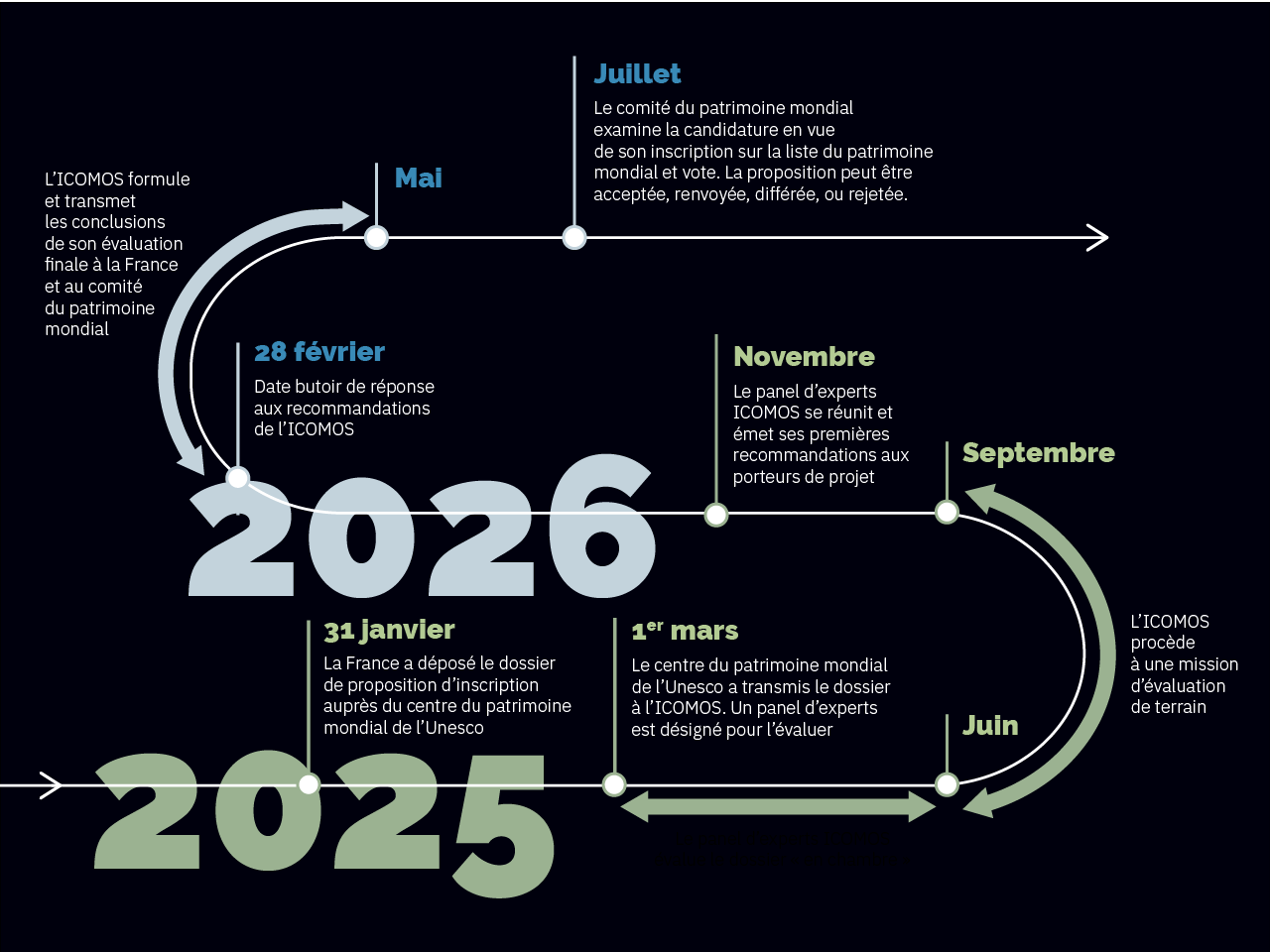
After its official submission, the dossier entered an evaluation phase by ICOMOS, the International Council on Monuments and Sites. A panel of specialists was then appointed to review the dossier in chambers throughout the year. Concurrently, an expert was designated to conduct a site visit to specifically verify the integrity and authenticity of the monuments while checking the practical implementation modalities of the management plan.
During the year, several exchanges and requests for clarification took place between ICOMOS and the project leaders until the end of February 2026. The ICOMOS panel then met to draft its final opinion, which was sent to the French authorities in May.
Inscription on the World Heritage List
At the end of this process, the Forteresses royales du Languedoc were inscribed on the UNESCO World Heritage List → during the 48th session of the World Heritage Committee, in July 2026. This international recognition attests to the Outstanding Universal Value of this serial property and to the collective commitment of the stakeholders mobilised since the process was launched.


