 Accueil > Discover > Fortresses >
 Aguilar
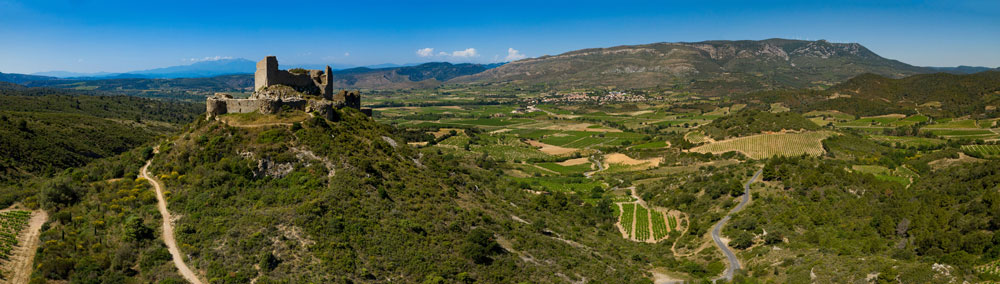
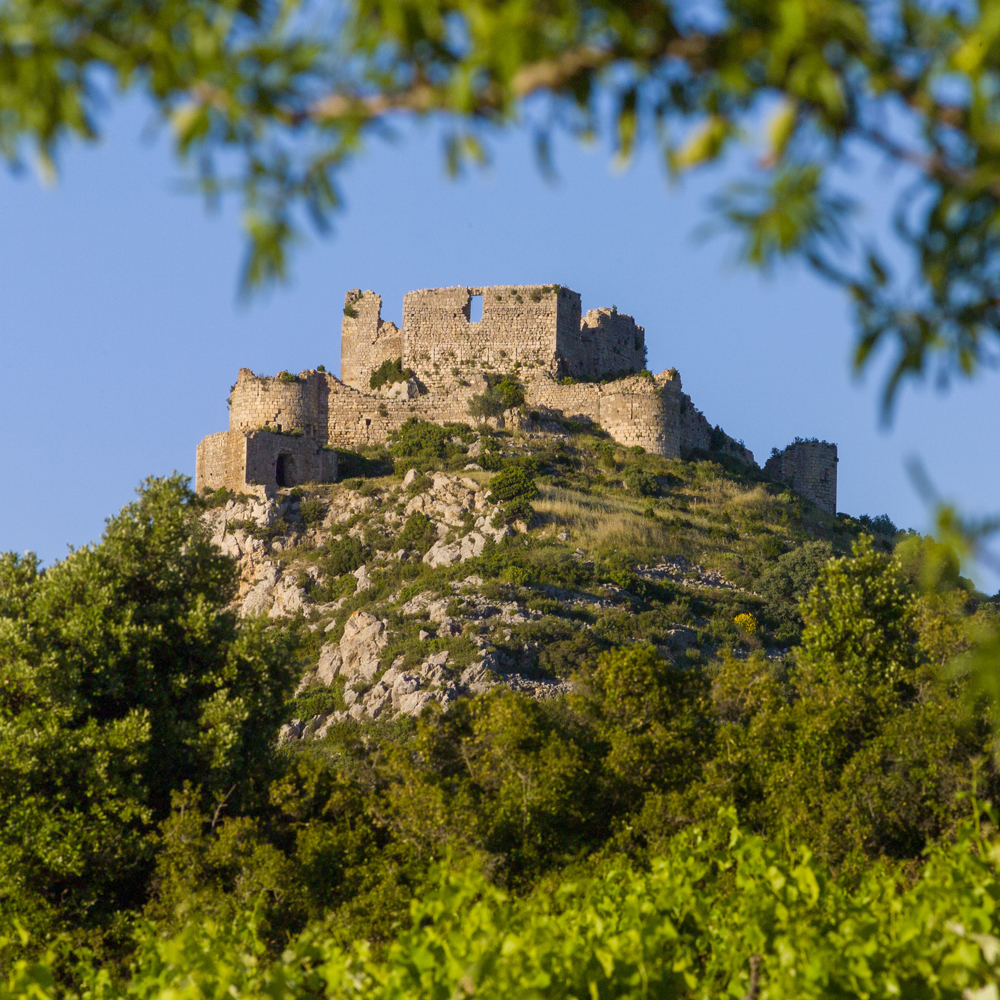
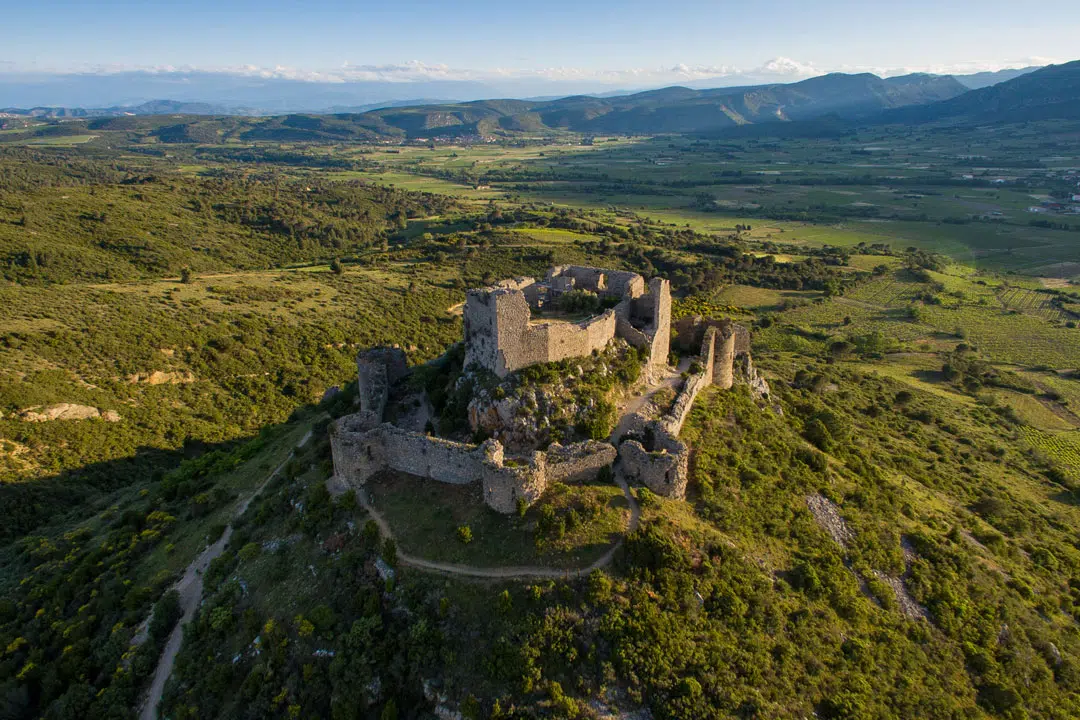
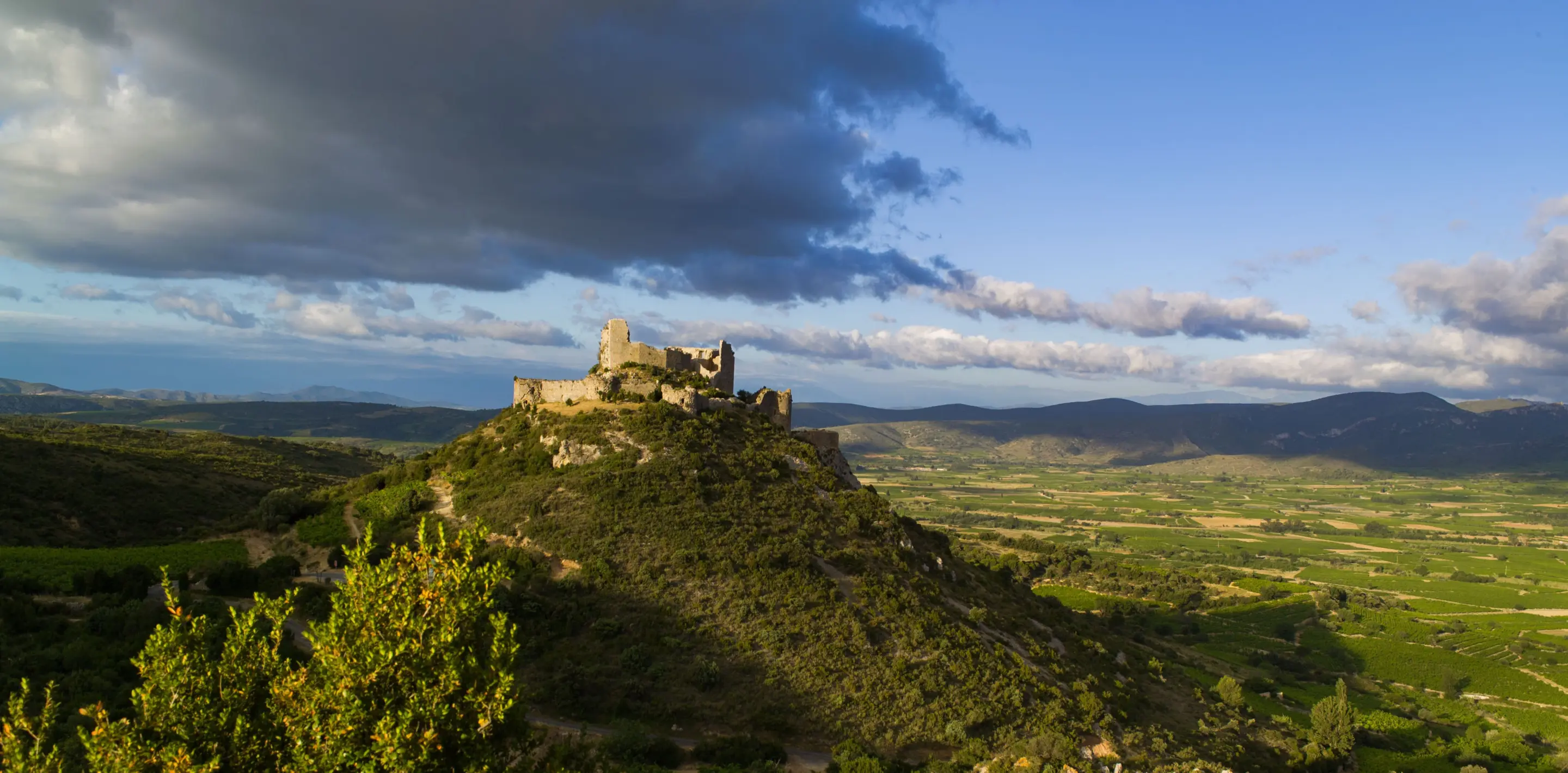
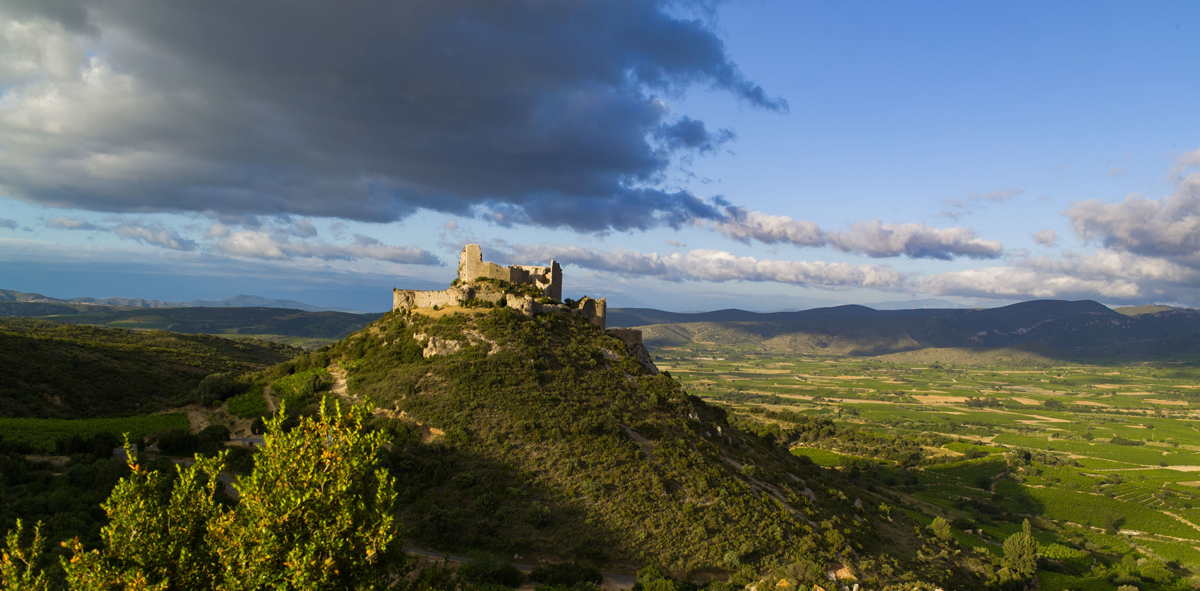
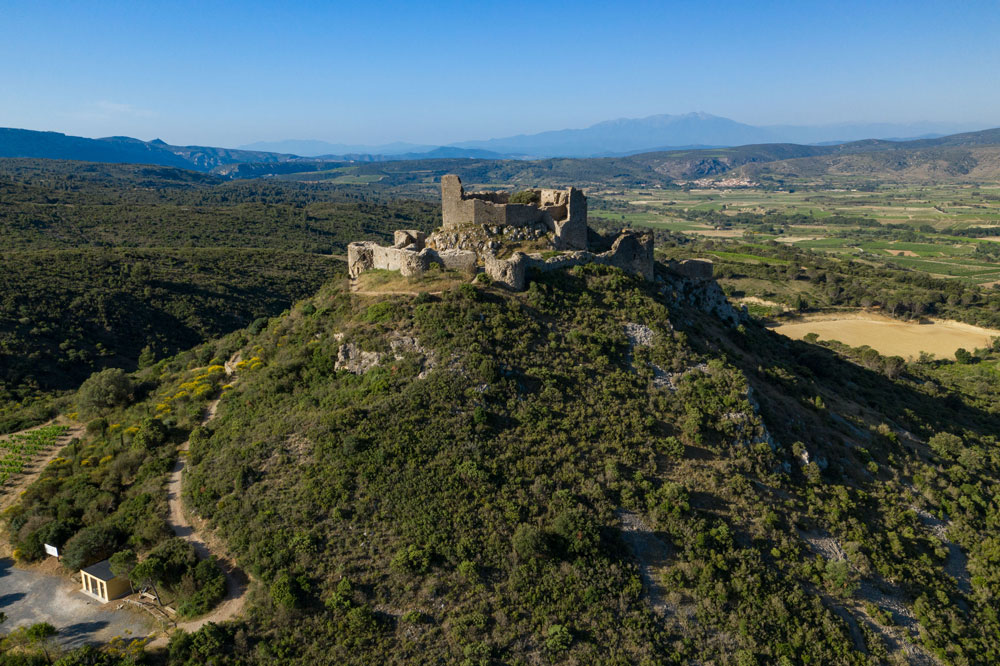
Nestled behind its powerful double enclosure, the ancient royal fortress of Aguilar dominates, at an altitude of 296 m, the Tuchan wine-growing plain, monitoring one of the rare passages through the Corbières and extending, beyond, to the first Pyrenean massifs. The site is located within the municipality of Tuchan.
CURRENT LANDSCAPE SETTING

Located in the southern part of the Eastern Corbières, in the southeast of the Aude department, Aguilar Castle is situated in the Tuchan wine-growing plain, between medium-altitude mountains and the Mediterranean Sea. Marked by the Mediterranean climate, this territory forms the transition between the Hautes-Corbières, the Roussillon reliefs, and the Fenouillèdes. This isolated position in the heart of the Corbières gives the landscape its characteristic and varied appearance. Aguilar Castle is located in a region of folds and thrusts that are at the origin of the different forms of relief and landscapes in this part of the Corbières, including the famous ‘pechs,’ as they are locally known, which designate these rounded peaks.
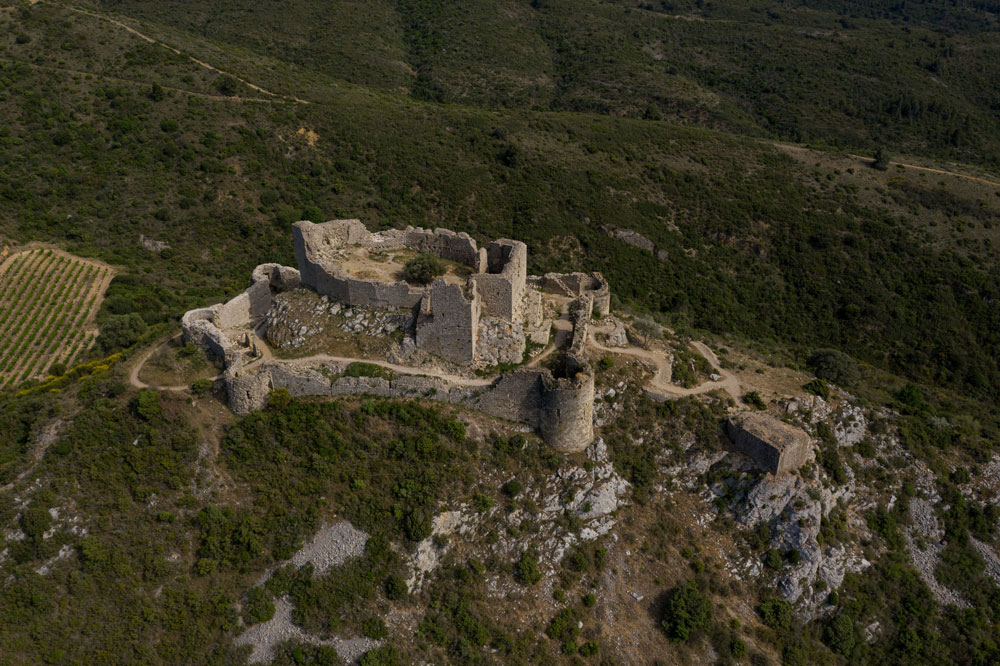
It is on one of these that Aguilar Castle stands, at an altitude of 296 m.
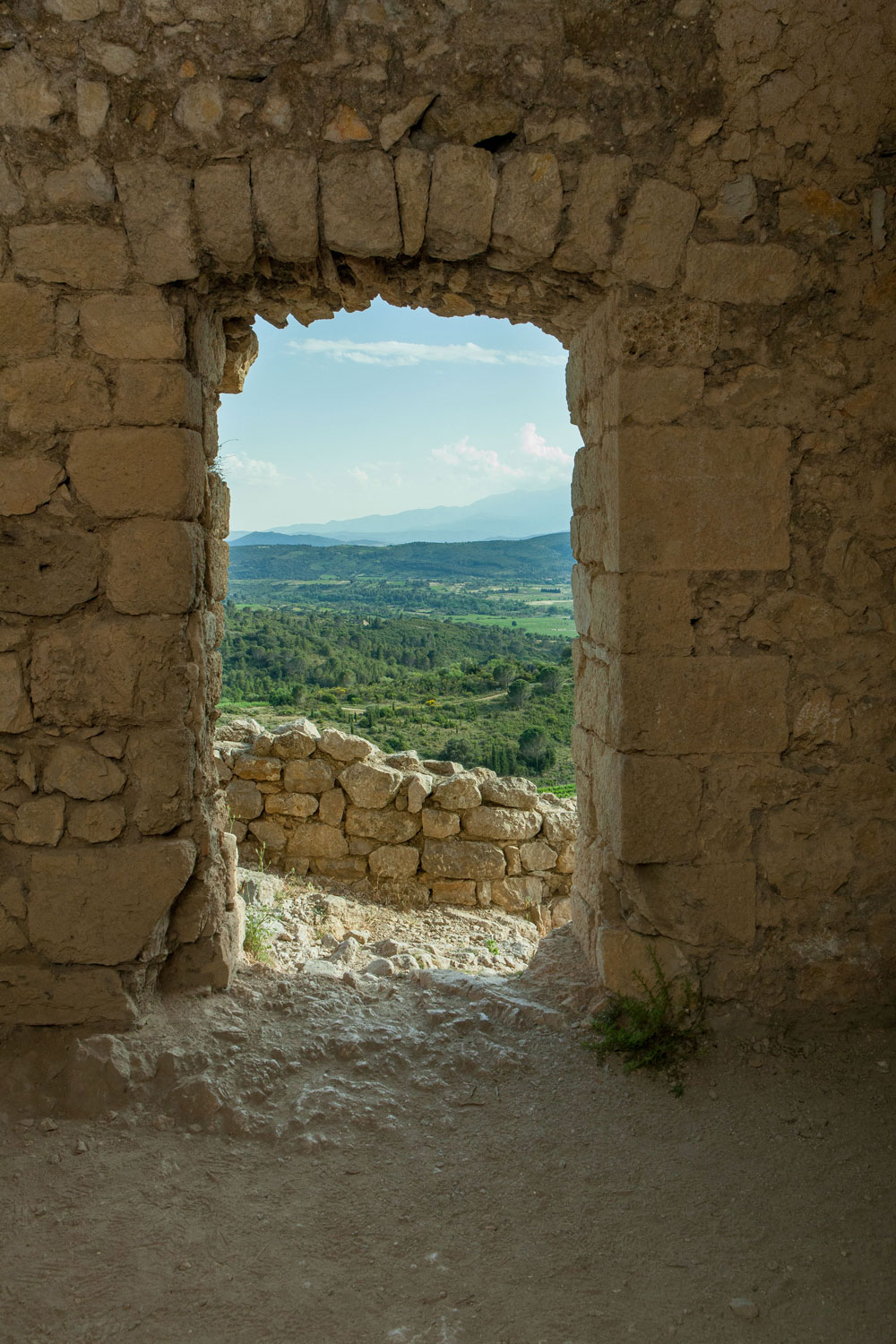
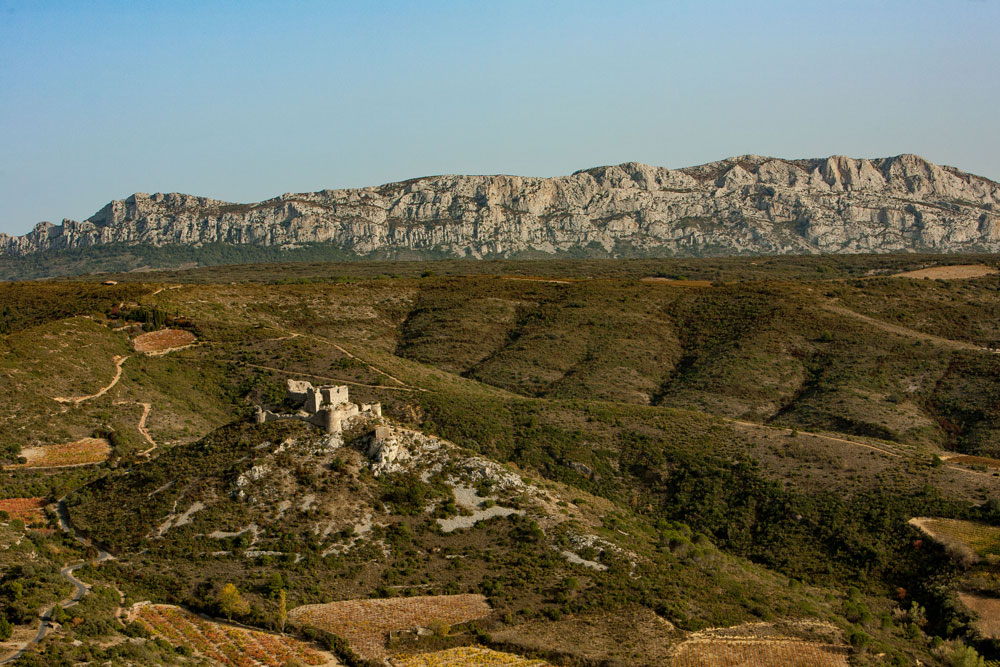
Despite this low altitude, it offers a panoramic view of the diverse landscapes of the Tuchan wine-growing plain, bordered to the west by the majestic Tauch mountain range. To the southwest, the panorama extends to the imposing Pyrenean massif of Canigou.
HISTORY
Overlooking the Tuchan plain, Aguilar Castle is part of the network of fortresses annexed by the King of France in the 13th century and rebuilt to protect against the Kingdom of Aragon, whose border was just a few kilometers away… A sentinel’s life amidst the majestic scenery of the Corbières.
UNCERTAIN ORIGINS
At an elevation of 296 m, “this peak called Aguilar” (puio quem dicunt Aguilar) is mentioned in 1020 in the will of Bernard Taillefer, Count of Besalù, who bequeathed it to his son, along with the viscounty of Fenouillèdes. However, it cannot be concluded that a castle existed at that date; perhaps there were some arrangements testifying to the power exercised by the count over the territory. The years 1050-1080 were a period of great unrest in this region, and, without knowing how, Aguilar entered the patrimony of the Termes family.
UNCERTAIN ORIGINS
At an elevation of 296 m, “this peak called Aguilar” (puio quem dicunt Aguilar) is mentioned in 1020 in the will of Bernard Taillefer, Count of Besalù, who bequeathed it to his son, along with the viscounty of Fenouillèdes. However, it cannot be concluded that a castle existed at that date; perhaps there were some arrangements testifying to the power exercised by the count over the territory. The years 1050-1080 were a period of great unrest in this region, and, without knowing how, Aguilar entered the patrimony of the Termes family.
OLIVIER DE TERMES, A SHREWD STRATEGIST
It was in 1241 that the mention of Aguilar’s “castrum” first appeared. After the failure of the revolt against Raimond Trencavel’s crusaders, in which he participated, Olivier de Termes unconditionally submitted to King Louis IX of France (Saint Louis) and handed over his land of Aguilar to him. Then occupied by a royal garrison, the castle was returned to him in 1250, in reward for his services in the Holy Land. For in the meantime, this shrewd diplomat and former defender of Cathar dissent did not hesitate to change sides to go to war in the East alongside the crusaders. Finally, in 1262, Olivier de Termes sold Aguilar to Louis IX, who integrated the castle into the royal fortresses tasked with defending the new border with Aragon, established in 1258 by the Treaty of Corbeil.
WATCHTOWER ON THE BORDER
Completely restructured, modernized, and reinforced with a strongly defended second enclosure, Aguilar thus stood on the front line facing the fortifications of the powerful Kingdom of Aragon, such as Força Réal, Opoul, or Tautavel, whose watchtower remains are visible from Aguilar. Only a small garrison held the position, but in case of danger, it could quickly raise the alarm to Carcassonne, using smoke signals or light flashes, relayed by the network of defensive structures that dot the Corbières.
In 1302, the garrison consisted of 16 men: the castellan, twelve sergeants, a chaplain, a gatekeeper, and a watchman. Their supply of weapons, provisions, and construction materials was ensured from the bailiwick of Carcassonne, as evidenced by the order given in 1321 to the king’s artilleryman to draw weapons and ammunition from Carcassonne’s equipment to supply Aguilar.
WATCHTOWER ON THE BORDER
Completely restructured, modernized, and reinforced with a strongly defended second enclosure, Aguilar thus stood on the front line facing the fortifications of the powerful Kingdom of Aragon, such as Força Réal, Opoul, or Tautavel, whose watchtower remains are visible from Aguilar. Only a small garrison held the position, but in case of danger, it could quickly raise the alarm to Carcassonne, using smoke signals or light flashes, relayed by the network of defensive structures that dot the Corbières.
In 1302, the garrison consisted of 16 men: the castellan, twelve sergeants, a chaplain, a gatekeeper, and a watchman. Their supply of weapons, provisions, and construction materials was ensured from the bailiwick of Carcassonne, as evidenced by the order given in 1321 to the king’s artilleryman to draw weapons and ammunition from Carcassonne’s equipment to supply Aguilar.
AN EARLY ABANDONMENT
On several occasions, particularly after the retrocession of the counties of Roussillon and Cerdagne to the King of Aragon by Charles VIII, Aragonese incursions ravaged the country (1495-1496). In 1525, troops of Charles V captured Aguilar and Tuchan and took the inhabitants captive.
In 1542, after the failure of the French army before Perpignan, a skirmish took place on the slopes and at the foot of Aguilar hill, recounted by Blaise de Montluc: the castle then appeared to be in ruins and its strategic interest greatly diminished. An early abandonment, also attested by the list of castellans, which ends in 1569, whereas the castles of Quéribus and Peyrepertuse maintained garrisons until the 18th century.
However, the Aude departmental council considered, in its session of April 24, 1792, its reuse against the Spanish. The victory of the revolutionary armies at Peyrestortes on September 17, 1793, rendered this project obsolete.
SITE DESCRIPTION
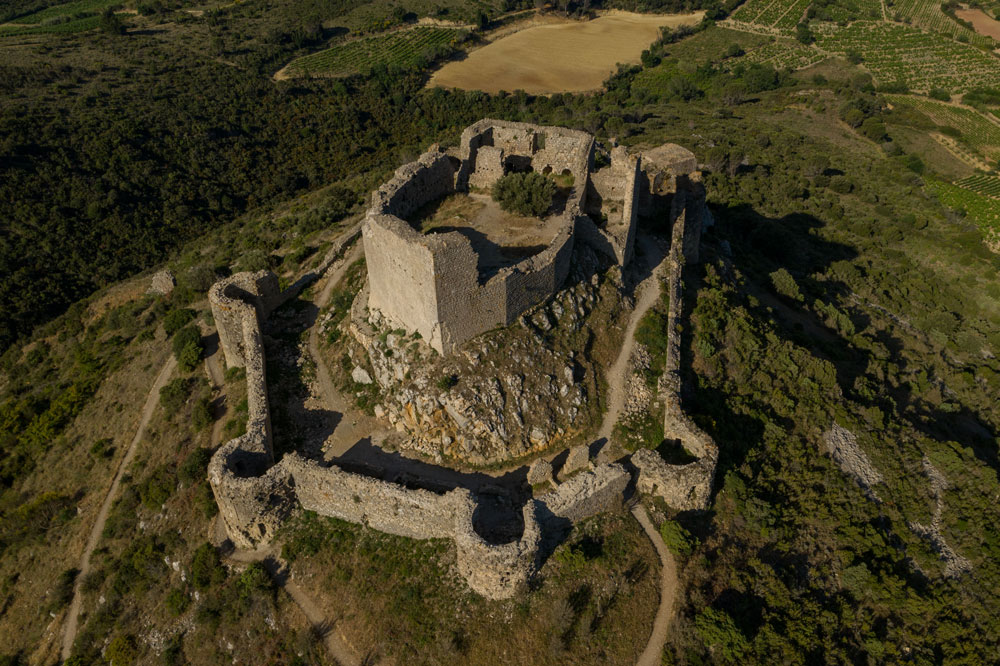
As with Termes Castle, the work of archaeologists and historians has made it possible to identify two different construction periods at Aguilar. While the base of the inner enclosure seems to be identifiable with the primitive seigniorial castle and could be dated to the 12th century, the outer enclosure bears the signature of the master builders of the King of France, from the last third of the 13th century. It features all the architectural innovations brought by Capetian military architecture, which spread across the territory to assert the power of the Kingdom of France.
THE ANCIENT CASTRAL VILLAGE
The primitive access to the castle was from the southeast and led to the eastern wall of the castral village, once nestled at the foot of the seigniorial castle and now disappeared. A few sections of this ancient wall remain, one of which includes the vestiges of a gateway.
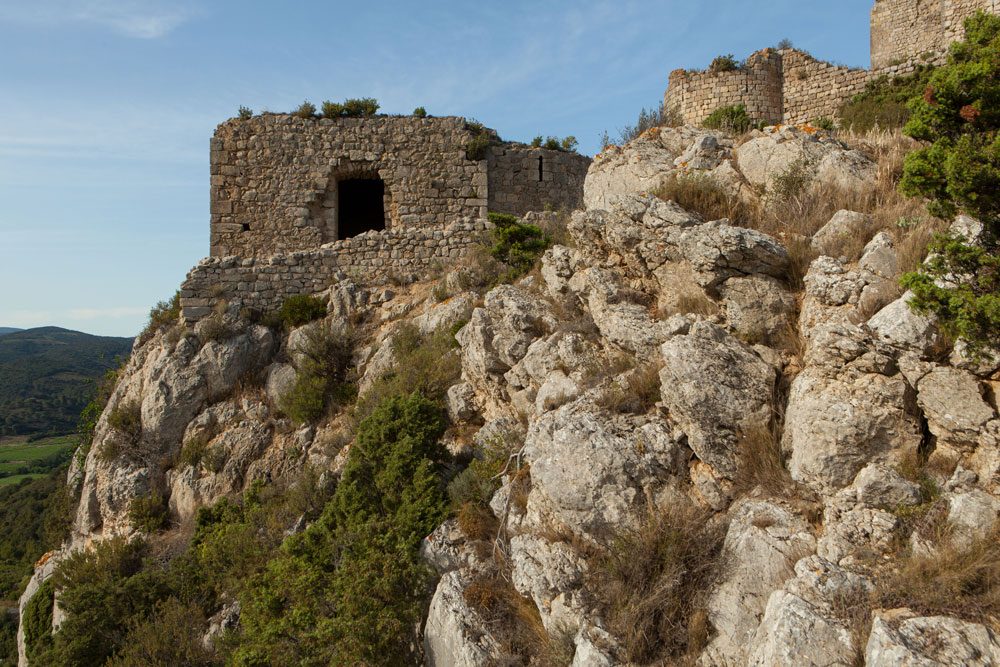
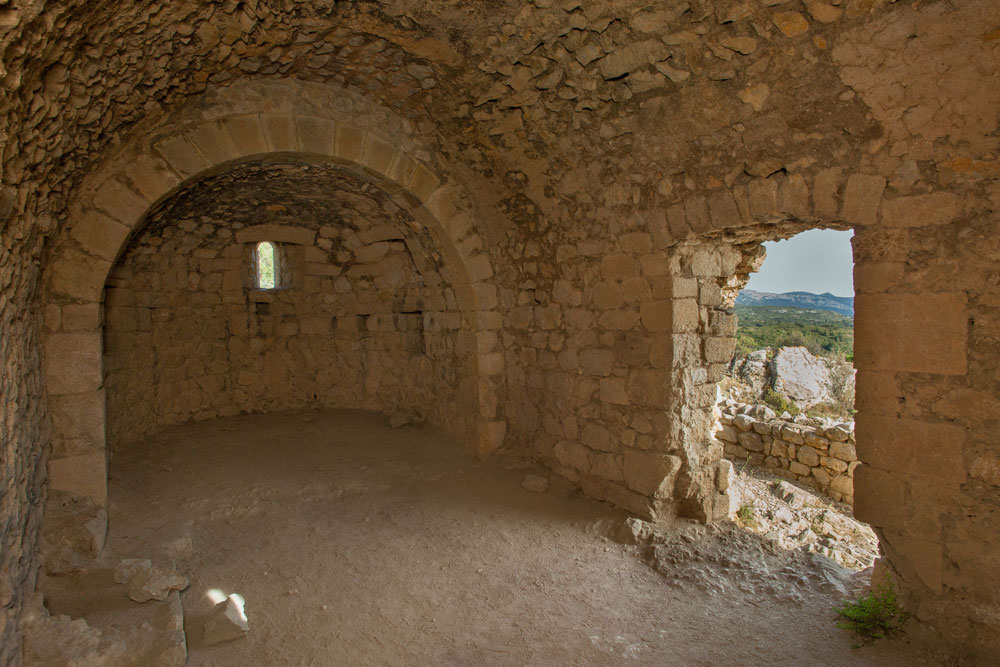
It is within the perimeter of the ancient village, perched on a small rocky promontory, that Saint Anne’s Chapel stands, a rectangular building covered by a slightly broken barrel vault and closed by an apse with a domed vault. Its presence is attested in 1262.
THE ANCIENT CASTRAL VILLAGE
The primitive access to the castle was from the southeast and led to the eastern wall of the castral village, once nestled at the foot of the seigniorial castle and now disappeared. A few sections of this ancient wall remain, one of which includes the vestiges of a gateway.
It is within the perimeter of the ancient village, perched on a small rocky promontory, that Saint Anne’s Chapel stands, a rectangular building covered by a slightly broken barrel vault and closed by an apse with a domed vault. Its presence is attested in 1262.
THE OUTER ENCLOSURE
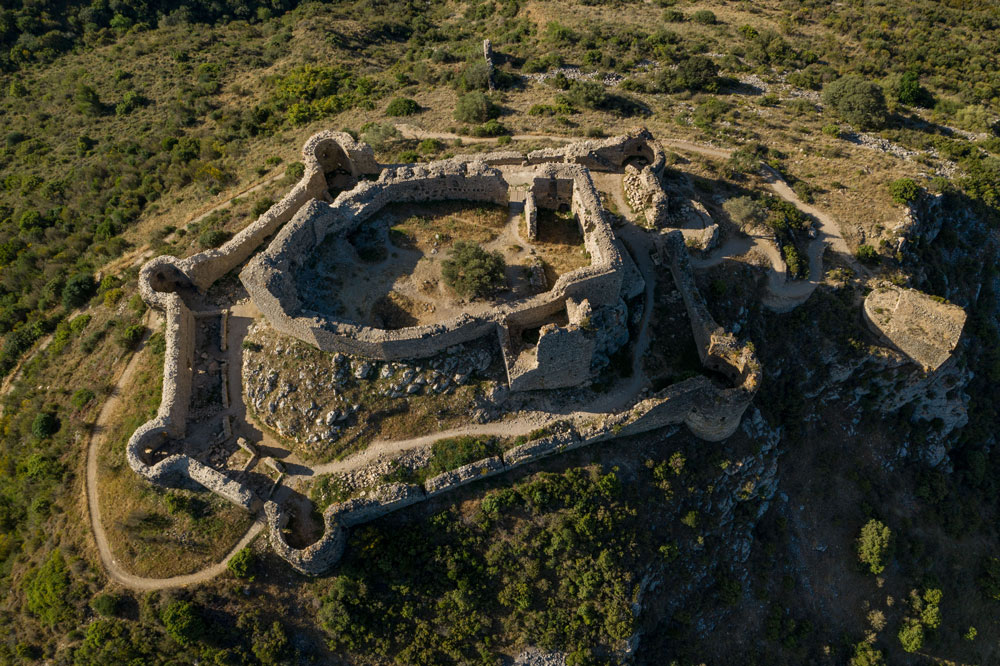
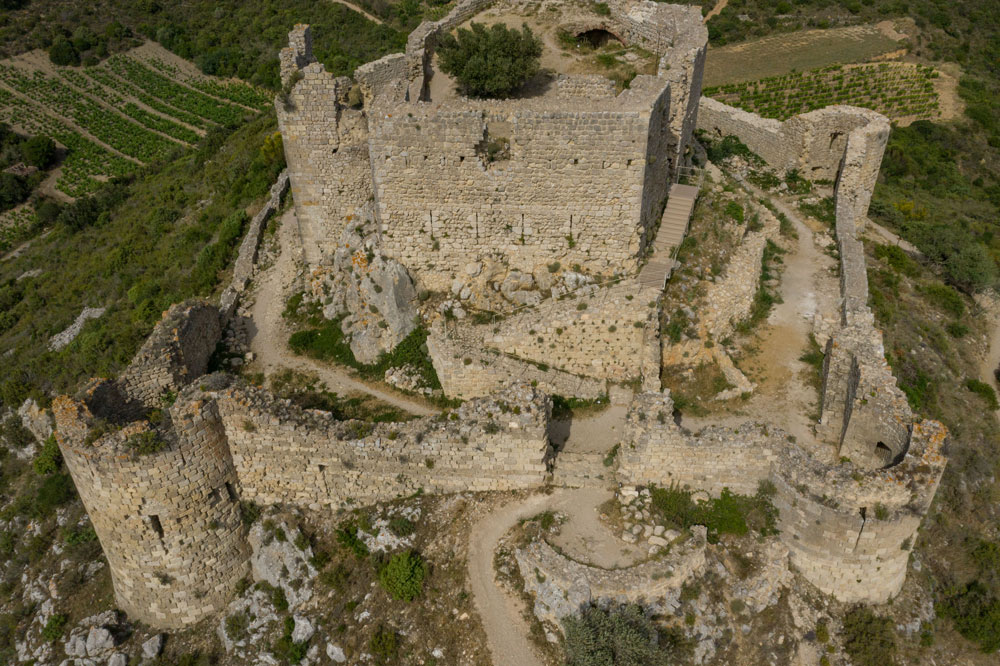
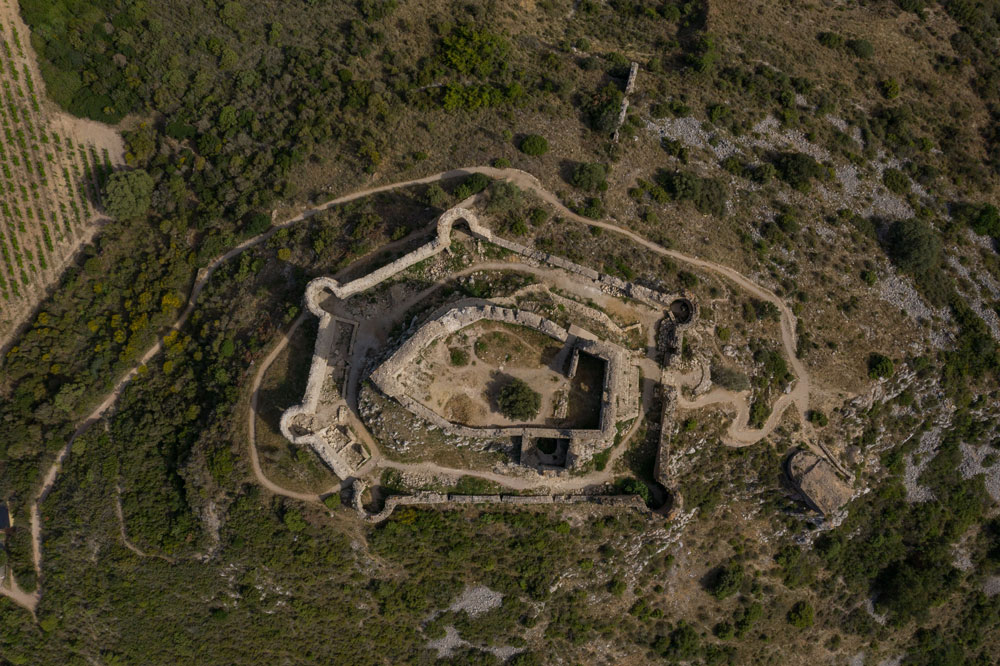
The outer enclosure, an irregular hexagon, bears the obvious hallmark of the royal engineers, who applied all the techniques of Capetian military architecture there in the 13th century. Starting with the six semi-circular towers that punctuate the rampart, whose bases are marked by rusticated stones. In addition to offering a panoramic field of fire to the defenders, positioned behind staggered spade-shaped arrow slits, these towers were open at the gorge on the inner side to prevent them from serving as refuge for attackers. But one still had to succeed in penetrating inside the enclosure! Open on the western front and preceded by a barbican, the main entrance was defended by a murder-hole and a portcullis, the base of whose groove is still visible on the remains of the gate. Along the walls, 1.20 m thick, traces of a postern gate are noted at the corner of the northeast tower, which would have allowed quicker access to the stronghold or discreet escape. The wall-walk, now disappeared, was accessible via three flights of straight stairs.
The lists, separating the two enclosures, are occupied by remains of service buildings, some of which, built of dry stone, are probably only the reflection of a late pastoral reuse of the site.
THE INNER ENCLOSURE
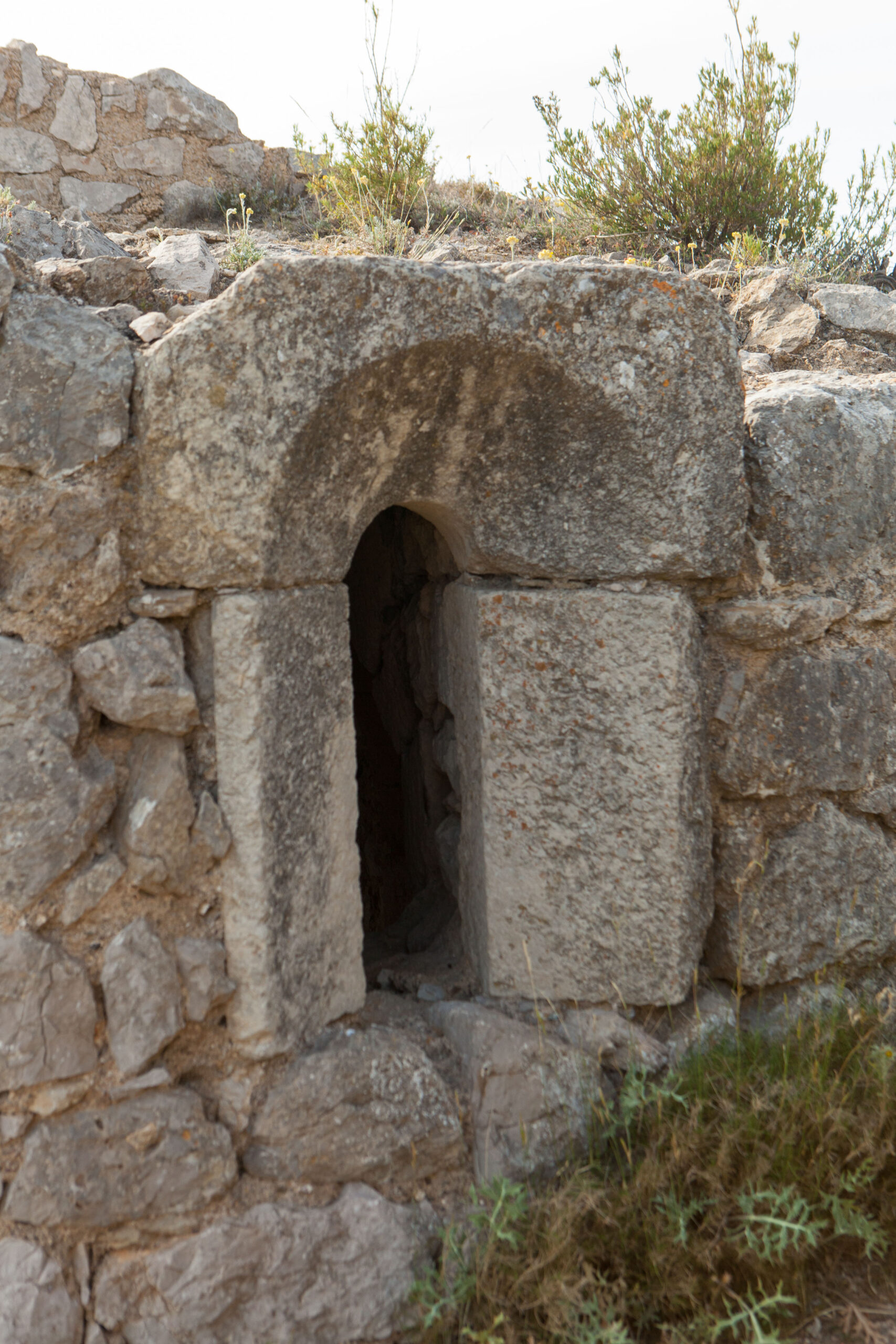
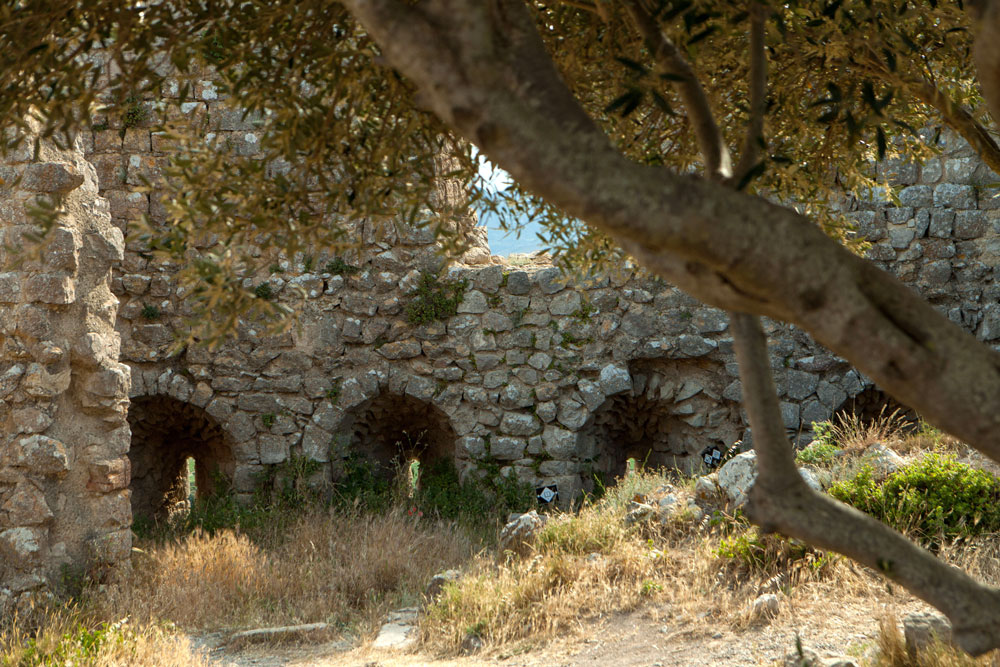
Facing the main gate, a ramp ascends to the gate of the second enclosure, running along the curtain walls under the watchful eye of several arrow slits. With an irregular polygonal plan and dominating the lists by 4 to 5 m, this second enclosure probably corresponds to the location of the primitive castle, whose remains stand alongside the redevelopments of the royal period. On the west side stood the castellan’s dwelling, materialized by a trapezoidal room with walls pierced by vaulted arrow slits (the same ones that overlook the access ramp) and two large windows (on the upper floor). Attached to the north front, the quadrangular tower shows traces of three levels. The first was occupied by a cistern, recognizable by its waterproof crushed brick mortar coating.
At the eastern end of the enclosure, the wall thickens to 2.80 m wide and adopts a spur shape. A development dating from the royal period, intended to protect the most vulnerable part of the fortress and to offer increased resistance to potential impacts from stone cannonballs.
Not far from there, the remains of a vaulted cellar made of pink sandstone emerge from the ground.
THE INNER ENCLOSURE
Facing the main gate, a ramp ascends to the gate of the second enclosure, running along the curtain walls under the watchful eye of several arrow slits. With an irregular polygonal plan and dominating the lists by 4 to 5 m, this second enclosure probably corresponds to the location of the primitive castle, whose remains stand alongside the redevelopments of the royal period. On the west side stood the castellan’s dwelling, materialized by a trapezoidal room with walls pierced by vaulted arrow slits (the same ones that overlook the access ramp) and two large windows (on the upper floor). Attached to the north front, the quadrangular tower shows traces of three levels. The first was occupied by a cistern, recognizable by its waterproof crushed brick mortar coating.
At the eastern end of the enclosure, the wall thickens to 2.80 m wide and adopts a spur shape. A development dating from the royal period, intended to protect the most vulnerable part of the fortress and to offer increased resistance to potential impacts from stone cannonballs.
Not far from there, the remains of a vaulted cellar made of pink sandstone emerge from the ground.
The fortress in pictures