 Accueil > Discover > Fortresses >
 lastours
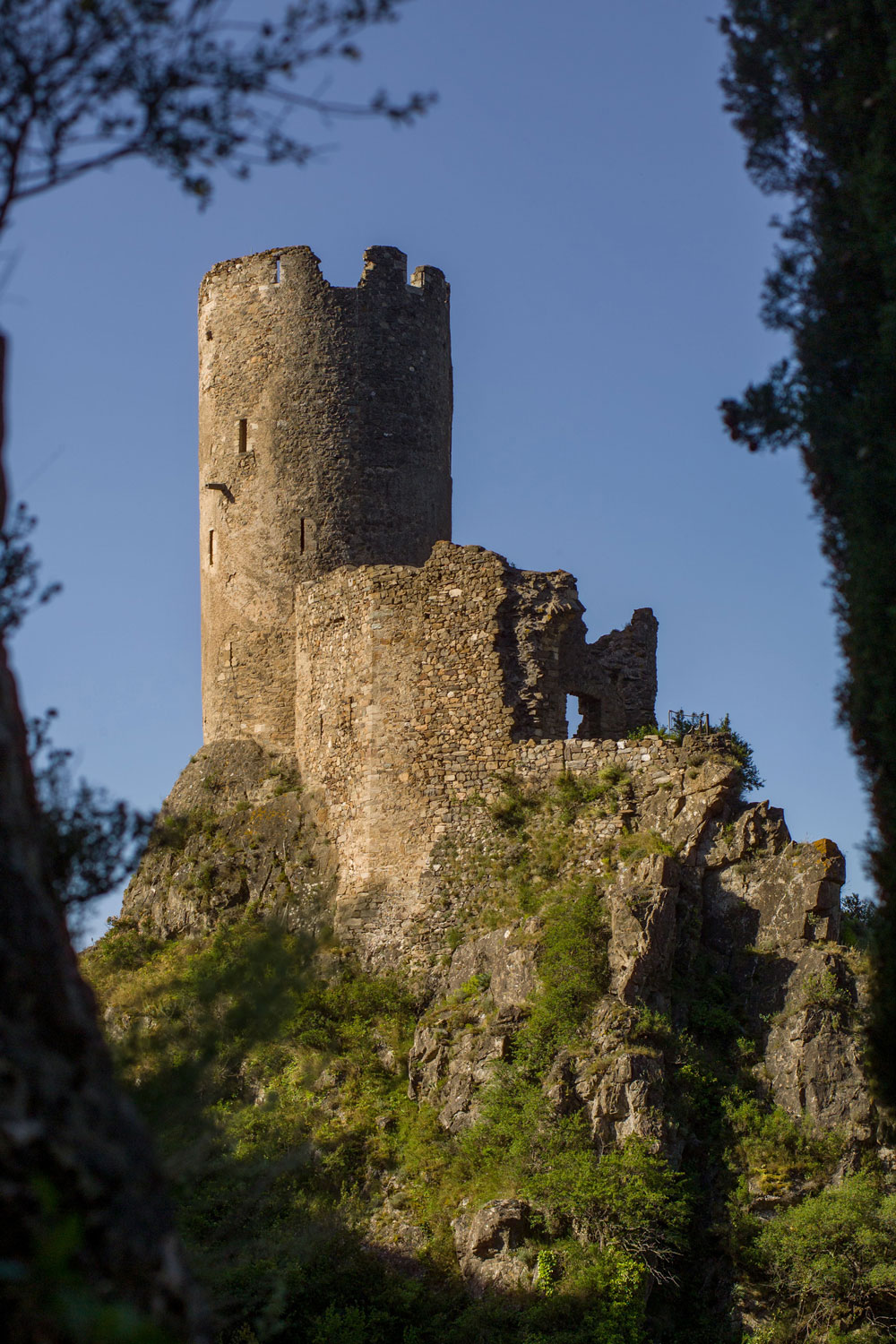
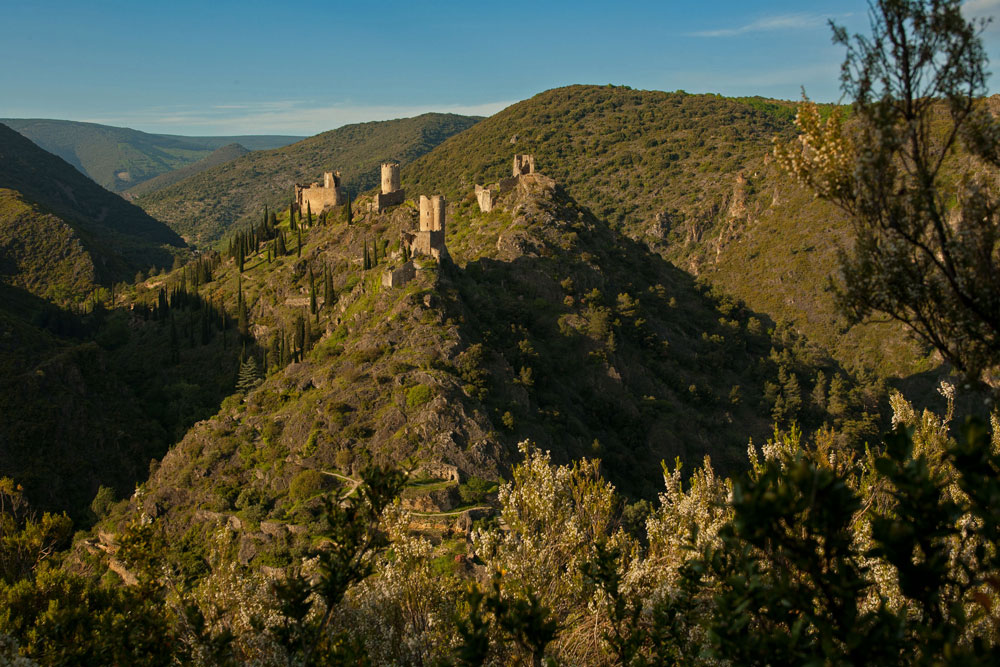
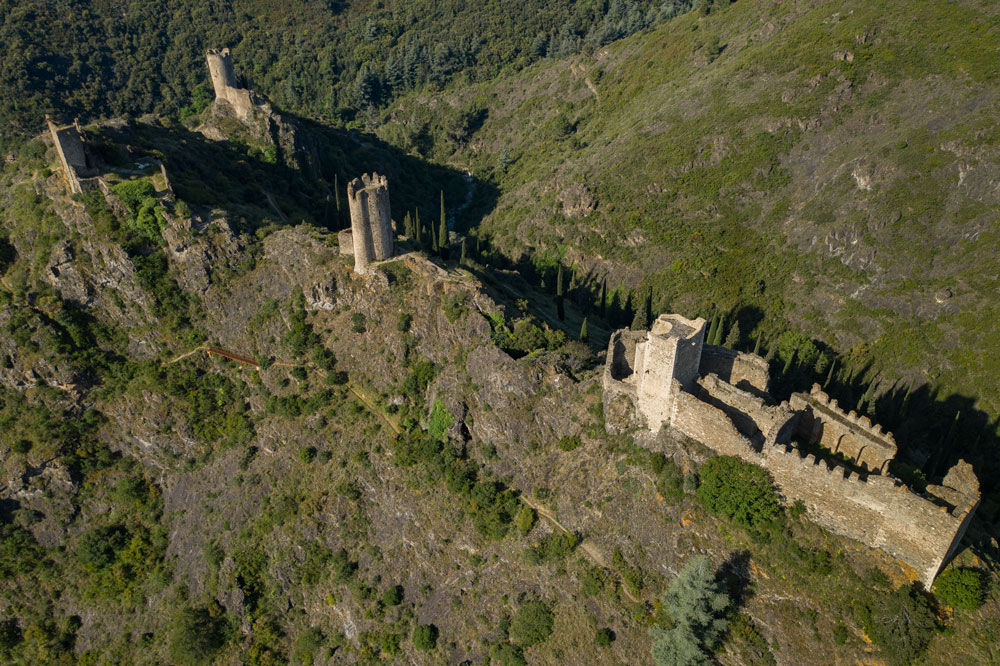
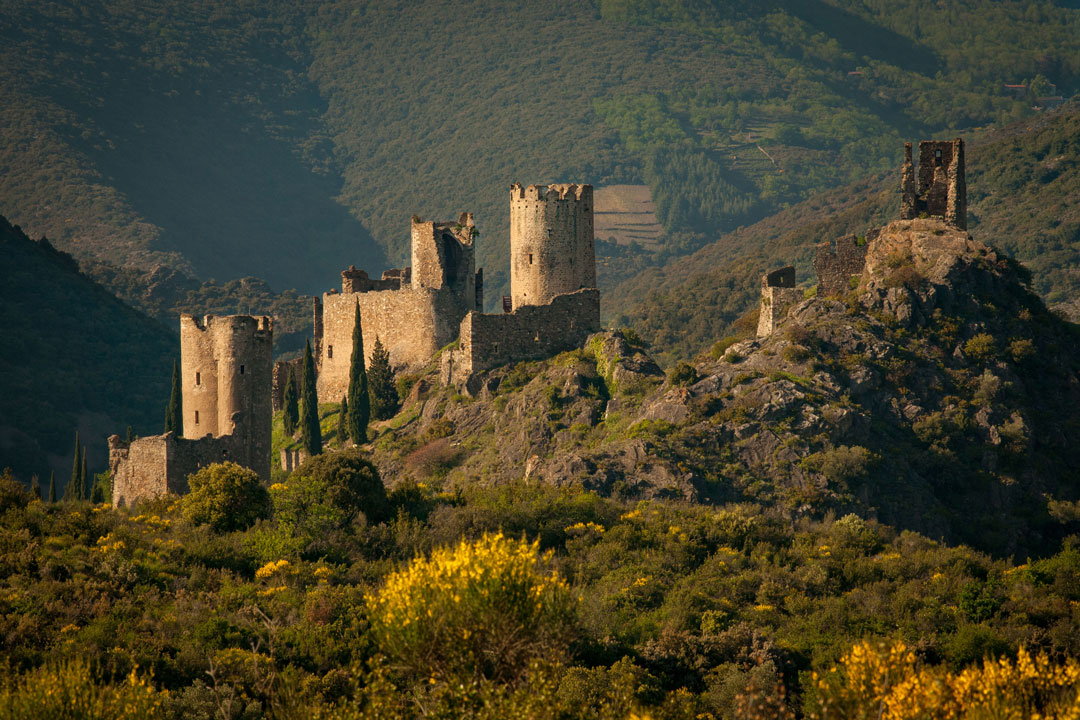
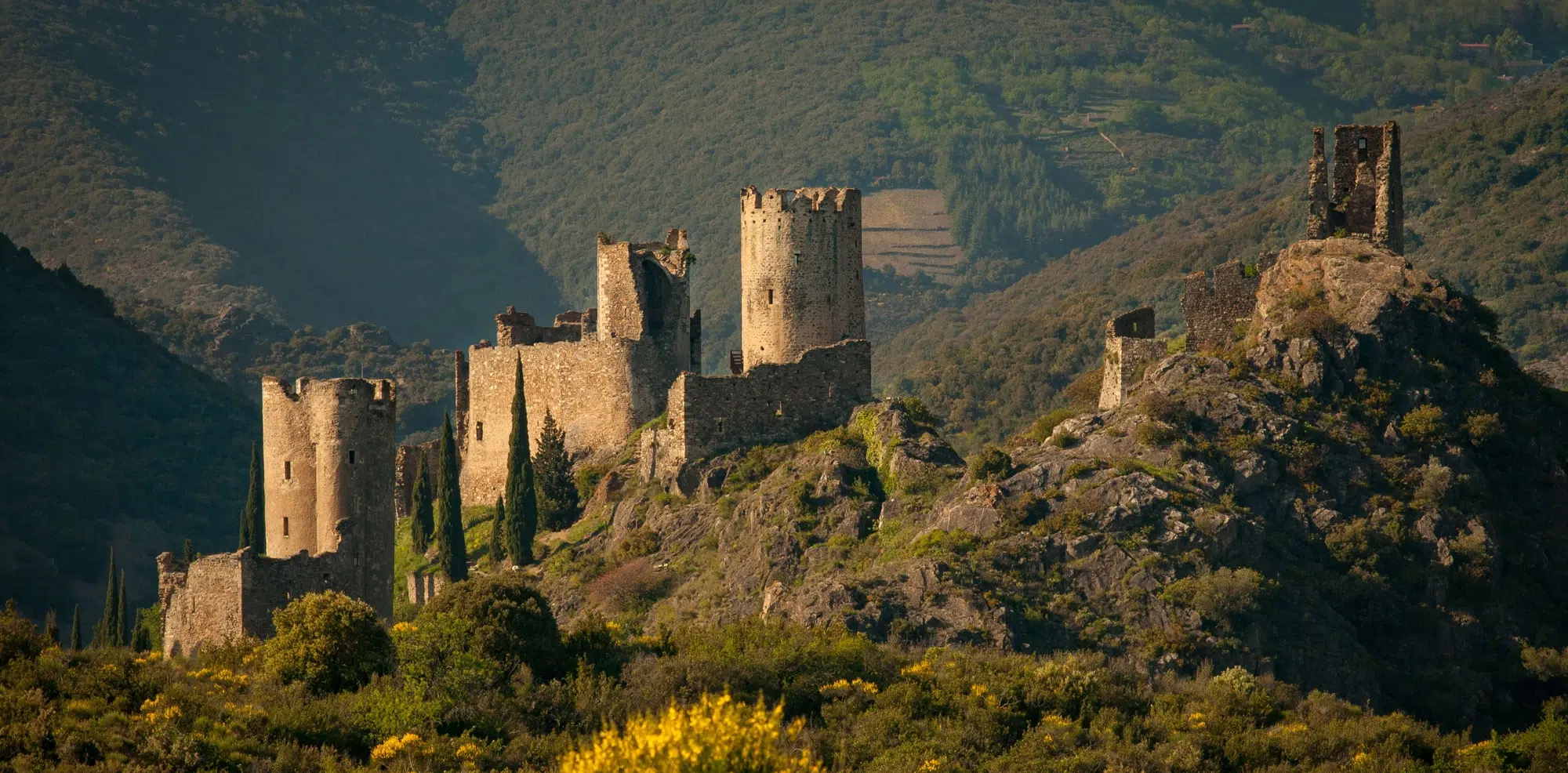
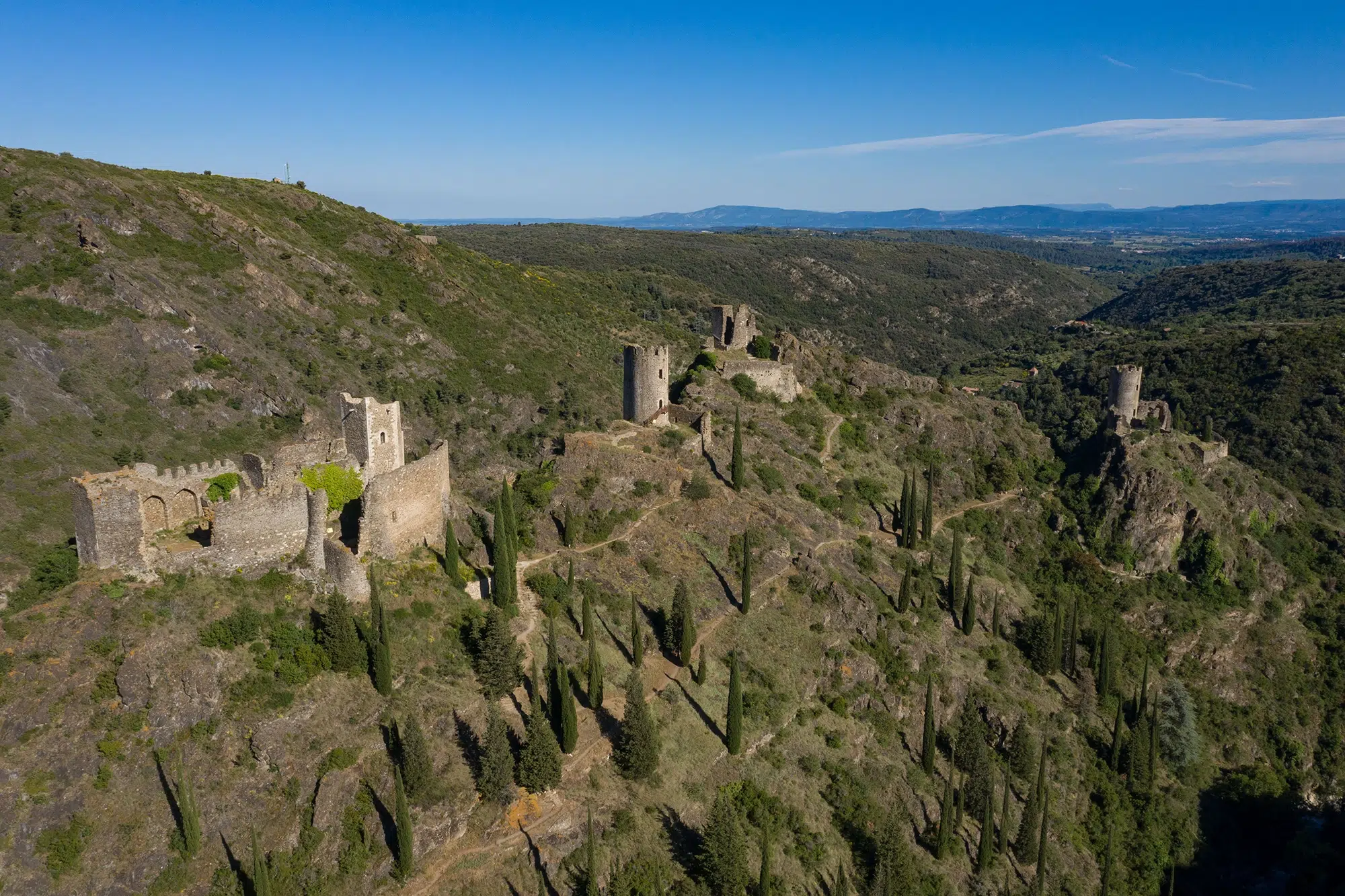
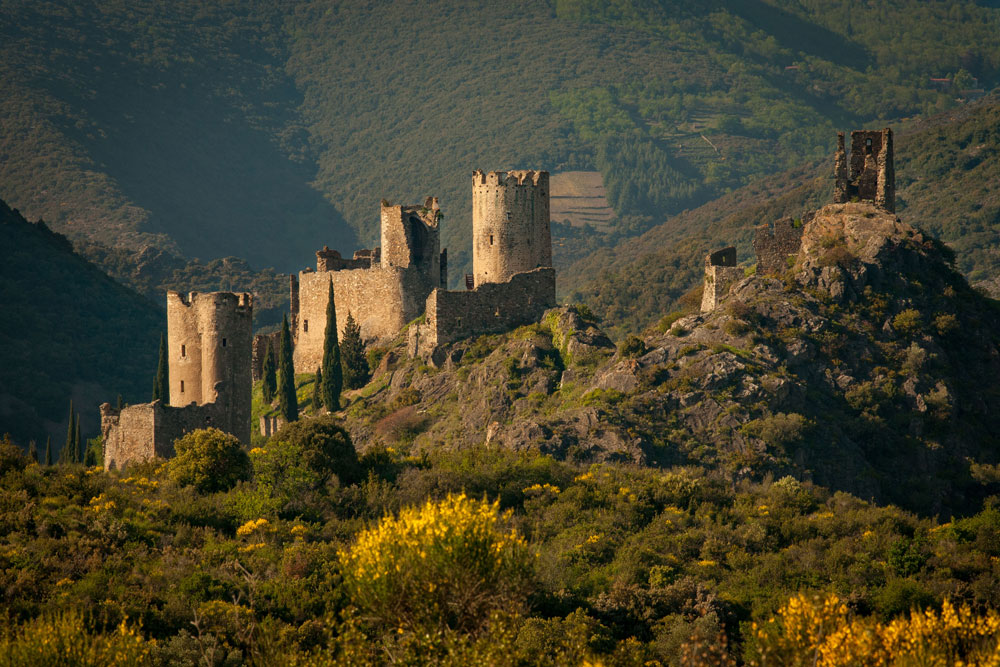
Cabaret, Tour Régine, Surdespine, and Quertinheux: the four castles of Lastours are spread out on the first foothills of the Montagne Noire, 18 km north of Carcassonne. Four mountain sentinels, erected from the second half of the 13th century at the request of the King of France, on the site of former feudal castles.
CURRENT LANDSCAPE SETTING

The four castles of Lastours are situated between 260 m and 285 m in altitude on a rocky ridge 600 m long and 250 m wide, on the first foothills of the Montagne Noire, in the heart of Cabardès, between the Orbiel river and the Grésilhou torrent. An arid and steep promontory, composed of very hard limestone dating from the primary era and carved with numerous cavities. The surrounding reliefs of the Montagne Noire, a contact zone between limestone and schist, abound with metallic ores of all kinds: iron, copper, argentiferous lead, gold, etc. Their very ancient exploitation, probably since the Bronze Age, has been attested since Antiquity by the remains of the Roman copper mine of Barrencs (2nd century BC) and continued very recently (closure of the Salsigne-Villanière gold mine in 2004).
Located west of Languedoc and southwest of the Massif Central, between Lauragais and Minervois, Cabardès is subject to oceanic and Mediterranean influences, giving rise to a diversity of landscapes dominated by garrigue and maquis.
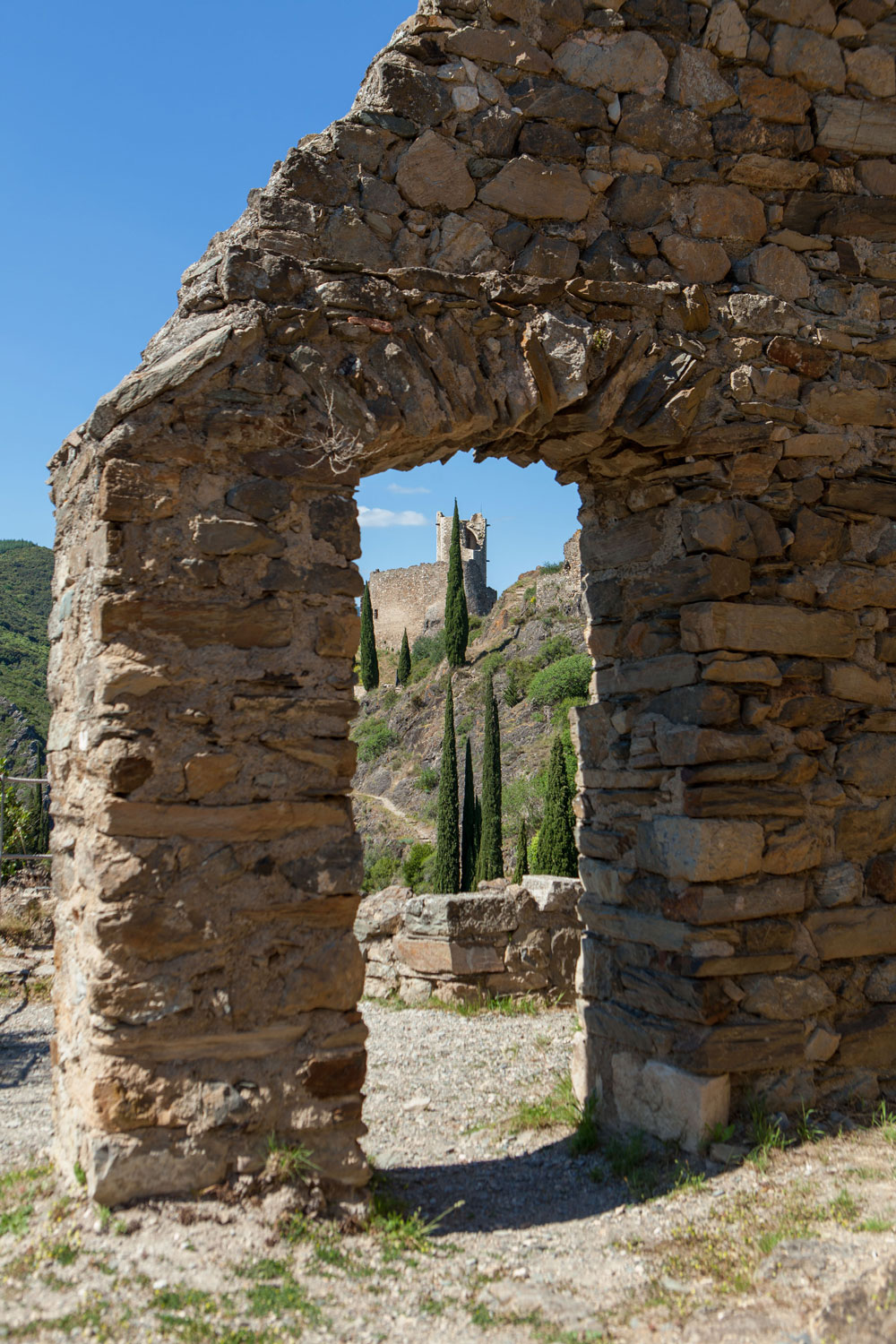
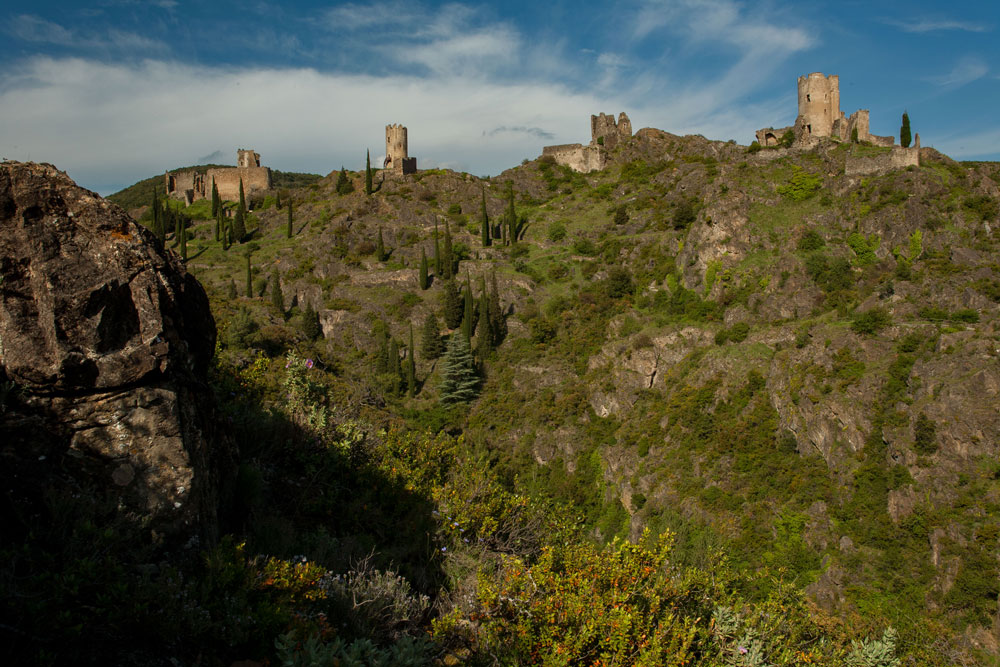
To this bushy and shrubby vegetation, capable of resisting significant water deficits, are added abundant holm oak woods on the most shaded slopes and Scots pine forests on certain slopes and plateaus. Not to mention the cypresses, planted around the castles in the 1930s to prevent soil erosion. Their majestic and slender silhouettes echo those of the fortified towers, adding to the site’s magic.
At the bottom of the valleys, watercourses have allowed for the establishment of more luxuriant vegetation, notably marked by the presence of willows and alders.
GOOD TO KNOW – To fully appreciate the site and enjoy the beauty of the landscape, it is advisable to go to the viewpoint, located near the campsite on the D 701, 2 km west of the village of Lastours.
HISTORY
Standing proudly on their rocky promontory, the proud silhouettes of the four castles of Lastours unequivocally illustrate their attachment to the royal domain in the 13th century. However, the site bears witness to a much older occupation and was long known by the name of its main edifice: Cabaret.
THE PRINCESS WITH THE NECKLACE
The first proven occupation of the four castles of Lastours dates back nearly 4,000 years. In 1961, archaeologists discovered the burial of a young girl dating from the Middle Bronze Age (circa 1700-1600 BC), in a cavity located below the current castles, known as the “Trou de la Cité”. The pearl adornment and bronze jewelry exhumed with the body, of exceptional delicacy and quality, suggest a high social status, which still earns the young girl the nickname “princess with the necklace” today. Borrowed from Greek and Egyptian art, the style of the jewelry in any case testifies to the exchanges existing at that period between the peoples of Cabardès and the Mediterranean world. The bronze work, for its part, suggests an early exploitation of the mining resources of the Montagne Noire.
Cabaret is then mentioned in the 6th century AD in Gregory of Tours’ History of the Franks, under the name of Caput Arietis Castra, captured in 585 by “Reccared, son of Leovigild [then King of the Visigoths]”, when Guntram, King of the Burgundians, evacuated the Carcassonne region. Gregory of Tours’ text thus seems to already indicate the existence of a fortified site. Scheduled excavations from 1988 to 1991 unearthed about ten tombs, dated to the 6th century, confirming this occupation.
THE PRINCESS WITH THE NECKLACE
The first proven occupation of the four castles of Lastours dates back nearly 4,000 years. In 1961, archaeologists discovered the burial of a young girl dating from the Middle Bronze Age (circa 1700-1600 BC), in a cavity located below the current castles, known as the “Trou de la Cité”. The pearl adornment and bronze jewelry exhumed with the body, of exceptional delicacy and quality, suggest a high social status, which still earns the young girl the nickname “princess with the necklace” today. Borrowed from Greek and Egyptian art, the style of the jewelry in any case testifies to the exchanges existing at that period between the peoples of Cabardès and the Mediterranean world. The bronze work, for its part, suggests an early exploitation of the mining resources of the Montagne Noire.
Cabaret is then mentioned in the 6th century AD in Gregory of Tours’ History of the Franks, under the name of Caput Arietis Castra, captured in 585 by “Reccared, son of Leovigild [then King of the Visigoths]”, when Guntram, King of the Burgundians, evacuated the Carcassonne region. Gregory of Tours’ text thus seems to already indicate the existence of a fortified site. Scheduled excavations from 1988 to 1991 unearthed about ten tombs, dated to the 6th century, confirming this occupation.
A CASTRUM ‘PERFECTLY’ HELD
The second mention of the site dates from 1063 and already refers to the existence of several castles on this spur. From the beginning of the 12th century, this site established itself as the center of an important mining lordship exploiting iron.
At that time, the names of three castles were known: Quertinheux, Surdespine, and Cabaret, each likely belonging to a member of the seigniorial family. These were then rather rudimentary edifices, located halfway up the current site and grouped with the villagers’ dwellings. The entire village settlement, grouped around the seigniorial residences, formed what is called a castrum. Excavations conducted over the past 25 years have unearthed two quarters of this castral village (11th-13th century), composed of large houses, forges, cisterns, a chapel, and a cemetery. A market even emerged there in 1145.
In a text from 1166, we learn that the lordship of Cabaret was held by no less than 22 co-lords! However, by the end of the 12th century, only three co-lords were mentioned. It was at this time that Cabaret became an important center of Catharism: the Cathar bishops of Carcassès frequently stayed in the castrum, and the houses sheltered small communities of “perfects”.
LORDS AGAINST CRUSADERS
In 1209, Cabaret was besieged in vain during the Barons’ Crusade led by Simon de Montfort. At the time, the fortress belonged to Pierre-Roger de Cabaret, a loyal supporter of the Trencavel viscounts, who succeeded in capturing Bouchard de Marly, a close associate of Simon de Montfort. His release allowed the lord of Cabaret to surrender on favorable terms in 1211. Despite this submission, the populations remained hostile to the crusaders, and in 1223, the castrum was retaken by three co-lords: Pierre-Roger de Cabaret, Pierre de Laure, and Bernard-Othon de Niort.
The situation, however, worsened with the start of the royal crusade in 1226: Cabaret and its inhabitants resisted the royal army for three years before submitting in 1229. The king then installed a garrison there.
LORDS AGAINST CRUSADERS
In 1209, Cabaret was besieged in vain during the Barons’ Crusade led by Simon de Montfort. At the time, the fortress belonged to Pierre-Roger de Cabaret, a loyal supporter of the Trencavel viscounts, who succeeded in capturing Bouchard de Marly, a close associate of Simon de Montfort. His release allowed the lord of Cabaret to surrender on favorable terms in 1211. Despite this submission, the populations remained hostile to the crusaders, and in 1223, the castrum was retaken by three co-lords: Pierre-Roger de Cabaret, Pierre de Laure, and Bernard-Othon de Niort. The situation, however, worsened with the start of the royal crusade in 1226: Cabaret and its inhabitants resisted the royal army for three years before submitting in 1229. The king then installed a garrison there.
ROYAL FORTRESSES
Around 1238, the royal authorities considered modifying the site’s fortification and began requisitioning inhabitants from neighboring villages. After the 1240 insurrection by Raymond II Trencavel, who attempted to retake the City of Carcassonne, the King of France asserted his power by ordering the razing of the entire castrum of Cabaret – the three castles, the village, its church, and its cemetery – as well as the boroughs of the City of Carcassonne.
Subsequently, the king had the site redeveloped: new castles, of rather reduced dimensions, were built at the top of the ridge, according to the principles of Capetian military architecture. Three of them took the names of the former seigniorial towers (Cabaret, Surdespine, and Quertinheux); a fourth filled the space between Cabaret and Surdespine, the Tour Régine.
Each tower was occupied by a small royal garrison, whose composition is attested in a text from 1260: at Cabaret, a castellan, a chaplain, a carpenter, and a sergeant; at Tour Régine, Quertinheux, and Surdespine, a castellan and two sergeants. As in other royal fortresses, all members of the castellany, as well as their families, were exempt from taxes (the ‘taille’). A comfortable status that ensured the king the loyalty of his garrisons and a portion of the population.
At the same time, as he did in Carcassonne by creating the bastide on the left bank of the Aude, the king moved the population of the castrum destroyed in 1240 to the other side of the Orbiel river. The new village, established in the years 1260-1270, took the name Ripparia Cabareti (River of Cabaret), until the French Revolution, when it took its current name of Lastours.
During the Wars of Religion in the 16th century, the castles of Lastours underwent several modifications, notably the construction of the outer curtain walls, before being gradually abandoned. The Orbiel valley, in contrast, saw the development of a flourishing textile industry in the 19th century, notably with the establishment of the Rabier cloth factory in the village of Lastours. Recognizable by its tall chimney, it now houses the castles’ visitor center.
SITE DESCRIPTION
As they appear today, the four castles of Lastours essentially date from their reconstruction by the King of France from the mid-13th century. Their adaptation to the mountainous terrain testifies to the military ingenuity of the era.
OVERVIEW
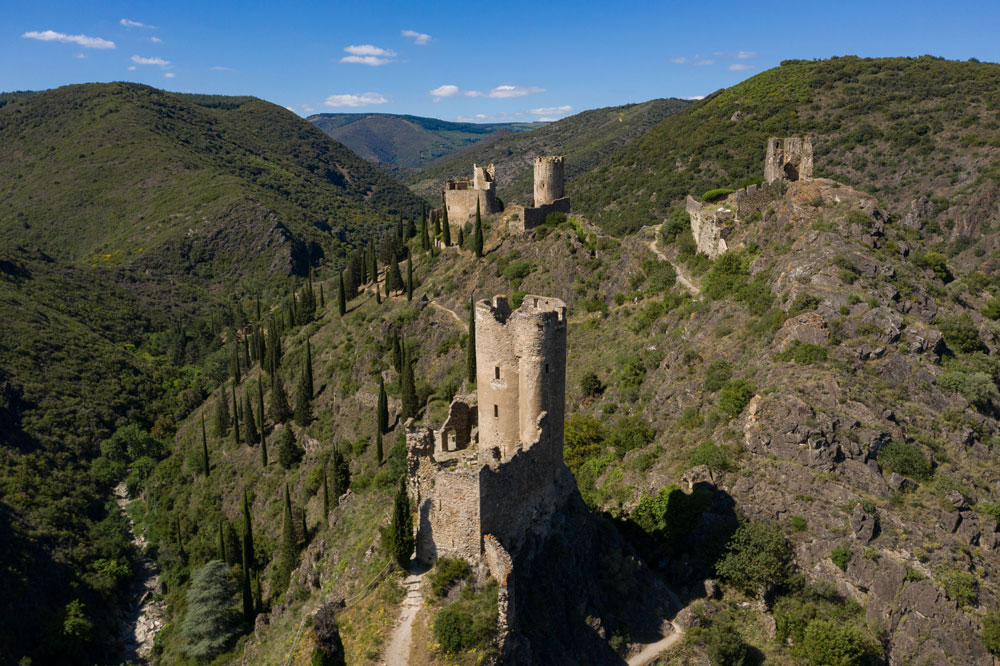
Observing the site from afar, tiered on a rocky ridge totaling nearly 12 hectares, roughly the area of Carcassonne, one might wonder why four small independent castles were preferred over a single large fortress. Out of a concern for adapting to the terrain and economizing resources, of course, but also in a logic of active defense: each castle commands another. If one is taken, the other can ensure its defense, and so on. Thus, each promontory has its fortified tower, its main building, its cistern, its castellan, and its sergeants.
And despite their small size, the castles create a very impressive “trompe-l’œil” effect from afar, thus reinforcing their defensive role.
From the visitor center, a winding path along the mountainside allows access to the castles in about twenty minutes on foot. Halfway up the slope, one crosses the famous “Trou de la Cité”, a rocky cavity so named due to a legend that would connect it by an impossible underground passage to the City of Carcassonne. It was here that the remains of the “princess with the necklace” were found.
OVERVIEW
Observing the site from afar, tiered on a rocky ridge totaling nearly 12 hectares, roughly the area of Carcassonne, one might wonder why four small independent castles were preferred over a single large fortress. Out of a concern for adapting to the terrain and economizing resources, of course, but also in a logic of active defense: each castle commands another. If one is taken, the other can ensure its defense, and so on. Thus, each promontory has its fortified tower, its main building, its cistern, its castellan, and its sergeants.
And despite their small size, the castles create a very impressive “trompe-l’œil” effect from afar, thus reinforcing their defensive role.
From the visitor center, a winding path along the mountainside allows access to the castles in about twenty minutes on foot. Halfway up the slope, one crosses the famous “Trou de la Cité”, a rocky cavity so named due to a legend that would connect it by an impossible underground passage to the City of Carcassonne. It was here that the remains of the “princess with the necklace” were found.
CABARET
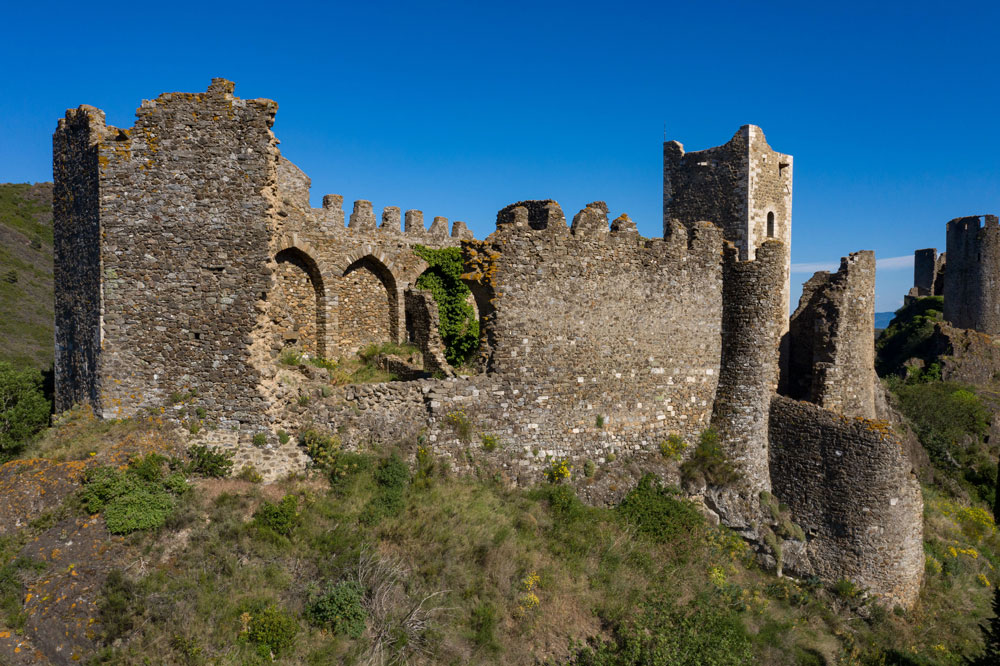
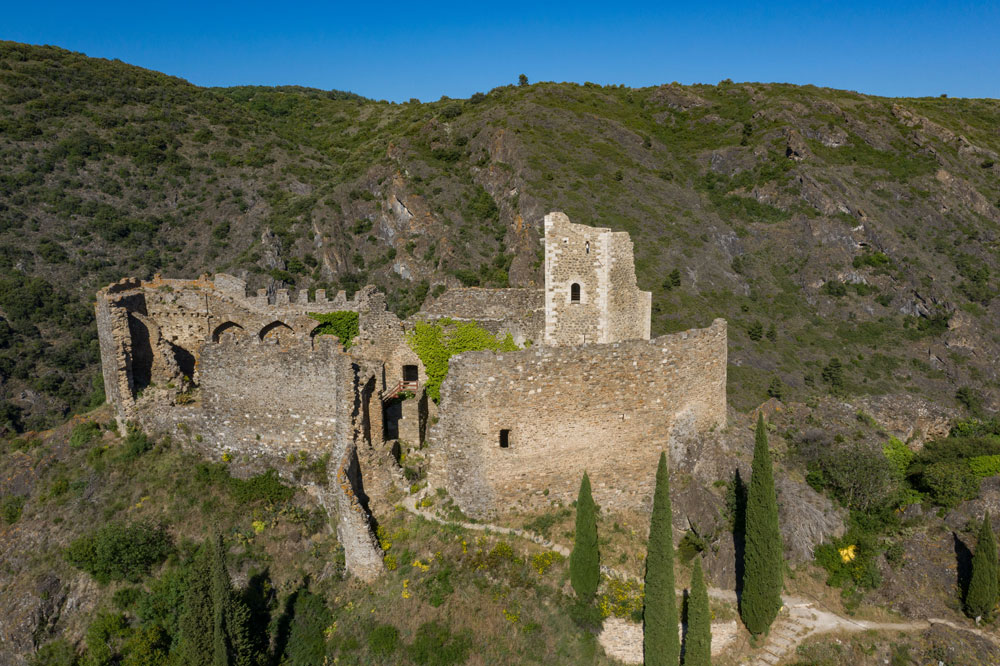
Located north of the rocky spur and built on a cliff directly overlooking the Orbiel river, Cabaret castle was undoubtedly the centerpiece of the defensive system designed here by the royal authorities.
Its name was long used to designate the entire site, and its garrison was the largest of the four castles, even including a chaplain.
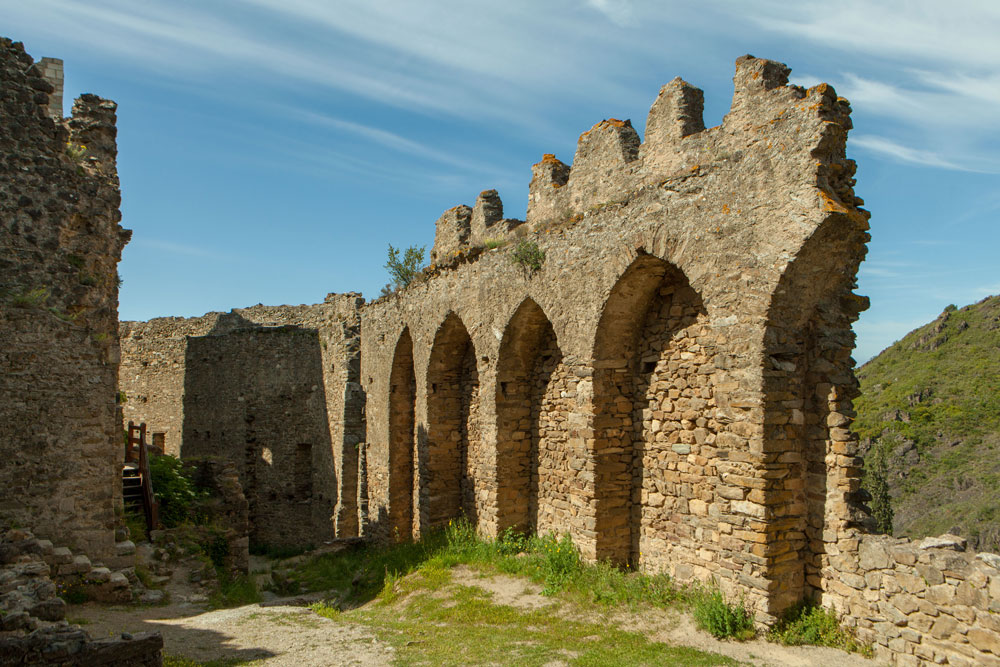
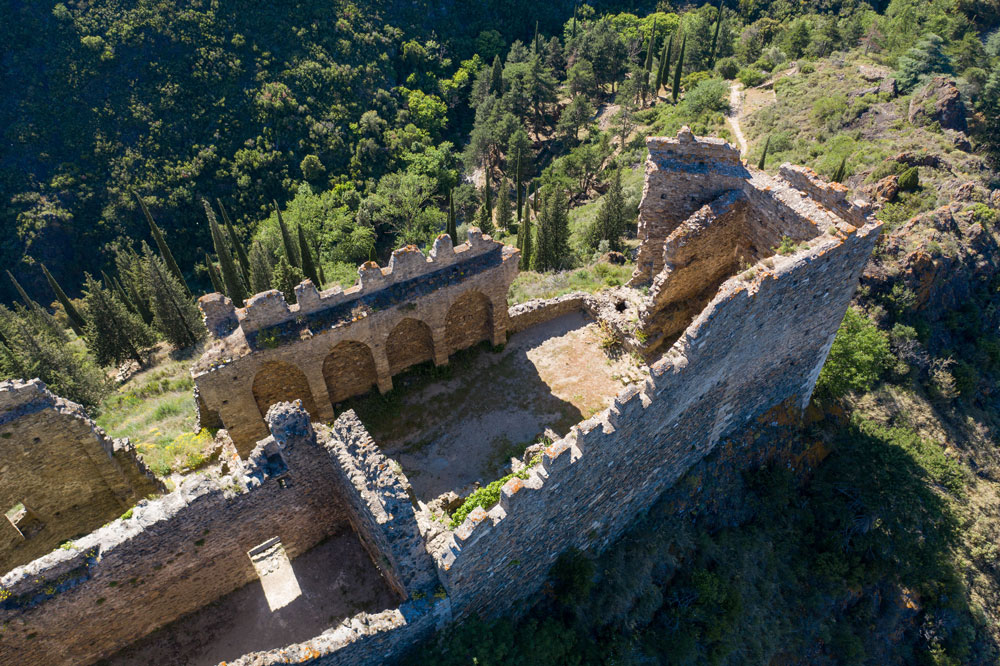
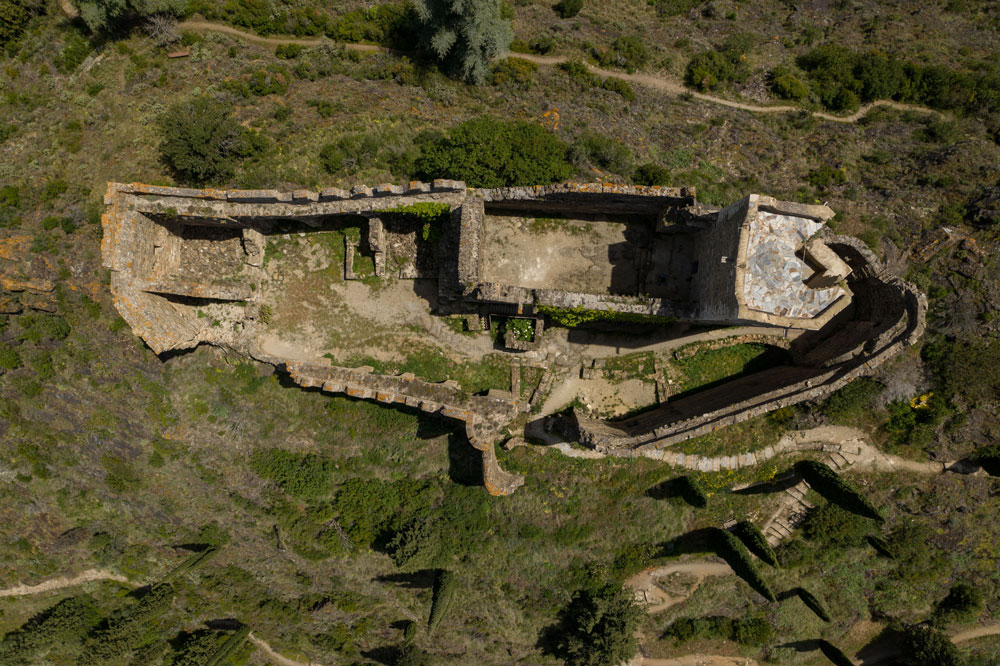
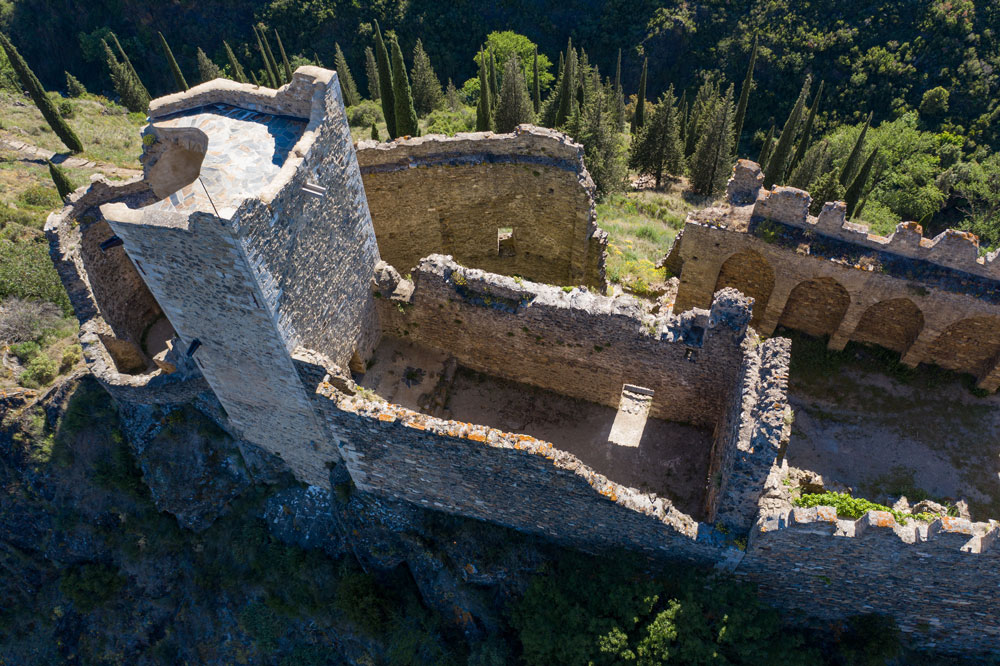
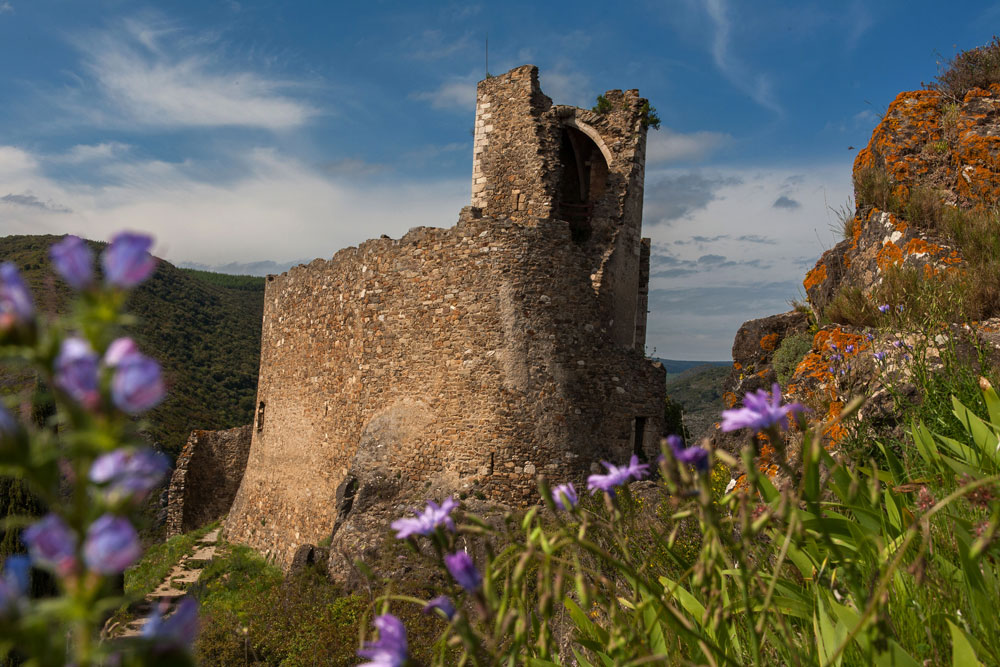
The edifice consists of a pentagonal keep, a main building, and a square tower, connected by a curtain wall. Two cisterns are also visible – one in the main building, the other near the north curtain wall.
The keep, reinforced in 2016, reveals several carefully cut cornerstones of light limestone, contrasting with the rest of the reused stones from the old castrum.
The seven arrow slits and the pentagonal shape of the keep, with its spur point, allow for multiple firing angles.
From the ground floor, vaulted with a broken barrel vault, a spiral staircase, entirely built into the thickness of the wall and now ruined, led to two rooms, the highest of which is vaulted with a ribbed cross vault.
A second staircase flanking the north wall of the main building led to the top of the ramparts and the sentry walk.
TOUR RÉGINE
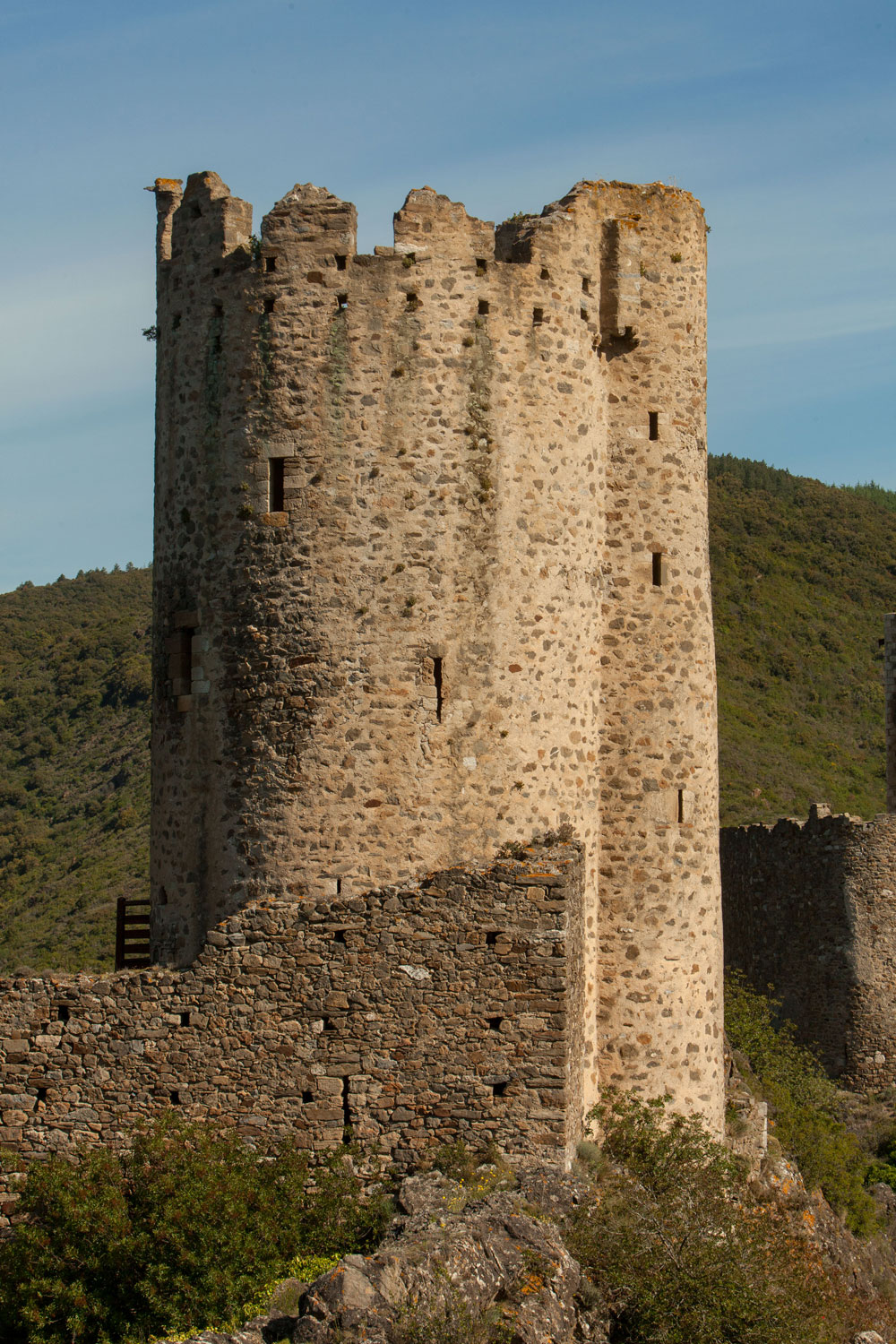
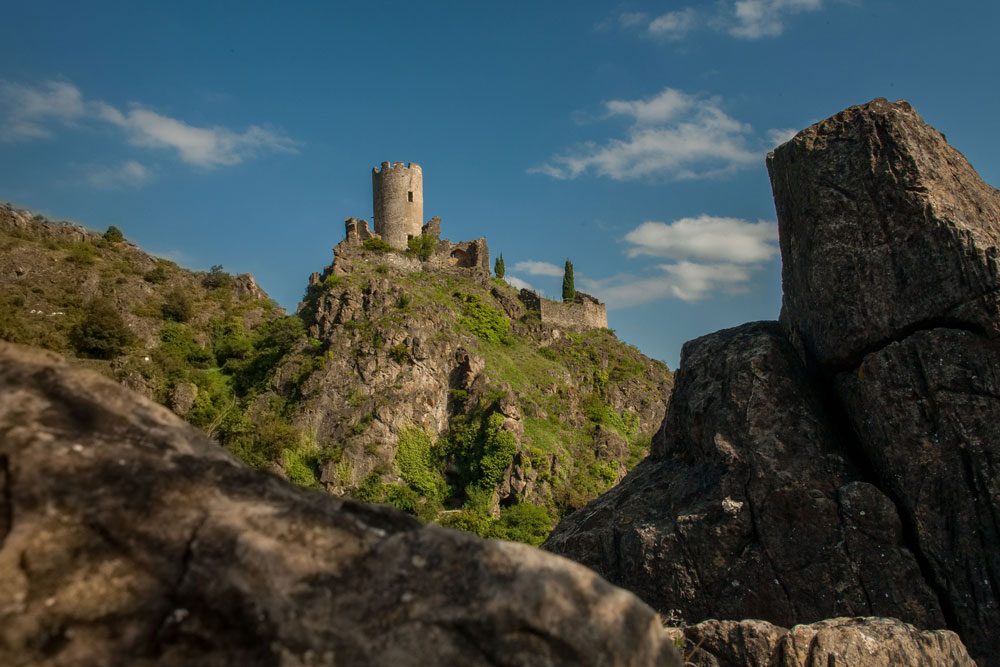
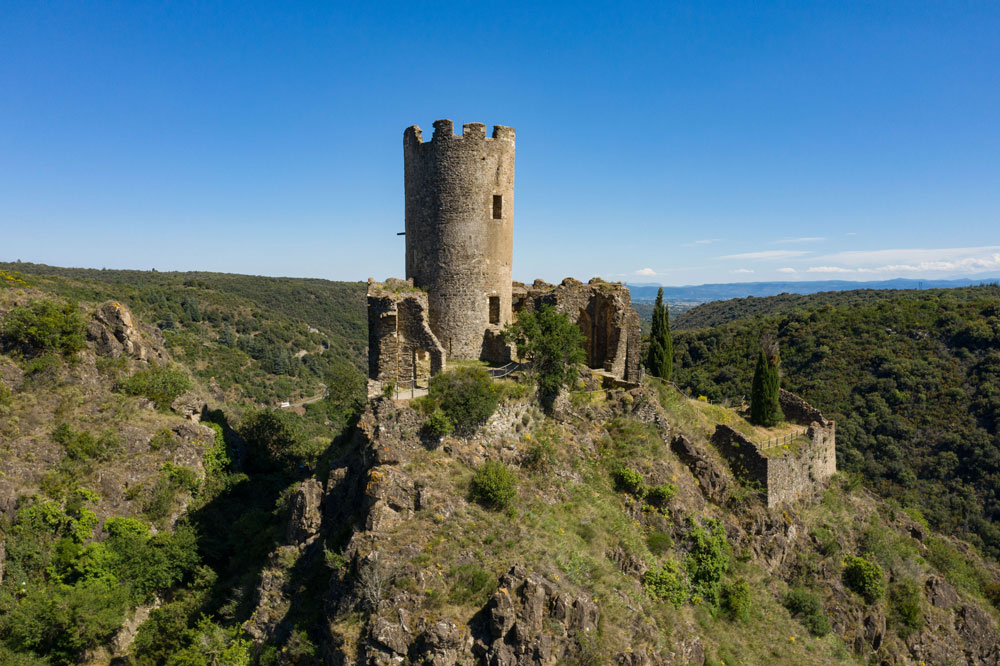
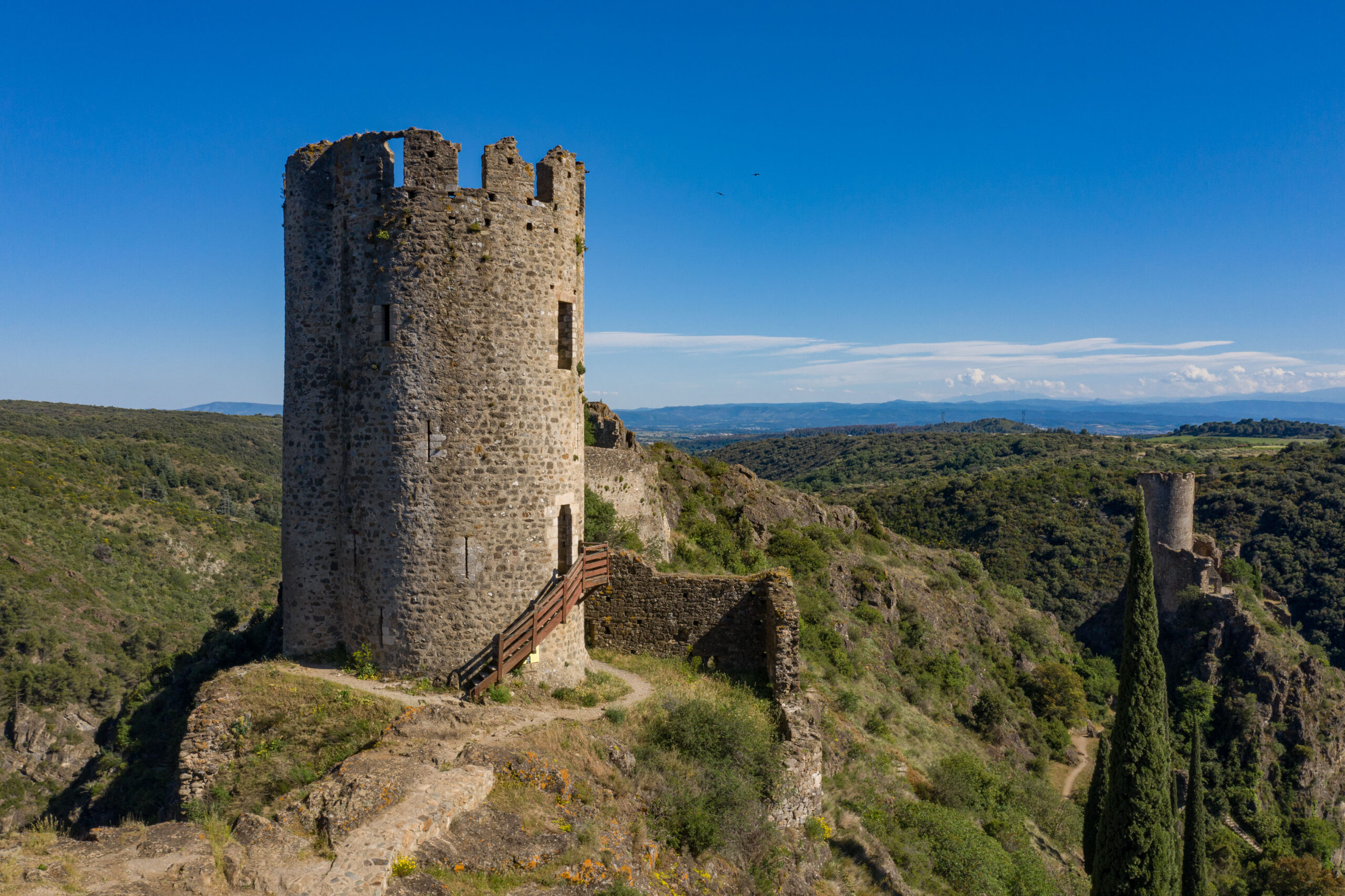
The Tour Régine, which means “queen’s tower”, symbolizes by its name the royal authority’s seizure of power in the 13th century. Its architecture presents many similarities with that of the Carcassonne towers. Smaller in area than Cabaret, the castle consists of a small enclosure, now quite ruined, and a circular tower, pierced with stirrup arrow slits and formerly crowned with hoardings, as evidenced by the putlog holes in the upper part. Inside remain the vestiges of a cistern, the largest on the site, and a remarkable snail-shell dome (a single row of stones arranged in a spiral). A spiral staircase served all floors, the last of which is vaulted with a ribbed cross vault.
TOUR RÉGINE
The Tour Régine, which means “queen’s tower”, symbolizes by its name the royal authority’s seizure of power in the 13th century. Its architecture presents many similarities with that of the Carcassonne towers. Smaller in area than Cabaret, the castle consists of a small enclosure, now quite ruined, and a circular tower, pierced with stirrup arrow slits and formerly crowned with hoardings, as evidenced by the putlog holes in the upper part. Inside remain the vestiges of a cistern, the largest on the site, and a remarkable snail-shell dome (a single row of stones arranged in a spiral). A spiral staircase served all floors, the last of which is vaulted with a ribbed cross vault.
SURDESPINE
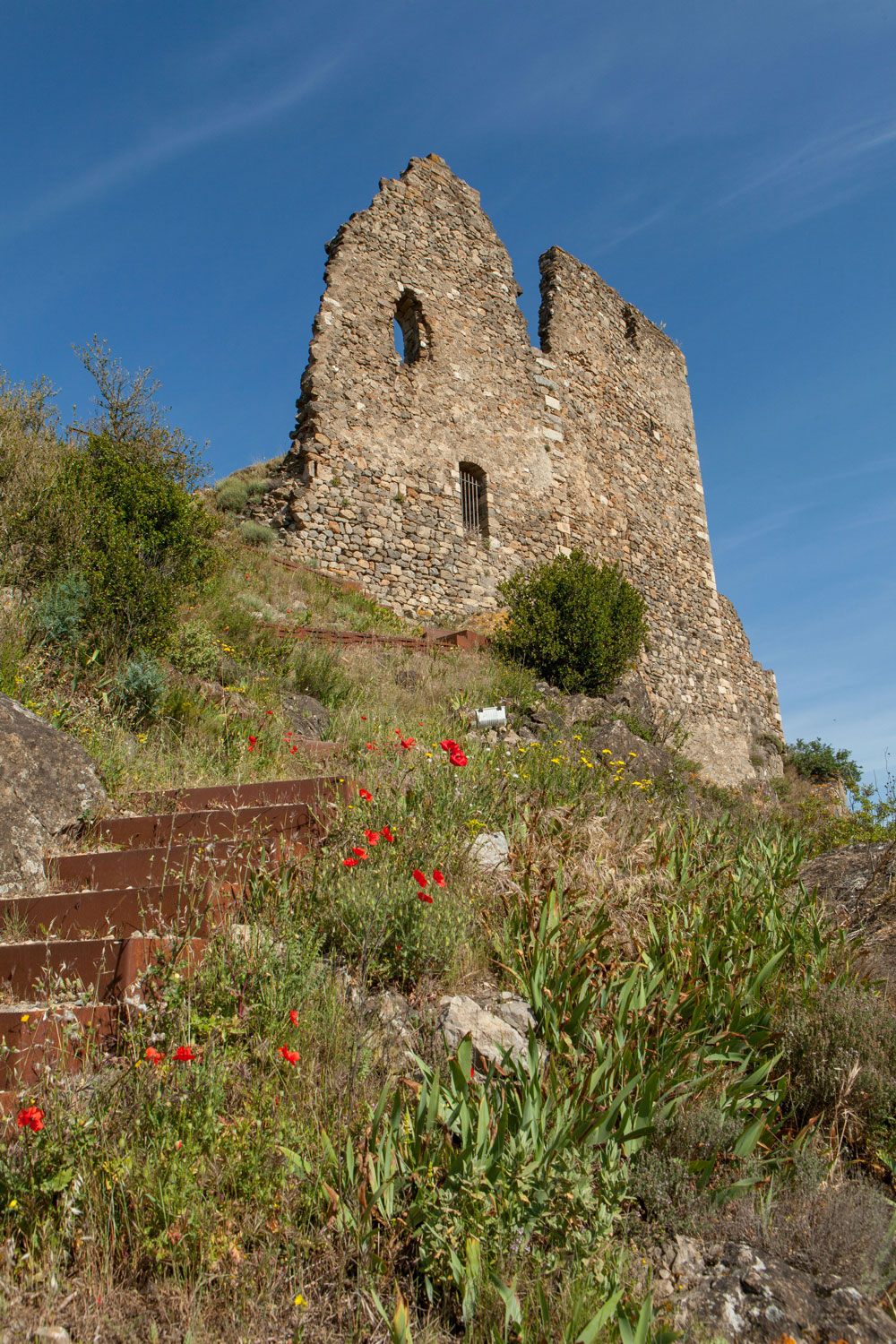
Further south, sometimes also called “Fleur d’Espine”, Surdespine castle is perched at the top of the ridge, from where, on a clear day, Carcassonne can be seen. It consists of two rectangular main buildings separated by a cistern and protected by a polygonal enclosure. The ensemble is quite poorly preserved, but one can slip into the vaulted rooms of the cistern, with walls coated in ‘tuileau’, a mixture of lime and broken tiles of a pink-orange color that ensured waterproofing.
QUERTINHEUX
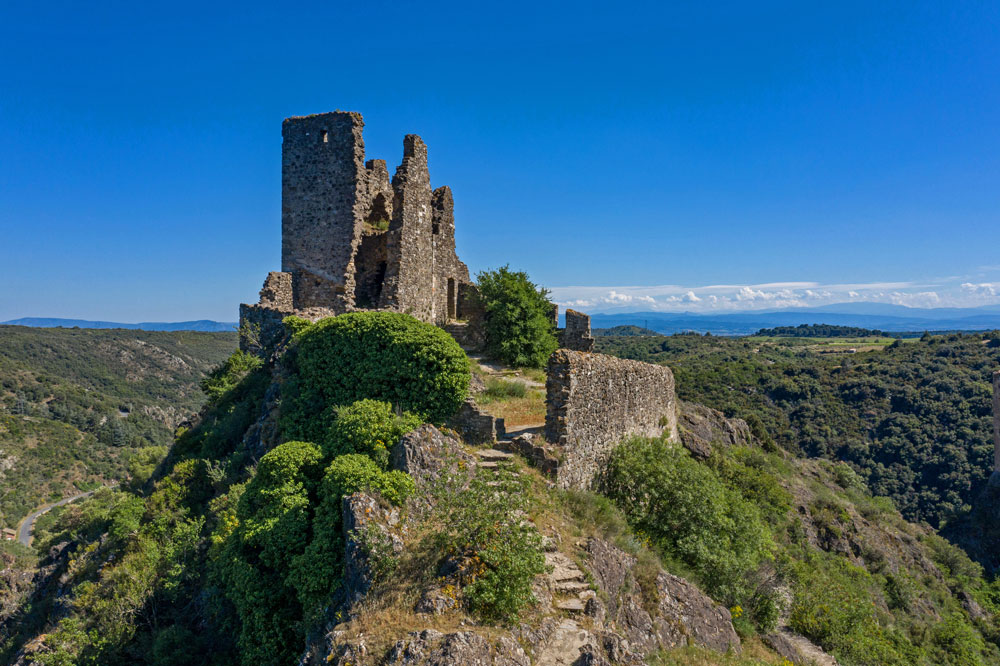
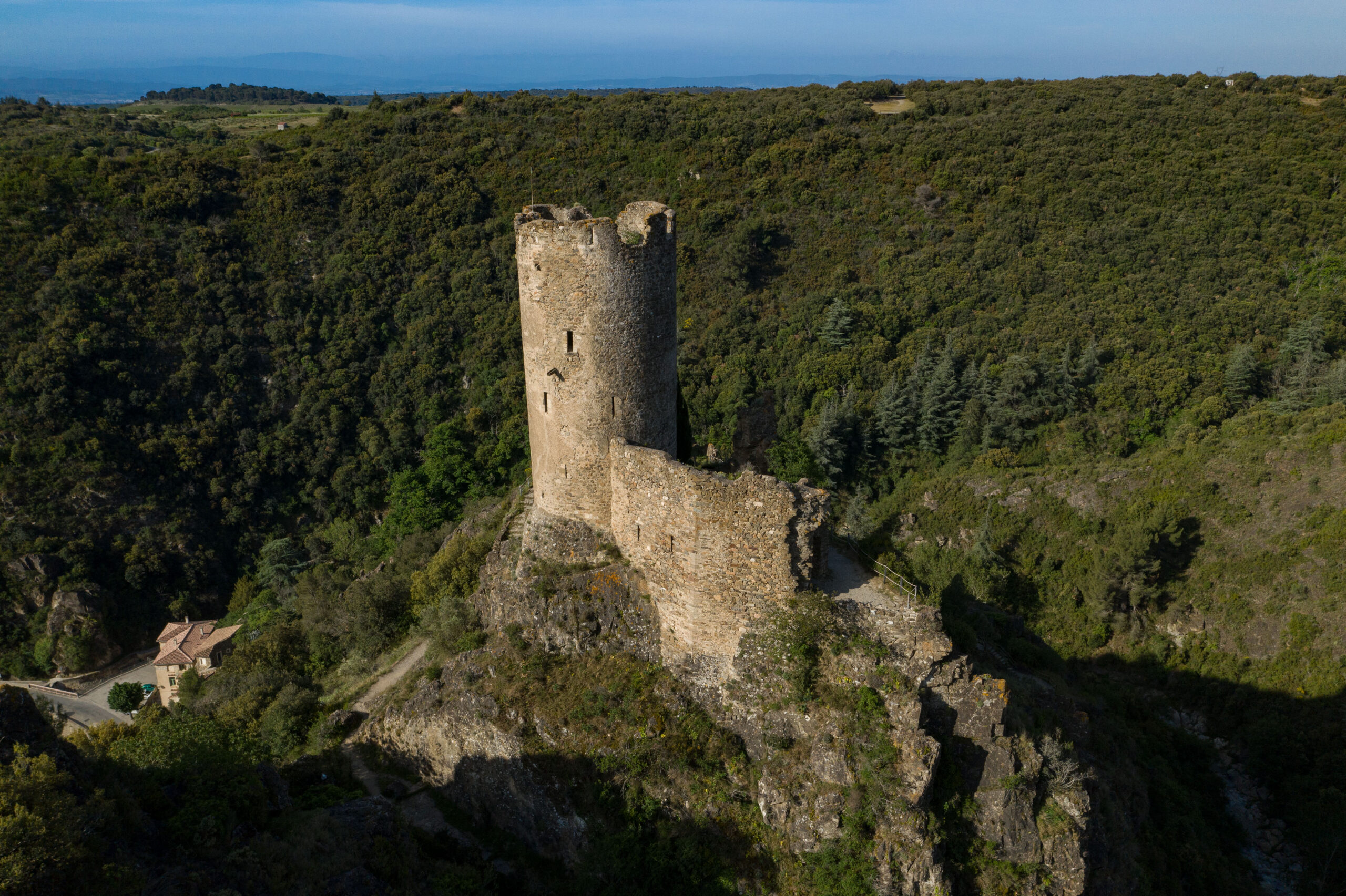
This last castle is located south of the site, perched on an isolated peak below the other three. The circular tower, comparable to the Tour Régine, is of careful construction; it comprises a ground floor and two upper floors. The latter had a ribbed cross vault, now collapsed, of which only the springing of the six ribs remains. Apart from the south rampart, quite well preserved with its sentry walk, and the cistern, whose vault is visible, the lower part of the castle is very ruined. The upper terrace is better preserved; enclosed by walls and dug with another cistern, it must have been occupied by the main building and protected to the north by a spur.
QUERTINHEUX
This last castle is located south of the site, perched on an isolated peak below the other three. The circular tower, comparable to the Tour Régine, is of careful construction; it comprises a ground floor and two upper floors. The latter had a ribbed cross vault, now collapsed, of which only the springing of the six ribs remains. Apart from the south rampart, quite well preserved with its sentry walk, and the cistern, whose vault is visible, the lower part of the castle is very ruined. The upper terrace is better preserved; enclosed by walls and dug with another cistern, it must have been occupied by the main building and protected to the north by a spur.
THE CASTRAL VILLAGE
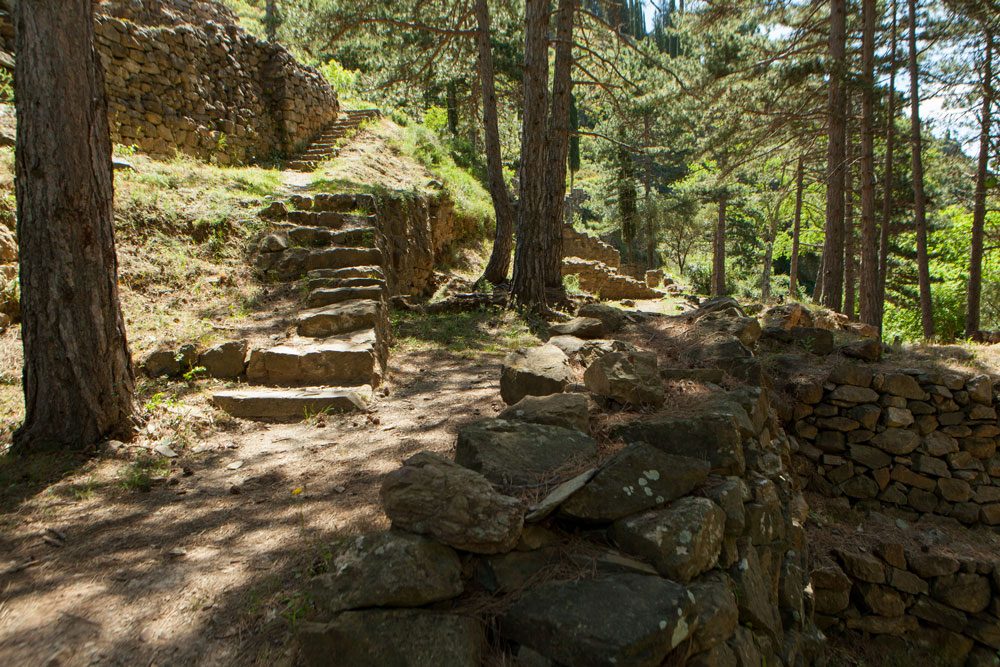
Thanks to the excavation and integration projects carried out since the 1980s in Lastours, it is now possible to visit, below the site, two quarters of the old castral village (11th-13th centuries) dismantled from 1240 by order of the king. To the north, surrounding a primitive castle, a complex of houses, forges, cisterns, and a paved street; to the south, the ruins of the Romanesque chapel Saint-Pierre-de-Cabaret (late 11th-early 12th century), surrounded by a cemetery, several houses, cisterns, and a forge. The excavations also yielded numerous everyday objects: ceramics, keys, buckles and clothing accessories, utensils, and tools. They help illustrate daily life at the time of the crusade.
The fortress in pictures