
 Accueil > Discover > Fortresses >
 puilaurens
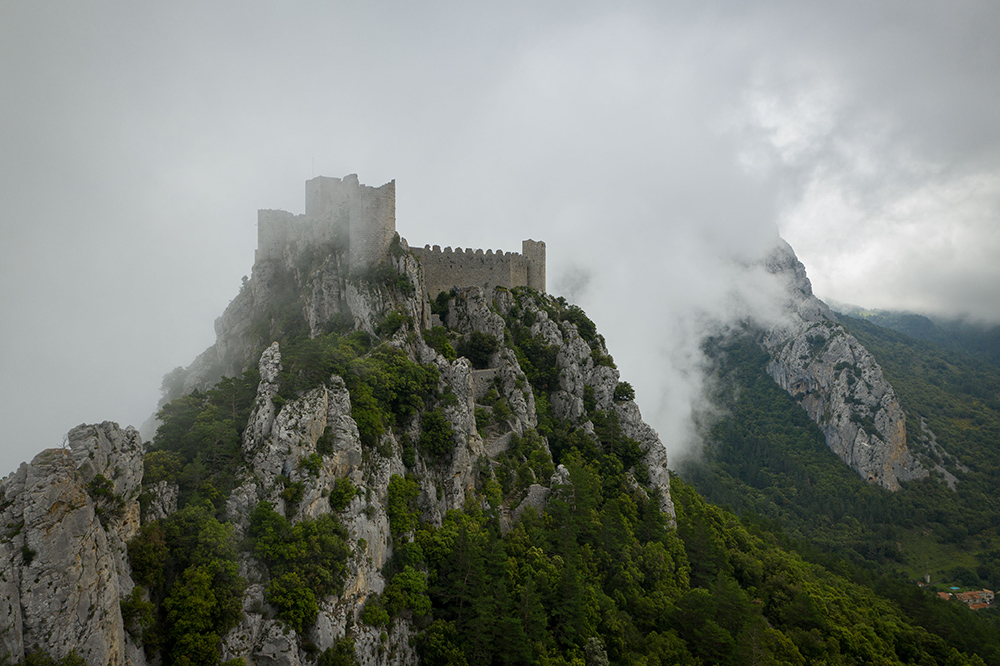
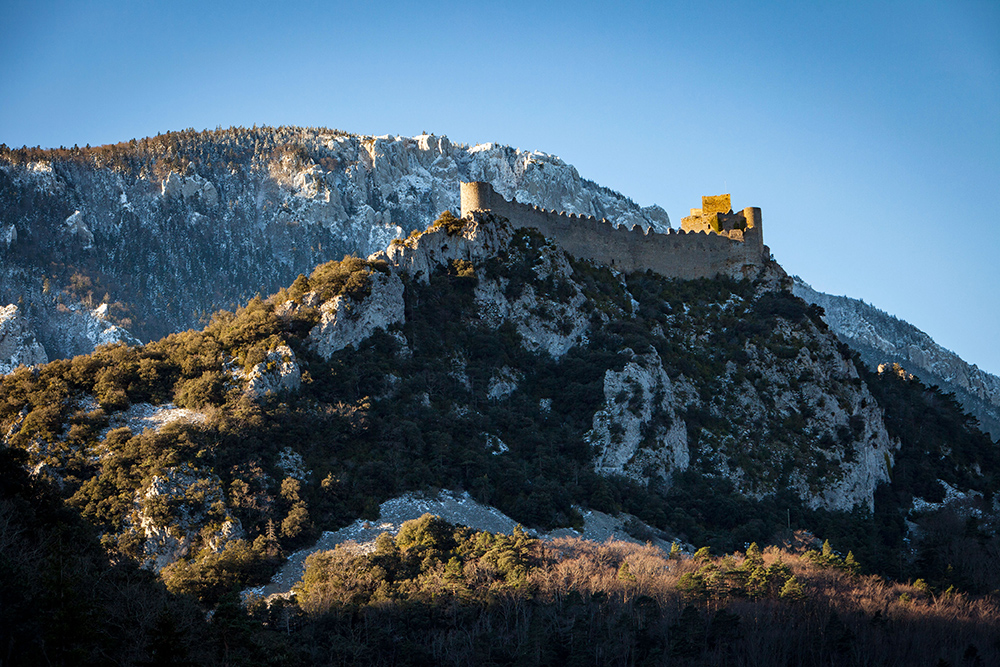
Dominating an important natural crossroads, at the intersection of the Aude plains and the high mountains of the Pyrenean massif, Puilaurens is undoubtedly the best preserved of the royal fortresses established in the region during the 13th century.
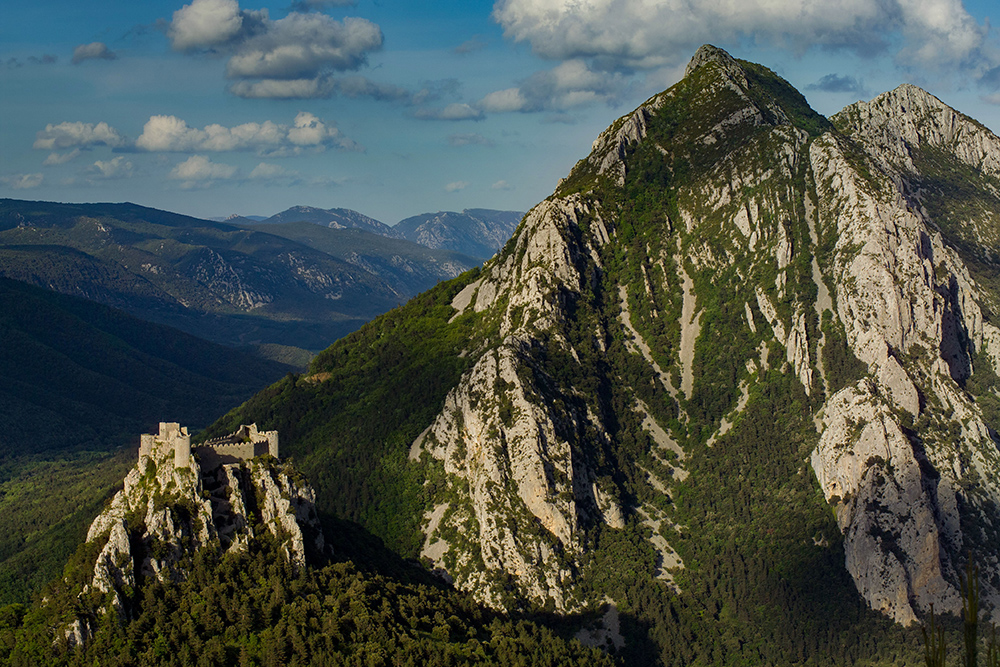
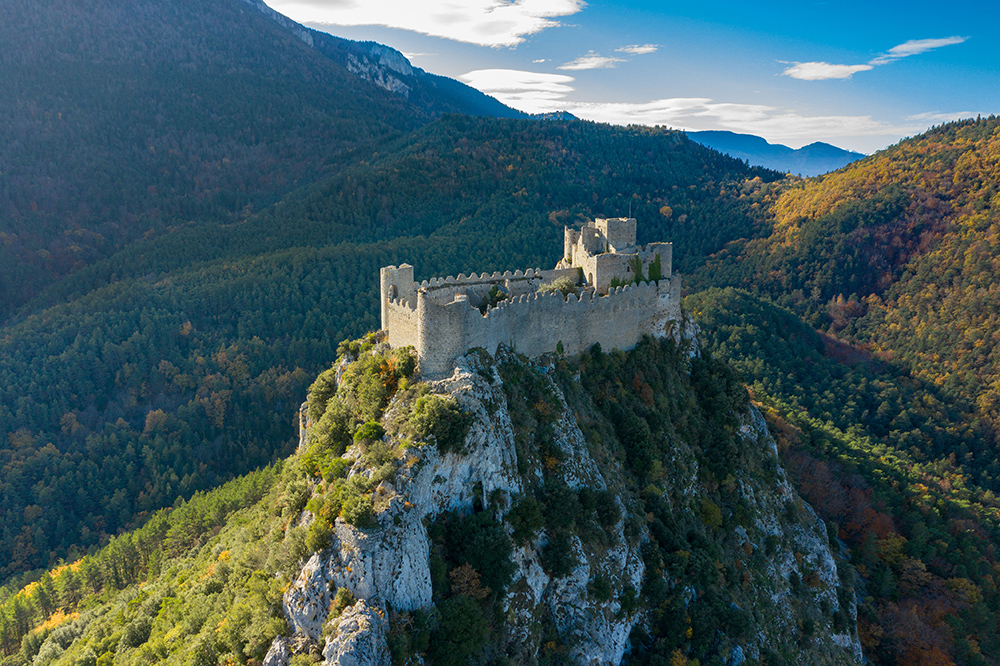
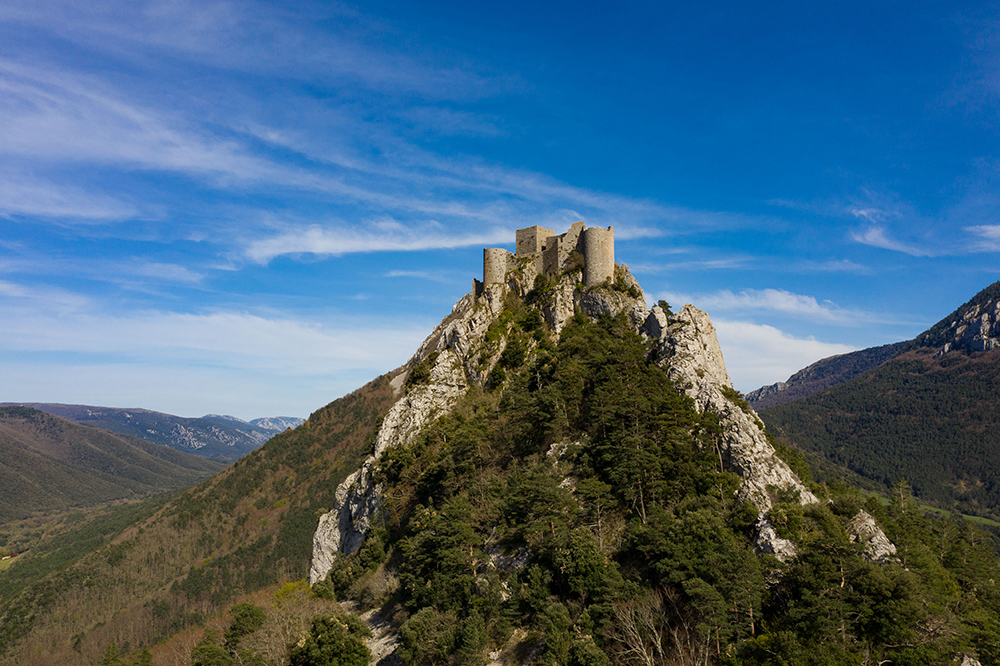
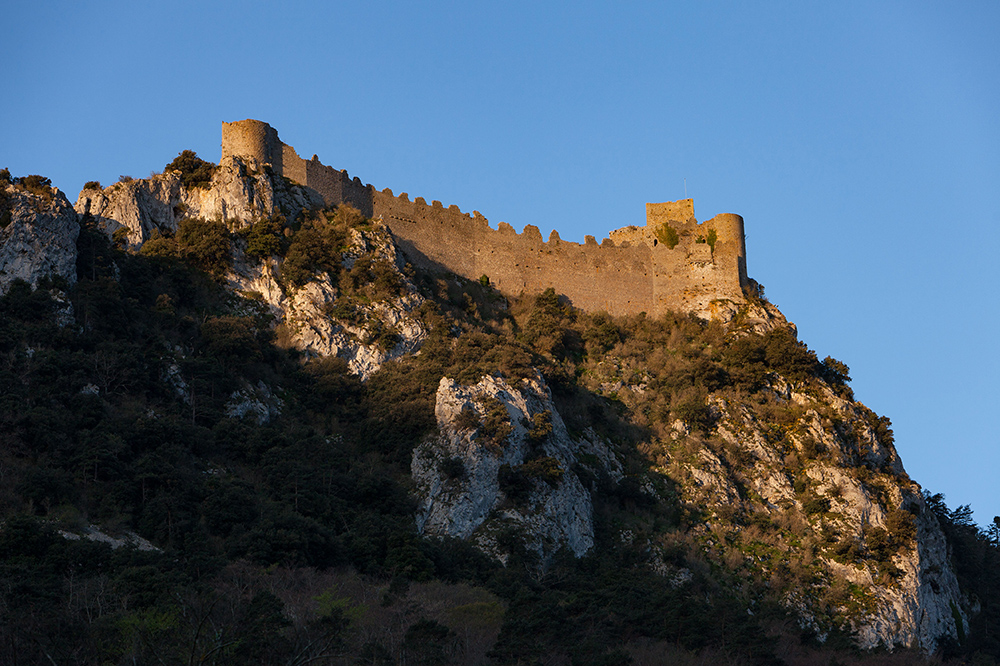
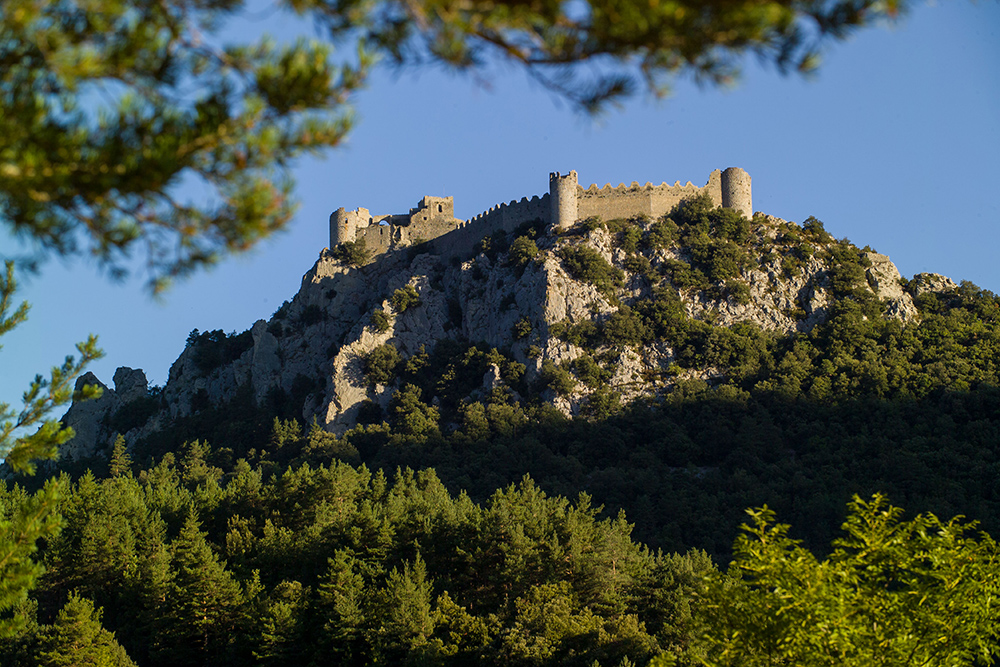
Its imposing crenellated silhouette has thus retained its full height, rising to an altitude of 697 m at the summit of a steep ridge, above the forests of the Boulzane valley. The site is located in the commune of Lapradelle-Puilaurens.
CURRENT LANDSCAPE SETTING

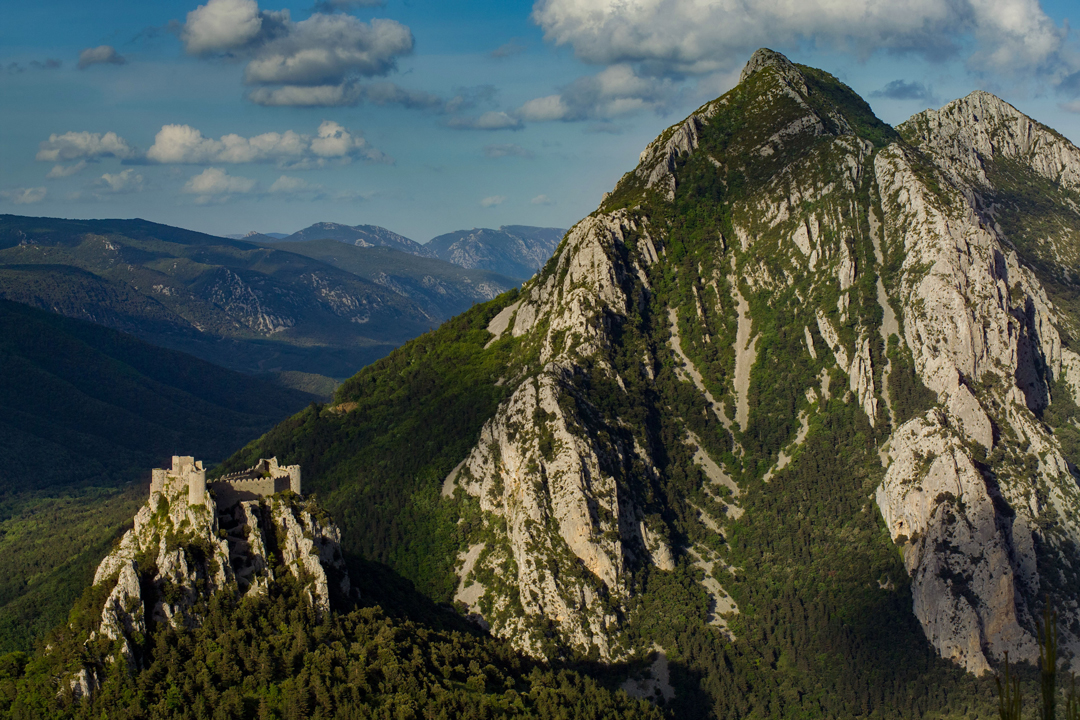
Puilaurens Castle occupies the summit of a very steep limestone ridge, at an altitude of 697 m, on the departmental border of Aude and Pyrénées-Orientales, between Fenouillèdes and Pays de Sault. It overlooks the Boulzane valley, a narrow valley carved by the river of the same name, blocked to the south by the Défilé de la Folie and to the north by the rocky ridge of Puilaurens. This valley is also the crossroads of two currently secondary routes; one, to the west, provides access towards Axat and, from there, towards Carcassonne or Foix, the other, to the east, passes through Aigues-Bonnes and leads to Fenouillet and then, from there, to Fenouillèdes and Roussillon.
A transitional territory between the plains of Aude and the high mountains of the Pyrenean massif, the surroundings of Puilaurens primarily benefit from a mountain climate, but are also subject to Mediterranean influences. This climatic diversity gives rise to three types of vegetation formations: pubescent oak forests, Scots pine forests, and beech-fir forests that are layered across the terrain. The Boulzane valley is thus bordered, to the west, by the En Malo-Bac-Estable state forest, to the south, by the Boucheville forest, and to the north, by the Fanges forest, an ancient royal forest that spans 1800 ha.
The omnipresence of forests constitutes one of the strong landscape interests of this territory, forming a magnificent green setting around the castle. Minimally affected by human activities, the environment appears wild and natural. However, this was not always the case: in the 1950s-1960s, photographs show often bare landscapes, victims of over-logging, particularly intense in the 19th century. Reforestation campaigns and the protection measures that forests now benefit from have restored the landscape heritage to its full splendor.
HISTORY
Overlooking the Boulzane valley and the passes leading to the Agly plain, and beyond to Roussillon, the powerful silhouette of Puilaurens unequivocally testifies to its attachment to the Kingdom of France in the second half of the 13th century. However, its first steps in history remain shrouded in mystery.
MONASTIC ORIGINS
Despite a human presence attested in the Boulzane valley since the end of the Paleolithic, it was not until 958 that the first mention appeared in texts of “mont Ardu” – the former name of the peak on which the ruins of Puilaurens stand. This then figured among the territories granted to the rich and influential abbey of Saint-Michel-de-Cuixa (Pyrénées-Orientales), as did the entire Boulzane valley – then called the Sainte-Croix valley. At the very beginning of the 11th century, the existence of a first fortified site at Puilaurens seems to be confirmed by a bull from Pope Sergius IV mentioning, among the abbey’s possessions, “the castrum of Saint-Laurent with the church of the same name” (castrum Sancti-Laurenti cum eadem ecclesia).
The castle then disappears from historical records for nearly two centuries. Unlike most castles in the Corbières, its name does not appear among the great seigneurial lineages, nor in feudal homage oaths, which are rare documents allowing historians to learn about the castle’s owners. It can therefore be assumed that Puilaurens remained under the tutelage of the Abbey of Cuixa throughout this period.
MONASTIC ORIGINS
Despite a human presence attested in the Boulzane valley since the end of the Paleolithic, it was not until 958 that the first mention appeared in texts of “mont Ardu” – the former name of the peak on which the ruins of Puilaurens stand. This then figured among the territories granted to the rich and influential abbey of Saint-Michel-de-Cuixa (Pyrénées-Orientales), as did the entire Boulzane valley – then called the Sainte-Croix valley. At the very beginning of the 11th century, the existence of a first fortified site at Puilaurens seems to be confirmed by a bull from Pope Sergius IV mentioning, among the abbey’s possessions, “the castrum of Saint-Laurent with the church of the same name” (castrum Sancti-Laurenti cum eadem ecclesia).
The castle then disappears from historical records for nearly two centuries. Unlike most castles in the Corbières, its name does not appear among the great seigneurial lineages, nor in feudal homage oaths, which are rare documents allowing historians to learn about the castle’s owners. It can therefore be assumed that Puilaurens remained under the tutelage of the Abbey of Cuixa throughout this period.
IN THE TIME OF THE CATHARS
The name of Puilaurens reappears in history shortly after the beginning of the Barons’ Crusade. In 1217, Pierre Cathala, the first castellan of Puilaurens identified with certainty, appears as a witness in the act of submission that Guillaume de Peyrepertuse made to Simon de Montfort, leader of the crusaders. Rebelling against royal authority, Guillaume occupied Puilaurens Castle in 1229, before quickly making his definitive submission.
In 1242, fleeing the Inquisition, a small community of “perfects” found refuge in Puilaurens and remained there from 1243 under the protection of Chabert de Barbaira, a faidit lord who also commanded Quéribus Castle. The official year of Puilaurens’ annexation by the King of France is not known, but it probably occurred between 1250 and 1255, the date on which Chabert de Barbaira handed over Quéribus Castle to Louis IX.
ROYAL FORTRESS
In August 1255, Saint Louis, deciding to militarily reorganize the region, ordered the seneschal of Carcassonne to rebuild Puilaurens Castle. The Treaty of Corbeil, three years later, ratified French sovereignty over the region and placed Puilaurens at the forefront of the new border with the Kingdom of Aragon. In that same year, 1258, the garrison consisted of twenty-five sergeants-at-arms commanded by a castellan and served by a chaplain.
The reconstruction work on the fortress, carried out according to the Capetian architectural model, was still ongoing in 1263, as evidenced by a letter written on December 8 by the castellan Simon Cauda. He acknowledged having received from the seneschal of Carcassonne “an anvil, wedges, and a sledgehammer” for stone cutting, but also “13,000 crossbow bolts, 18 shields, five iron helmets“, as well as numerous provisions: “six salted pigs, two bushels of wheat, six setiers of flour, one setier of salt“, etc. A substantial supply intended to ensure the protection of the fortress in case of confrontation with Aragonese troops.
In 1473, and again in 1495, the latter indeed attempted to besiege Puilaurens, but in vain.
ROYAL FORTRESS
In August 1255, Saint Louis, deciding to militarily reorganize the region, ordered the seneschal of Carcassonne to rebuild Puilaurens Castle. The Treaty of Corbeil, three years later, ratified French sovereignty over the region and placed Puilaurens at the forefront of the new border with the Kingdom of Aragon. In that same year, 1258, the garrison consisted of twenty-five sergeants-at-arms commanded by a castellan and served by a chaplain.
The reconstruction work on the fortress, carried out according to the Capetian architectural model, was still ongoing in 1263, as evidenced by a letter written on December 8 by the castellan Simon Cauda. He acknowledged having received from the seneschal of Carcassonne “an anvil, wedges, and a sledgehammer” for stone cutting, but also “13,000 crossbow bolts, 18 shields, five iron helmets”, as well as numerous provisions: “six salted pigs, two bushels of wheat, six setiers of flour, one setier of salt”, etc. A substantial supply intended to ensure the protection of the fortress in case of confrontation with Aragonese troops.
In 1473, and again in 1495, the latter indeed attempted to besiege Puilaurens, but in vain.
RESTORATION AND ABANDONMENT
In 1595, the Duke of Joyeuse, governor of Languedoc, had the castle restored, which then underwent profound transformations: addition of supplementary fortifications adapted to firearms; construction of residential buildings within the first enclosure and redevelopment of part of the second enclosure. In 1615, Louis XIII authorized the castellan, Henri Montsarat du Vivier, to cut 150 fir trees in the royal forests for castle repairs. In 1637, Puilaurens was taken by Spanish troops. The stronghold was, in fact, defenseless: its garrison had gone to the aid of French forces defending Leucate.
After the Treaty of the Pyrenees in 1659, which pushed the Aragonese border beyond Roussillon, Puilaurens no longer held strategic interest: however, the castle maintained a garrison of ten men commanded by a governor. The site was abandoned in the early years of the Revolution.
SITE DESCRIPTION
Unlike other fortresses in the Corbières, Puilaurens does not appear to have preserved elements predating the royal conquest. The primitive castle was probably razed during the reconstruction ordered by Louis IX in 1255. The current remains therefore date essentially from the last third of the 13th century and from the redevelopments carried out during the 16th and 17th centuries.
ACCESS
Situated on a rocky promontory surrounded by steep slopes, the castle is only accessible from its southern side. From the visitor parking, a rocky path leads in 15 minutes beneath the castle walls. However, to reach the entrance, one must still climb the impressive zigzag ramp built into the rock fault.
Bordered by nine tiered low walls, these switchbacks formed as many traps for the assailant, at the mercy of archers and crossbowmen posted on the ramparts and upper towers. With the development of firearms, the low walls were fortified in the 16th century, and a barbican, pierced with loopholes, was built upstream.
ACCESS
Situated on a rocky promontory surrounded by steep slopes, the castle is only accessible from its southern side. From the visitor parking, a rocky path leads in 15 minutes beneath the castle walls. However, to reach the entrance, one must still climb the impressive zigzag ramp built into the rock fault. Bordered by nine tiered low walls, these switchbacks formed as many traps for the assailant, at the mercy of archers and crossbowmen posted on the ramparts and upper towers. With the development of firearms, the low walls were fortified in the 16th century, and a barbican, pierced with loopholes, was built upstream.
LOWER ENCLOSURE
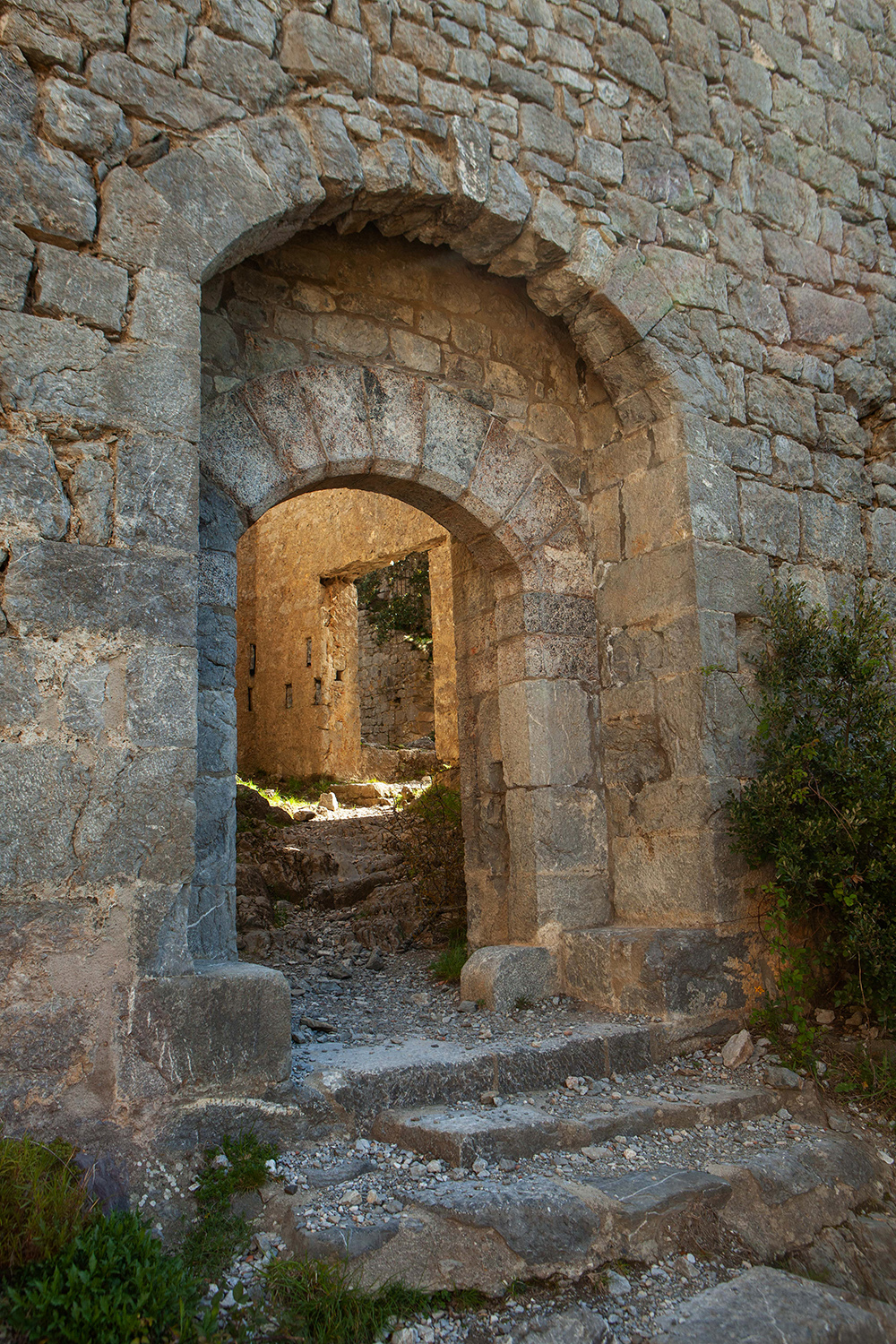
The lower enclosure is organized around a vast courtyard, which is accessed after passing through the entrance gate, surmounted by a murder-hole, and a first small courtyard.
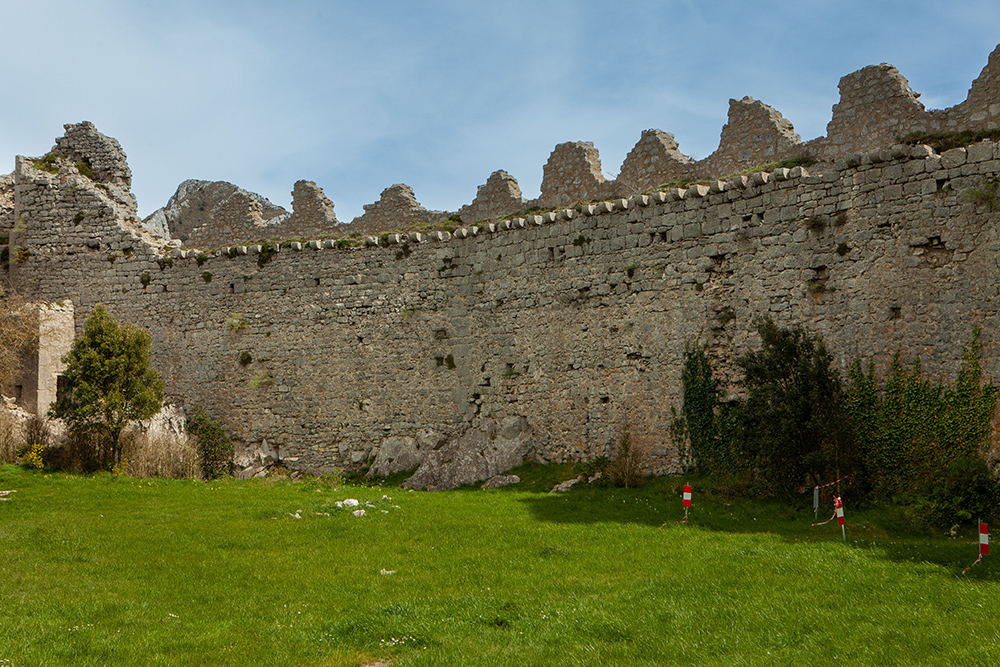
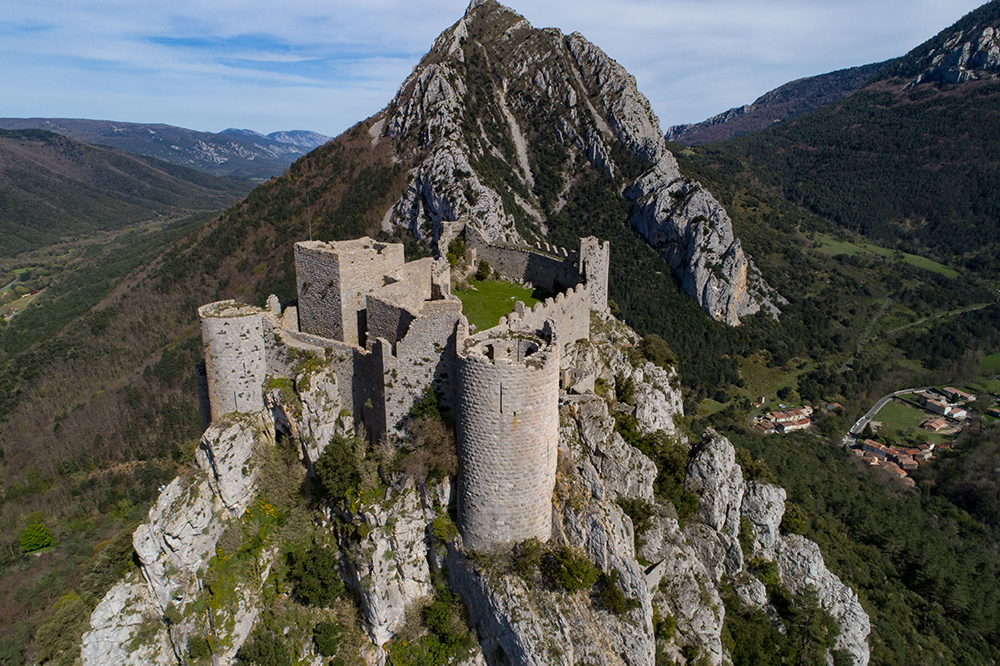
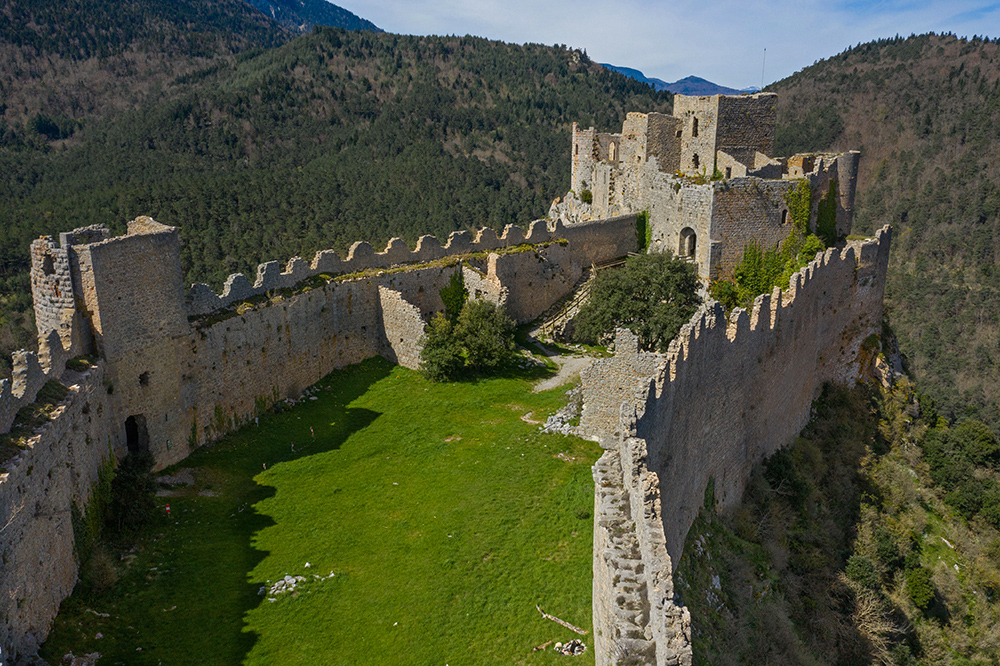
The irregular layout of the large courtyard follows the contours of the rock, delimiting a vast space approximately 60 m by 25 m. The walls have retained their full height, from 8 to 10 m, and most of their crenellation, undoubtedly restored in the 16th or 17th century. Two semi-circular towers punctuate the enclosure to the east and south, both originally open at the gorge – the southern one is now blocked by a wall.
On the northern front, the remains of a residential building show traces of a partially buried access. It serves a cistern and a room defended by two archer slits; a narrow postern overlooks the remains of a second cistern, intended to collect the overflow from the first.
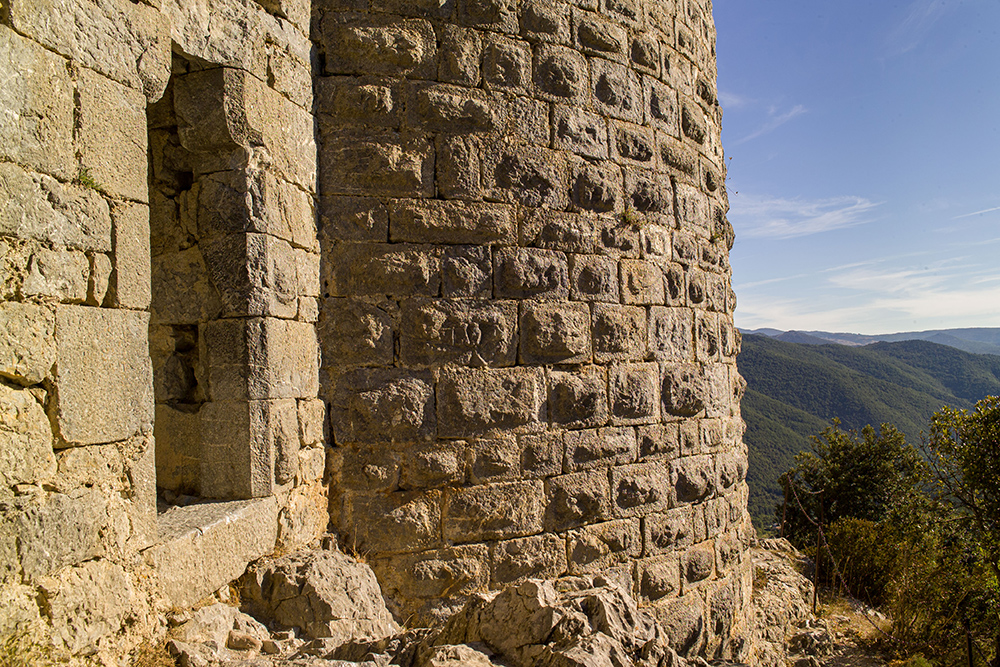
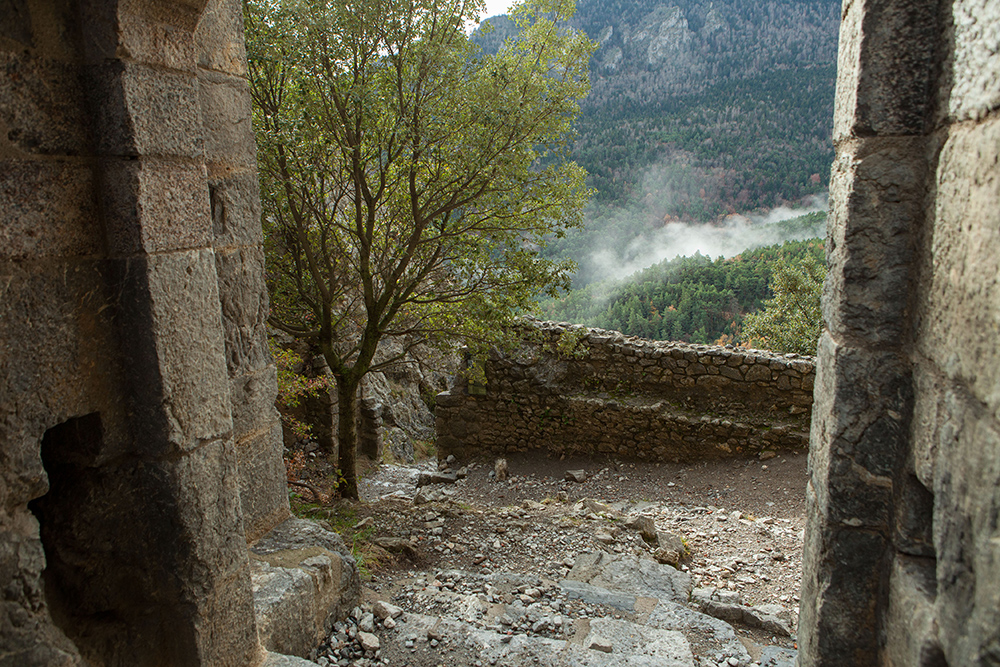
A second postern, pierced at the foot of the east tower, provides access to an outdoor platform, from which one can enjoy a wide panorama of the village of Puilaurens, the Boulzane valley, and in the distance, the Canigou massif. It is also an opportunity to admire the exterior facing of the east tower, made of rusticated stones.
UPPER ENCLOSURE
Adjoining the northwest of the large courtyard, the upper enclosure is a fortified réduit built at the summit of the site and overlooking the first wall by a few meters. The study of its various constructions testifies to significant redevelopments in the 16th and 17th centuries.
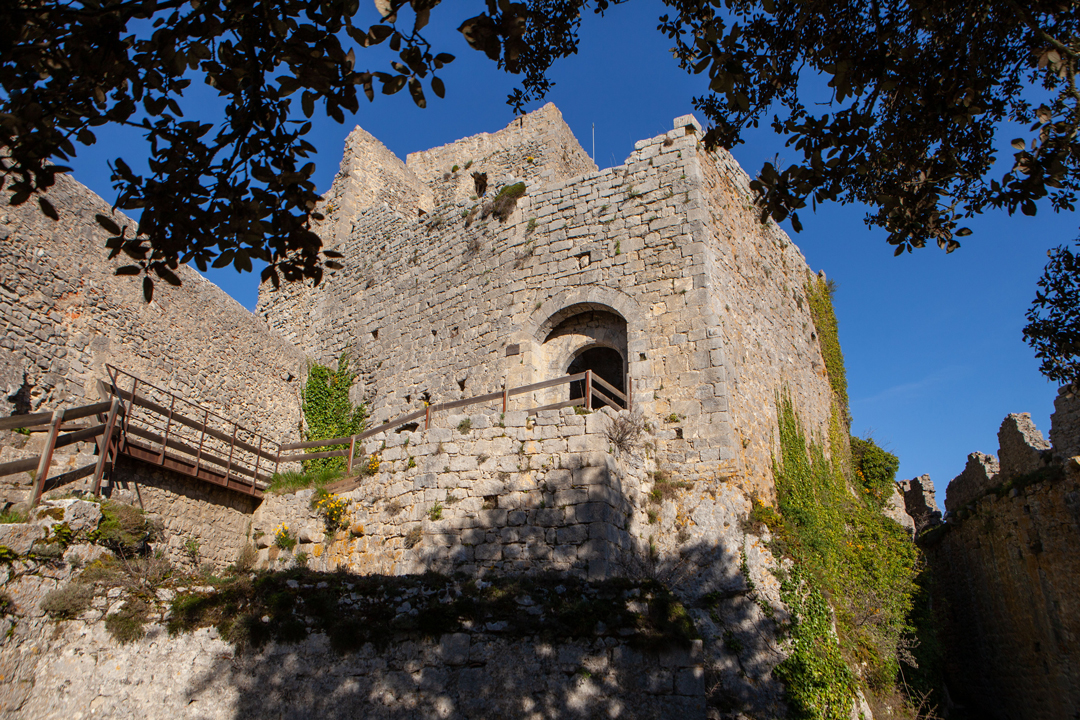
A footbridge leads to the entrance gate located in the southeast corner. Immediately opposite, a corridor situated between the wall and the rock leads to the North tower, open at the gorge. On one side of this corridor opens a narrow passage, carved into the rock, accessing galleries leading to the outside, on the cliff face. These, closed by masonry, must have served as stores or reserves.
By taking stairs, uncovered during the works, one arrives at a quadrangular tower. Equipped with a fireplace and a cupboard, this dwelling does not seem to date back beyond the 16th century.
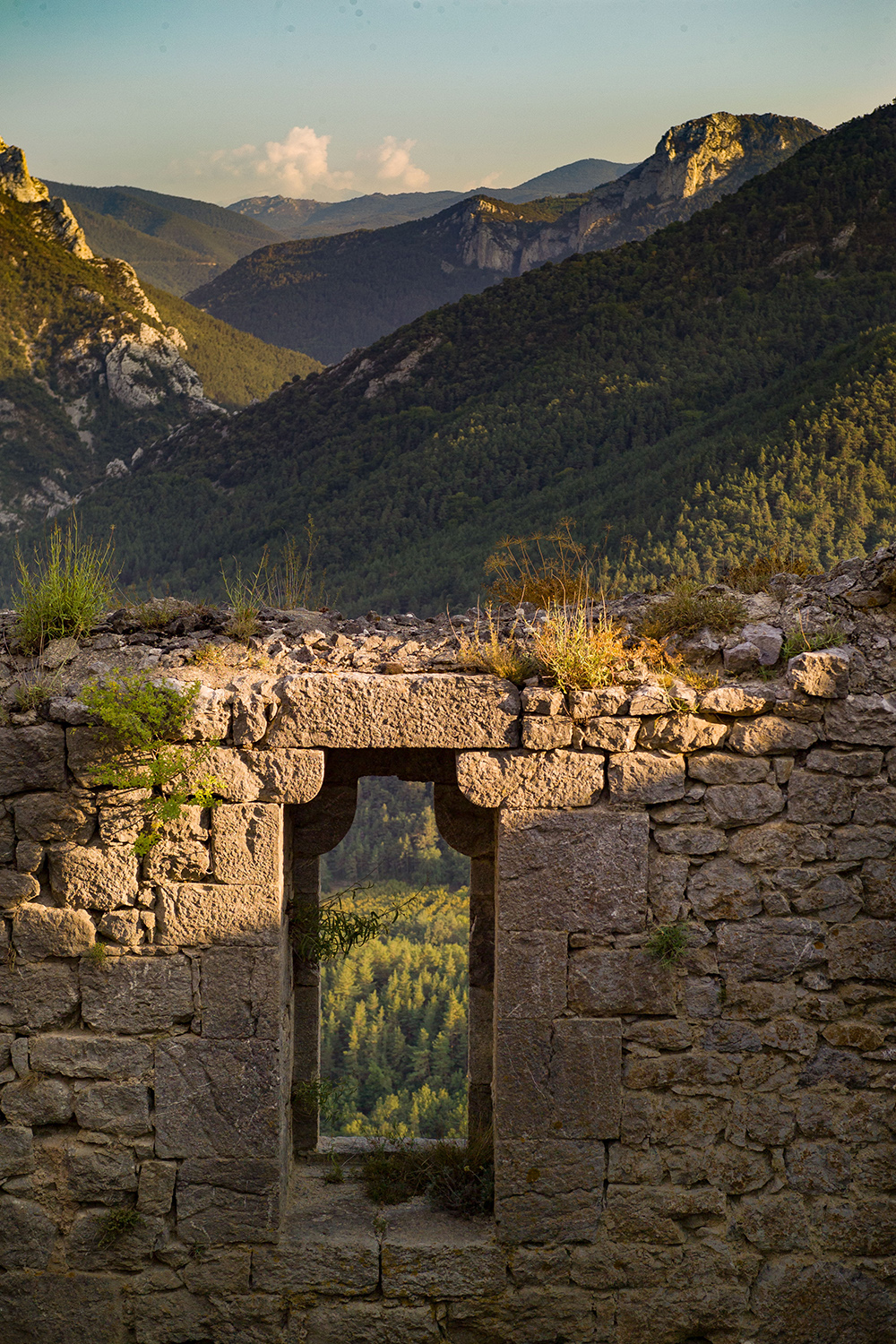
To the west, the ramparts overlooking the access chicanes lead to a circular tower faced with rusticated stones on the exterior side, named “White Lady’s Tower” by local tradition. It is indeed said that Blanche de Bourbon, assassinated by her husband the King of Castile, haunts the premises during pale nights, enveloped in white veils. In any case, there is no trace of a ghost in the lower room of the tower, vaulted with ogival ribs, but there are two archer slits and an astonishing speaking tube, carved into the wall, which allowed communication with the upper level. On the upper floor, a window with a window seat and a door remain.
Served by a staircase condemned by 17th-century works, latrines are visible in the height of the northern curtain wall, a short distance from a cistern.
UPPER ENCLOSURE
Adjoining the northwest of the large courtyard, the upper enclosure is a fortified réduit built at the summit of the site and overlooking the first wall by a few meters. The study of its various constructions testifies to significant redevelopments in the 16th and 17th centuries.
A footbridge leads to the entrance gate located in the southeast corner. Immediately opposite, a corridor situated between the wall and the rock leads to the North tower, open at the gorge. On one side of this corridor opens a narrow passage, carved into the rock, accessing galleries leading to the outside, on the cliff face. These, closed by masonry, must have served as stores or reserves.
By taking stairs, uncovered during the works, one arrives at a quadrangular tower. Equipped with a fireplace and a cupboard, this dwelling does not seem to date back beyond the 16th century.
To the west, the ramparts overlooking the access chicanes lead to a circular tower faced with rusticated stones on the exterior side, named “White Lady’s Tower” by local tradition. It is indeed said that Blanche de Bourbon, assassinated by her husband the King of Castile, haunts the premises during pale nights, enveloped in white veils. In any case, there is no trace of a ghost in the lower room of the tower, vaulted with ogival ribs, but there are two archer slits and an astonishing speaking tube, carved into the wall, which allowed communication with the upper level. On the upper floor, a window with a window seat and a door remain.
Served by a staircase condemned by 17th-century works, latrines are visible in the height of the northern curtain wall, a short distance from a cistern.
The fortress in pictures