 Accueil > Discover > Fortresses >
 montségur
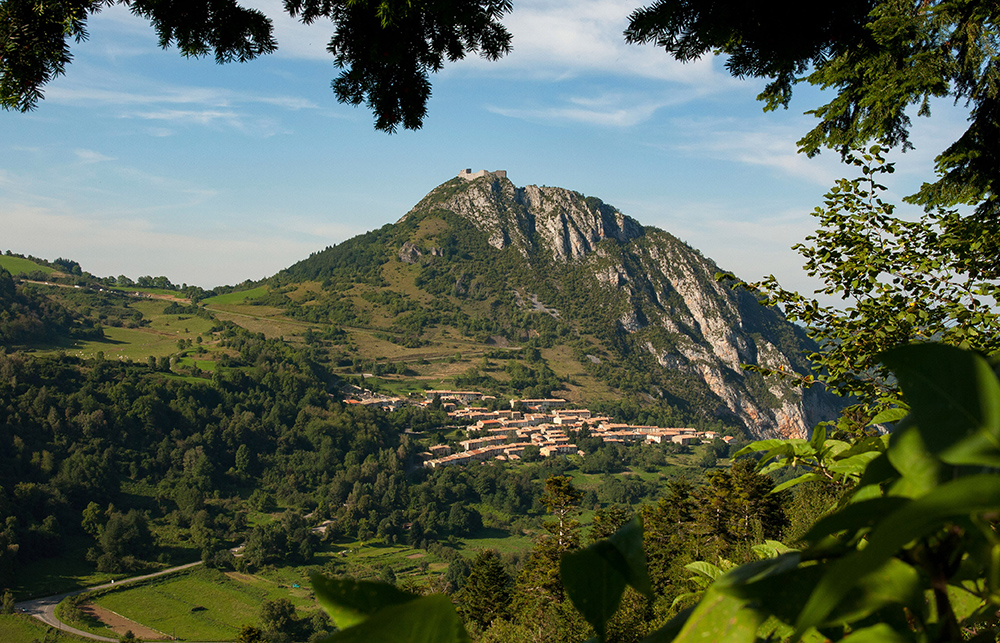
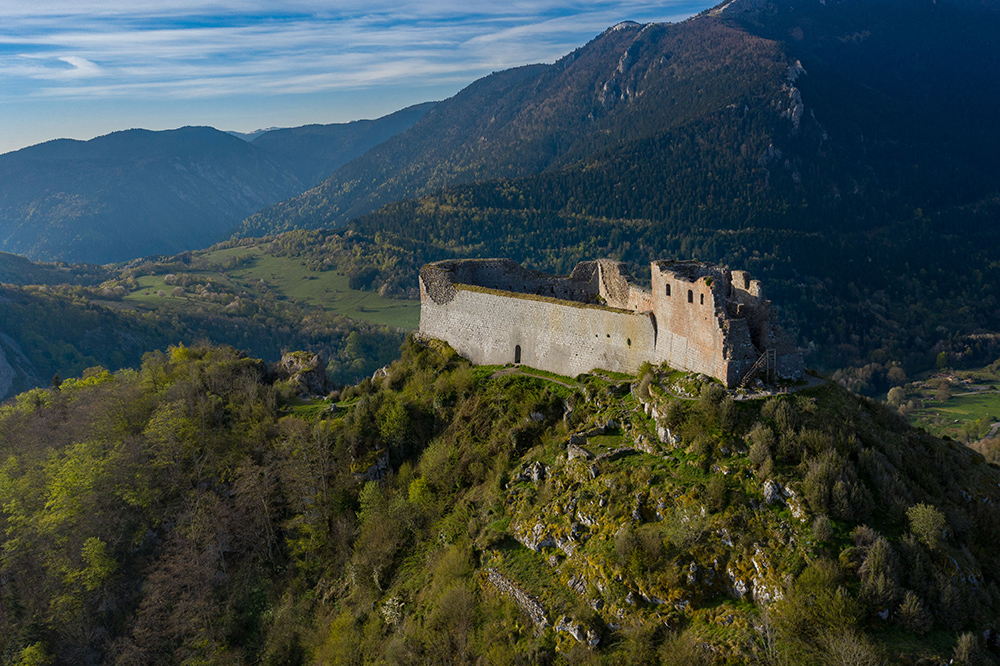
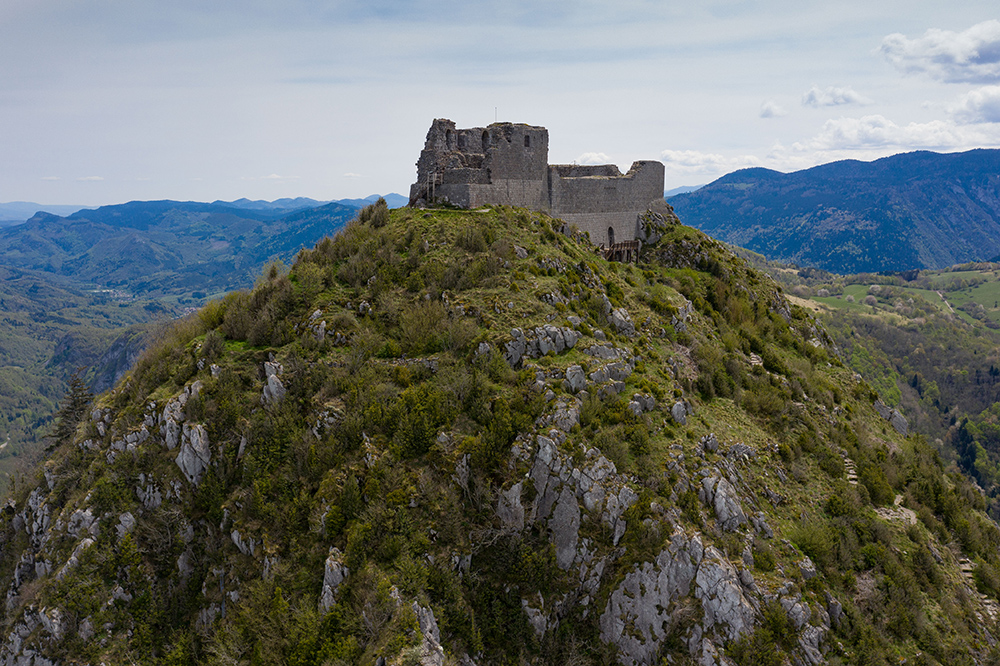
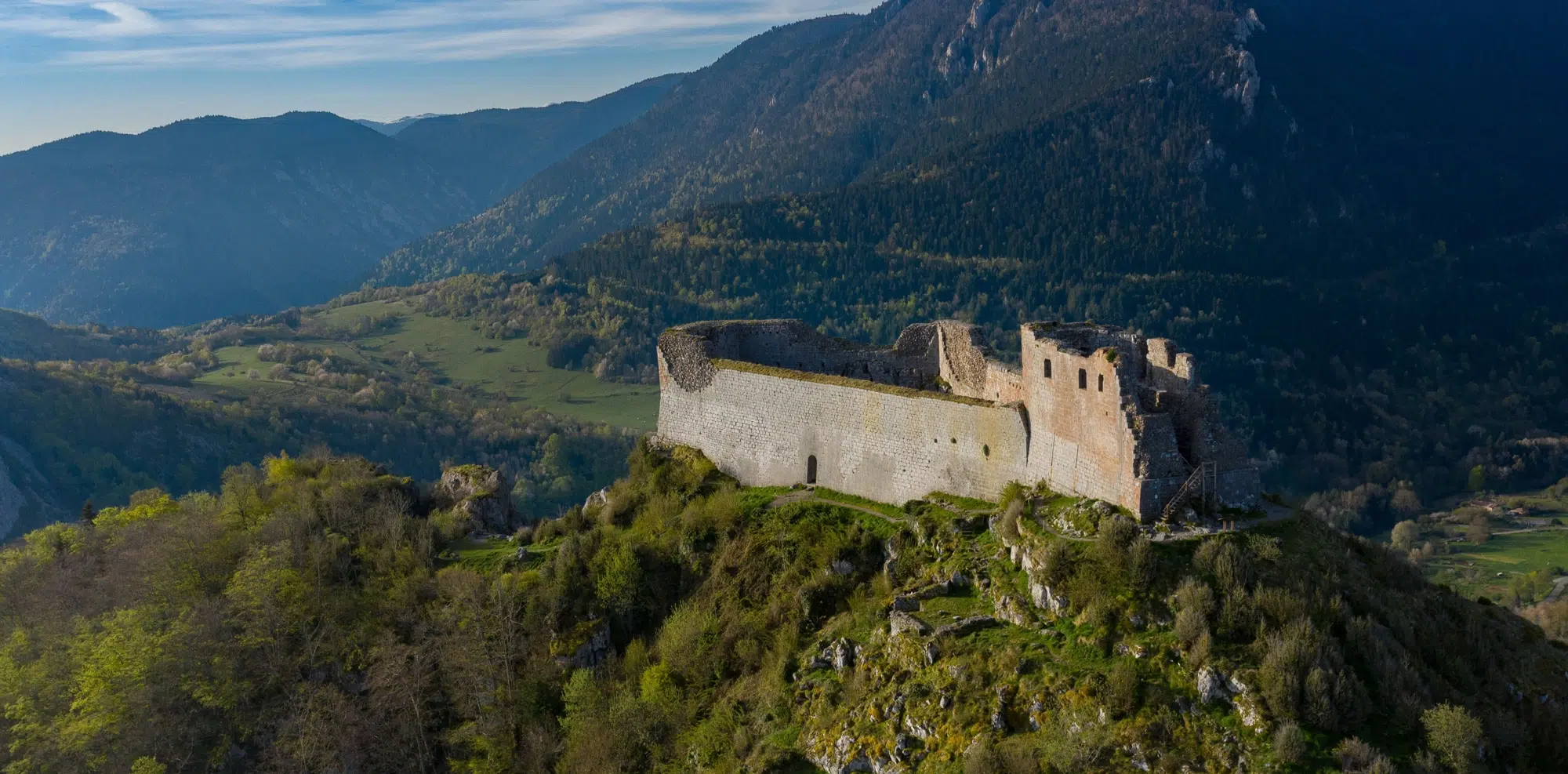
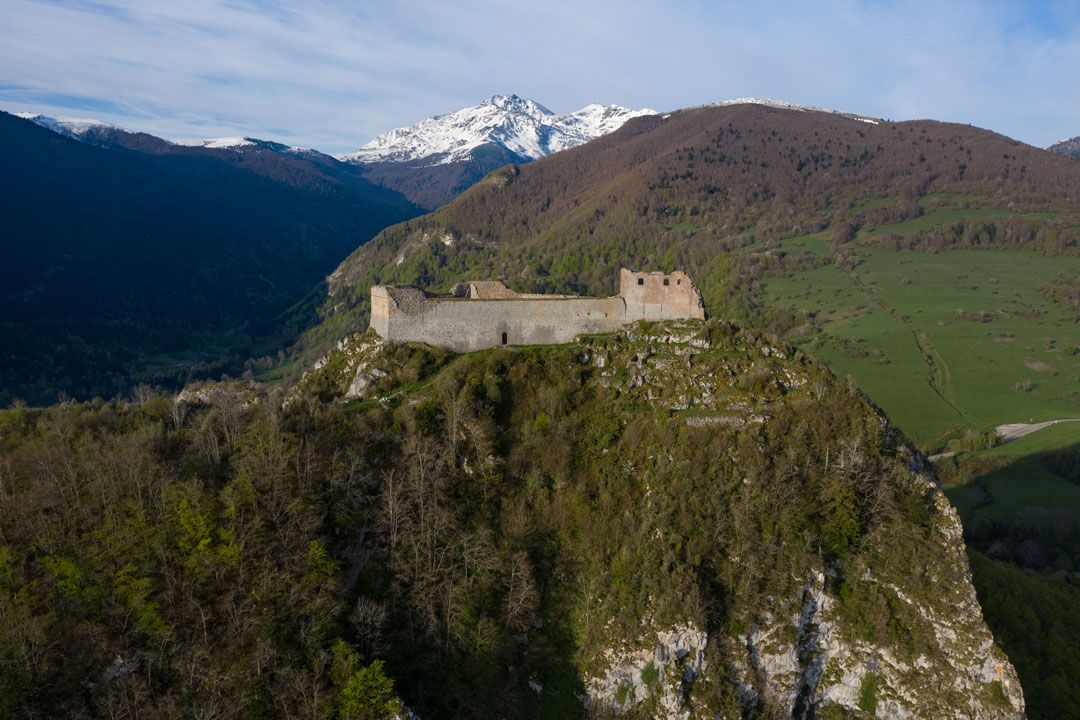
Located on the northern front of the Pyrenees, at an altitude of 1,207 m, atop a rocky peak (the ‘pog’), Montségur Castle stands as the highest of the royal fortresses in Languedoc. While the memory of the Cathars still lingers over the site, the current fortress bears witness to the new authority of the King of France over the territory, from the second half of the 13th century.
The castle is located in the commune of Montségur, in the Ariège department.
CURRENT LANDSCAPE SETTING

AT MONTSÉGUR CASTLE
Located on the eastern borders of the Ariège department, on the edge of the Aude, Montségur Castle stands at an altitude of 1,207 m in the heart of the Pays d’Olmes, on the northern Pyrenean front. This territory, characterized by its very mountainous features, is marked to the north by the Pyrenean foothills where the limestone ridges of the Plantaurel barely exceed 1,000 m in altitude, and, to the south, by the mass of the Tabe mountain, which culminates at 2,368 m, at the Pic de Soularac.
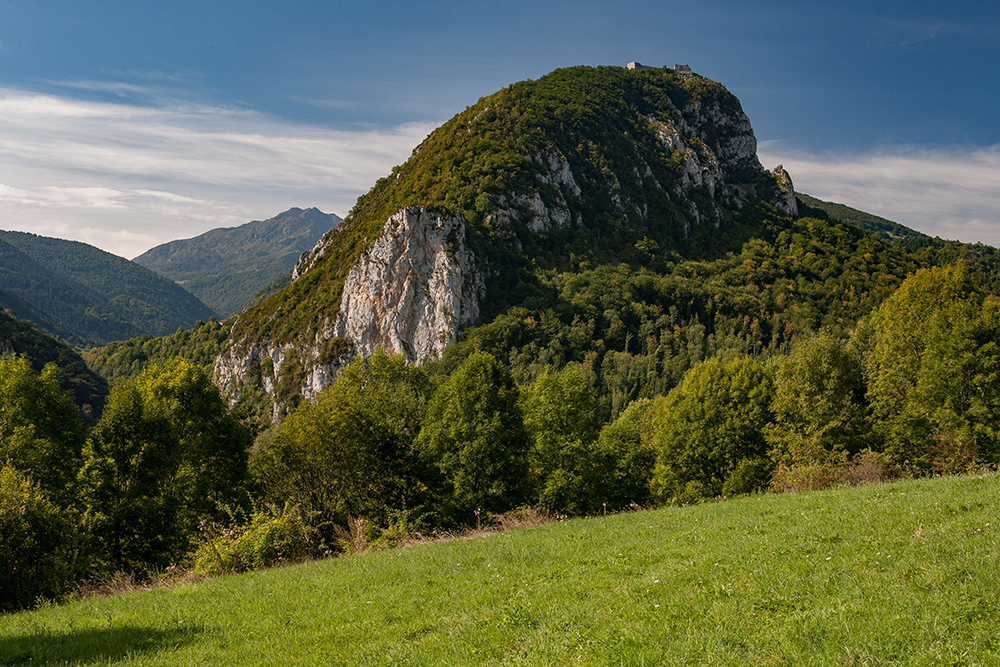
Montségur Castle itself is located atop a rocky ridge, on a particularly steep peak on the northern side. This is the famous ‘pog’ of Montségur. A name derived from the Latin ‘podium’, which refers to a small eminence, a hill, or a mountain. The entire ridge is composed of compact secondary limestones (here Urgo-Aptian), which everywhere generated fault reliefs, gorges, and cliffs. In this specific case, the site is also one of an overthrust along the great North Pyrenean fault. It raised limestone scales in contact with the ancient Tabe massif, with the Montségur scale being the most spectacular, overlooking the valley by more than 500 m.
A prime geographical location
The dominant position of the site offers an exceptional panorama to the north, towards the plain, with the Montagne Noire forming the horizon, nearly 70 km away. In the foreground, the successive ranges of the wooded sub-Pyrenean mountains emerge, followed by the Plantaurel and the towns of Lavelanet and Laroque-d’Olmes. The Aquitaine hills and the western Corbières are fully visible to the northeast, while the view extends northwest to the Ariège plain.
The climate is primarily oceanic and mountainous, but with Mediterranean influences. Indeed, the advanced position of the Tabe massif leads to strong contrasts and abundant rainfall (950 mm/year in Bélesta, 1,320 mm/year in Montségur). This situation is conducive to the development of forests, the most prominent vegetation in the Pays d’Olmes landscape. Forests cover nearly 60% of the area on the mountainous front, and up to 70% on the edge of the Pays de Sault, where fir is the dominant species.
A prime geographical location
The dominant position of the site offers an exceptional panorama to the north, towards the plain, with the Montagne Noire forming the horizon, nearly 70 km away. In the foreground, the successive ranges of the wooded sub-Pyrenean mountains emerge, followed by the Plantaurel and the towns of Lavelanet and Laroque-d’Olmes. The Aquitaine hills and the western Corbières are fully visible to the northeast, while the view extends northwest to the Ariège plain.
The climate is primarily oceanic and mountainous, but with Mediterranean influences. Indeed, the advanced position of the Tabe massif leads to strong contrasts and abundant rainfall (950 mm/year in Bélesta, 1,320 mm/year in Montségur). This situation is conducive to the development of forests, the most prominent vegetation in the Pays d’Olmes landscape. Forests cover nearly 60% of the area on the mountainous front, and up to 70% on the edge of the Pays de Sault, where fir is the dominant species.
HISTORY
The name and history of Montségur are inextricably linked to the Cathar tragedy. However, the fortress admired today, rebuilt by order of Louis IX from the mid-13th century, never knew these “good men” and “good women” who found refuge atop the ‘pog’ before royal troops seized it. At least three castles appear to have succeeded one another at Montségur throughout history. They are respectively named I, II, and III by archaeologists and historians.
“MONTSÉGUR I”, MYTH OR REALITY?
On April 30, 1244, Raymond de Péreille was interrogated by the Dominican inquisitor Ferrer. That day, he assured the inquisitor that about forty years prior, he had rebuilt the ‘castrum’ of Montségur, then “in ruins,” and had done so at the urgent request of Cathar Church dignitaries present in Mirepoix. In reality, this “Montségur I,” as archaeologists have come to call this stronghold predating the one that housed the Cathar high hierarchy for forty years, has left no written trace or archaeological remains.
If we assume that an initial Montségur (in ruins in 1204) topped the ‘pog’ before the end of the 12th century, it can only be imagined as a simple military outpost. By evoking the existence of an initial Montségur, perhaps Raymond de Péreille wished to minimize his role in the construction of this refuge for “heretics”?
“MONTSÉGUR II”, THE CATHARS’ SAFE MOUNT
The existence of a Cathar community on the ‘pog’ of Montségur is attested from the beginning of the Barons’ Crusade (1206). The ‘castrum’ of Montségur was located at the heart of lordships that had embraced Catharism. It welcomed the local nobility: the family of Raymond de Péreille, as well as the episcopal hierarchy of Toulouse and its deacon from Mirepoix. To escape persecution, Guilhabert de Castres, the Cathar bishop of Toulouse, settled there in 1209. He was accompanied by noble families from Lauragais. While the population of the ‘pog’ decreased somewhat from 1216, gradually reclaiming lands reconquered from the Crusaders, it increased again after the Treaty of Meaux-Paris (1229). The latter ended the royal crusade and heralded the beginning of the Inquisition.
Bishop Guilhabert de Castres then returned to Montségur in 1232, making it “the seat and head” of the Cathar Church. A large religious community of “perfects” (parfaits) and “perfect women” (parfaites) took refuge alongside him. They soon numbered over two hundred people. As for the lay population, it consisted mainly of the Mirepoix-Péreille seigneurial clan (with their family and household staff), and ‘faidits’ knights (lords dispossessed of their property by the Crusaders) with their relatives and men-at-arms. All these people now lived in safety, atop the “safe mount” (translation of the Occitan Montségur).
“MONTSÉGUR II”, THE CATHARS’ SAFE MOUNT
The existence of a Cathar community on the ‘pog’ of Montségur is attested from the beginning of the Barons’ Crusade (1206). The ‘castrum’ of Montségur was located at the heart of lordships that had embraced Catharism. It welcomed the local nobility: the family of Raymond de Péreille, as well as the episcopal hierarchy of Toulouse and its deacon from Mirepoix. To escape persecution, Guilhabert de Castres, the Cathar bishop of Toulouse, settled there in 1209. He was accompanied by noble families from Lauragais. While the population of the ‘pog’ decreased somewhat from 1216, gradually reclaiming lands reconquered from the Crusaders, it increased again after the Treaty of Meaux-Paris (1229). The latter ended the royal crusade and heralded the beginning of the Inquisition.
Bishop Guilhabert de Castres then returned to Montségur in 1232, making it “the seat and head” of the Cathar Church. A large religious community of “perfects” (parfaits) and “perfect women” (parfaites) took refuge alongside him. They soon numbered over two hundred people. As for the lay population, it consisted mainly of the Mirepoix-Péreille seigneurial clan (with their family and household staff), and ‘faidits’ knights (lords dispossessed of their property by the Crusaders) with their relatives and men-at-arms. All these people now lived in safety, atop the “safe mount” (translation of the Occitan Montségur).
THE SIEGE OF MONTSÉGUR
Neither the King of France nor the Pope could tolerate this heretical stronghold. It defied their authority and regularly sent “perfects” to spread their beliefs in the Toulouse, Lauragais, or Carcassès regions. In 1242, following the assassination of two inquisitors in Avignonet-Lauragais by knights and sergeants from Montségur, the Pope asked Louis IX (the future Saint Louis) “to put an end to this synagogue of Satan.”
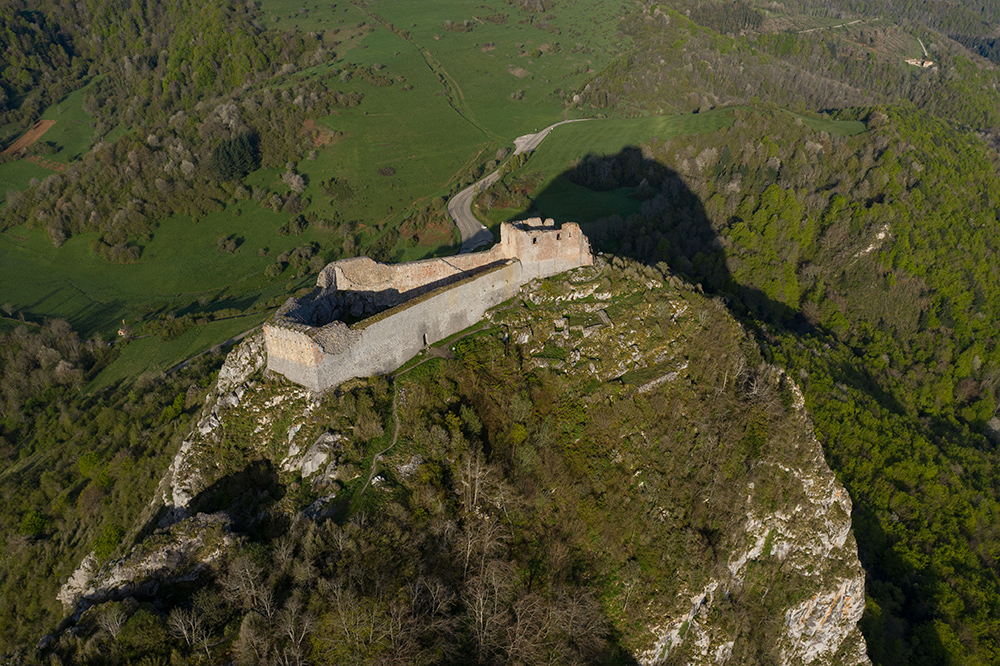
The king’s seneschal in Carcassonne immediately raised an army. The expedition was placed under the spiritual authority of the Archbishop of Narbonne. The siege began in the spring of 1243. The attack started on the southwest side. After several failures, the attackers discovered a weak point at the eastern end of the rocky ridge. Shortly before Christmas, after a perilous night climb, they managed to seize the watch post of Roc de la Tour. Catapults, trebuchets, and other weapons of war were then transported, in dismantled pieces.
For two months, meter by meter, the Crusaders managed to gain the immediate vicinity of the ‘castrum’. The assault was launched at the end of February. It was repelled. Pierre-Roger de Mirepoix, aware that if another attack succeeded, a general massacre would ensue, negotiated the surrender of the stronghold. The lay people would be spared, as would the “perfects” and “perfect women” who would abjure. A 15-day truce, starting from March 1, was granted to the defenders before the surrender. On March 16, after ten months of siege, Montségur was handed over to the seneschal, while an immense pyre was erected at the foot of the mountain for the Cathars who refused to abjure. Chronicles state that they numbered 225. Documentary sources have allowed 68 of them to be precisely identified.
“MONTSÉGUR III”, THE LÉVIS FORTRESS
After the fall of Montségur, the “heretical” village was undoubtedly deliberately razed by the Crusaders, as dictated by canon and civil law. In July 1245, the stronghold was handed over to its new lord, Guy II de Lévis, who paid homage to the King of France and was entrusted with the construction of a fortress. Unlike the other castles in the series, its construction was therefore not directed directly from the seneschalty of Carcassonne. But the objective remained the same: to symbolize the king’s control over the territory and guarantee its defense against the Crown of Aragon. To this end, Guy II de Lévis’s master builders undertook a vast construction project on the ruins of the old ‘castrum’, using the same architectural techniques as those of the other royal mountain fortresses, probably in the last third of the 13th century.
Over the next two centuries, the Lévis family maintained a garrison in this military stronghold, strategically well-placed on the line of fortresses that, via Roquefixade, Puivert, and Quillan, ran from Foix to the Corbières and thence to the sea. According to a document from January 15, 1476, Jean IV de Lévis was required, by order of the king, to maintain a garrison there and ensure its repairs, along with six other strongholds in the country. In 1496, the castle was still described as “defensible.” Probably abandoned from the 16th century, the site lost its strategic interest with the signing of the Treaty of the Pyrenees in 1659.
“MONTSÉGUR III”, THE LÉVIS FORTRESS
After the fall of Montségur, the “heretical” village was undoubtedly deliberately razed by the Crusaders, as dictated by canon and civil law. In July 1245, the stronghold was handed over to its new lord, Guy II de Lévis, who paid homage to the King of France and was entrusted with the construction of a fortress. Unlike the other castles in the series, its construction was therefore not directed directly from the seneschalty of Carcassonne. But the objective remained the same: to symbolize the king’s control over the territory and guarantee its defense against the Crown of Aragon. To this end, Guy II de Lévis’s master builders undertook a vast construction project on the ruins of the old ‘castrum’, using the same architectural techniques as those of the other royal mountain fortresses, probably in the last third of the 13th century.
Over the next two centuries, the Lévis family maintained a garrison in this military stronghold, strategically well-placed on the line of fortresses that, via Roquefixade, Puivert, and Quillan, ran from Foix to the Corbières and thence to the sea. According to a document from January 15, 1476, Jean IV de Lévis was required, by order of the king, to maintain a garrison there and ensure its repairs, along with six other strongholds in the country. In 1496, the castle was still described as “defensible.” Probably abandoned from the 16th century, the site lost its strategic interest with the signing of the Treaty of the Pyrenees in 1659.
SITE DESCRIPTION
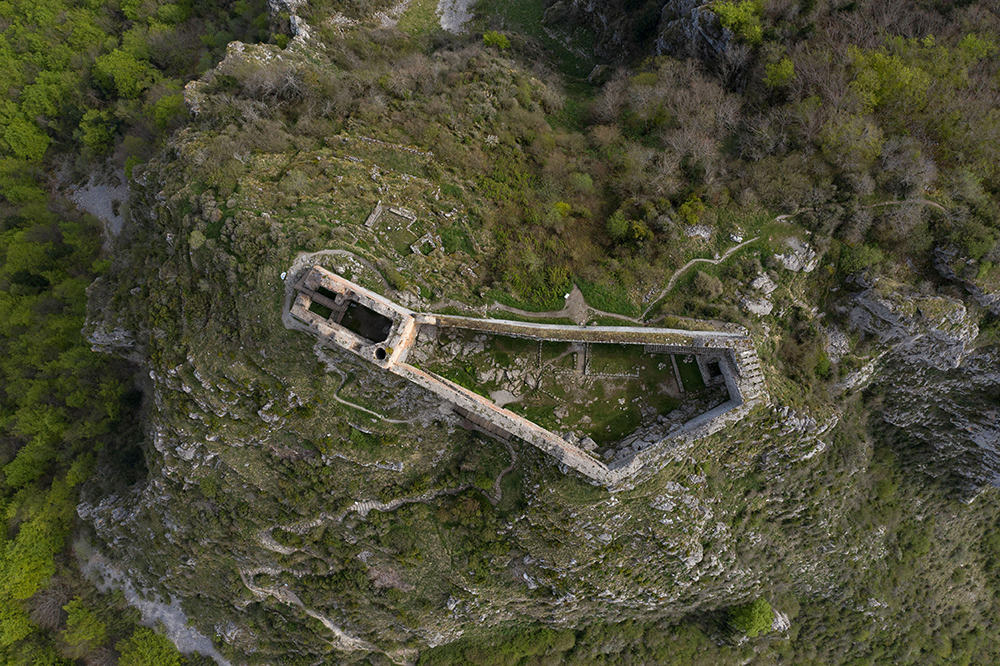
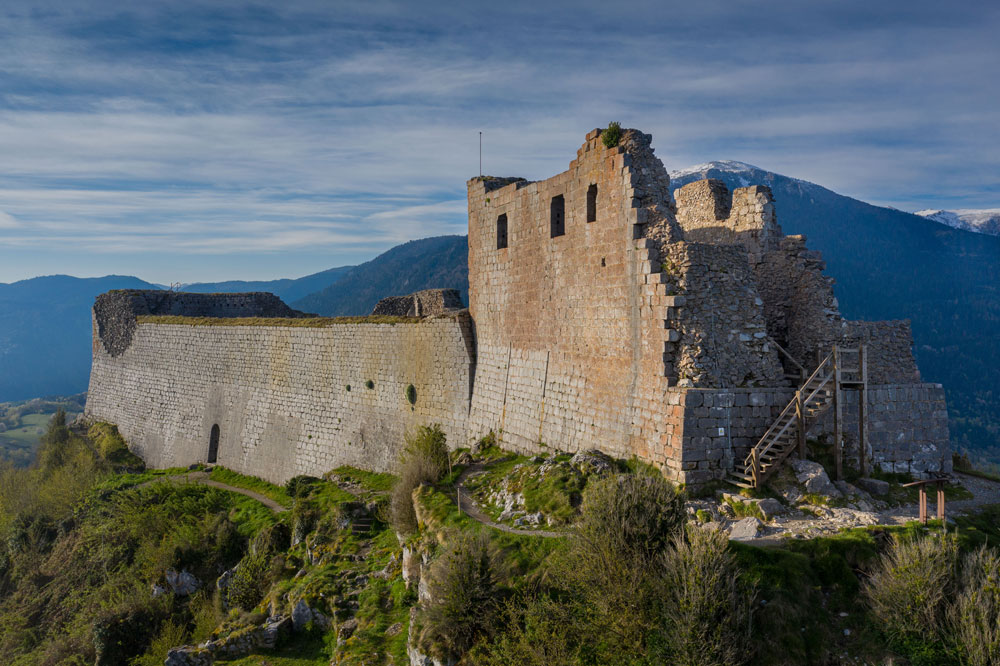
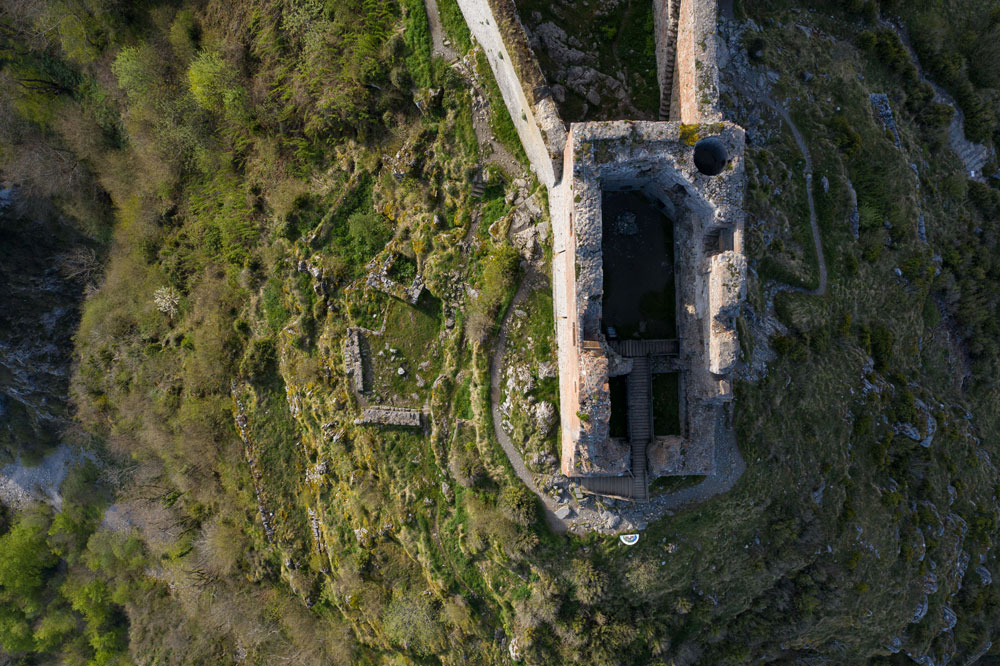
Montségur Castle was built between the second half of the 13th century and the beginning of the 14th century. It replaced the old Cathar ‘castrum’. The royal fortress of Montségur consists of a vast courtyard and a keep serving as living quarters. It is accessed via its southwest face, after an approximately 30-minute walk uphill.
THE COURTYARD
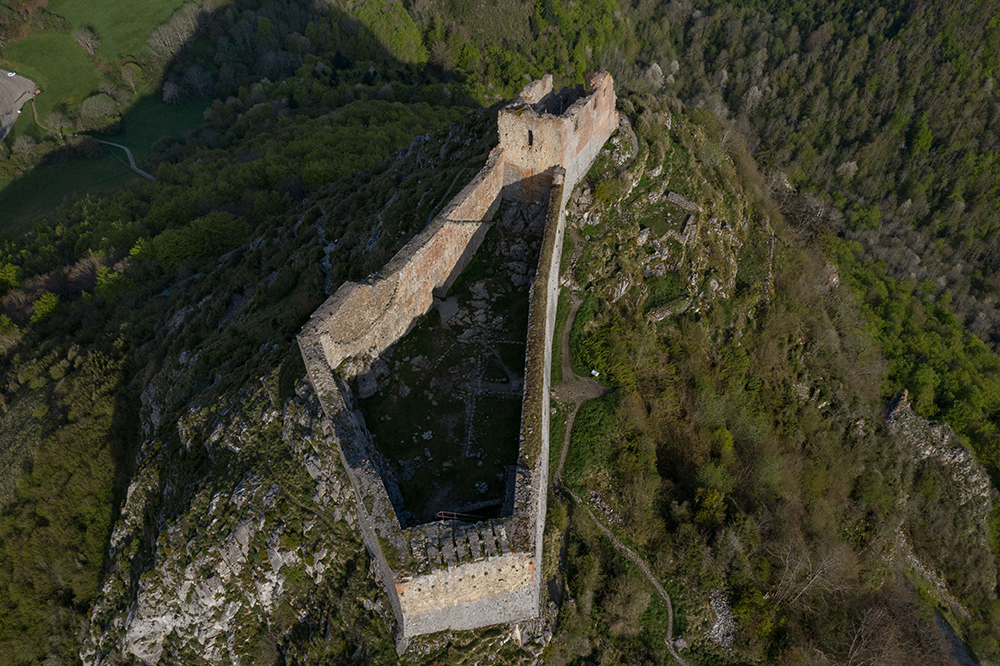
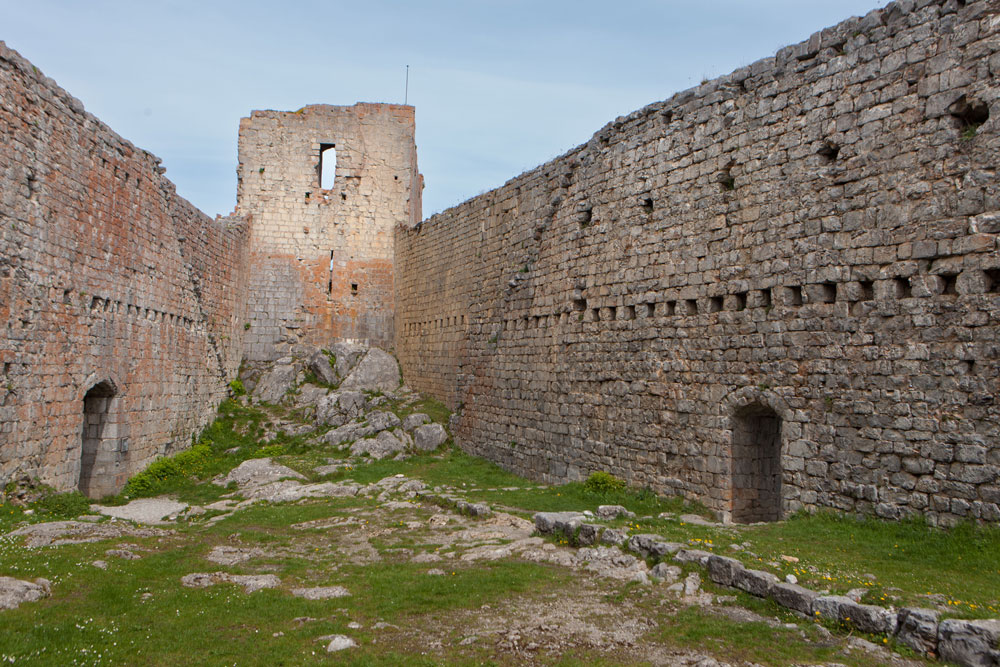
The castle courtyard, whose layout closely follows the contour of the rocky summit, is surrounded by walls approximately 2.50 m thick and up to 15 m high in places. Pierced into the southwest flank, the restored entrance gate reveals the remains of a ‘bretèche’, a small defensive overhang structure.
The interior of the courtyard is now devoid of any buildings. Only a few wall bases on the ground and the putlog holes, where the beams supporting the upper floors were embedded, allow one to imagine the original layout. Three straight-flight staircases, built into the thickness of the walls, provided access to the partially preserved wall-walk.
The eastern front is characterized by a “shield wall” (mur-bouclier) 4 m thick and formerly crowned with hoardings. This defense was particularly elaborate.
It shows that the builders of the new royal fortress had learned the lesson from the siege of 1244. There was no question of being caught by surprise by an attack from the east!
THE KEEP
Located northwest of the site, the keep-residence (logis-donjon) undoubtedly originally had at least one additional floor and was only accessible via the first floor. The high door visible today on the courtyard side was likely connected to the wall-walk by a wooden structure that could be easily retracted in case of attack. Access is now gained from the outside by walking around the wall.
On the lower level, rectangular in plan, a cistern and a room defended by five arrow slits remain. A spiral staircase, built into the southwest corner, led to the first floor. Formerly vaulted with ogival ribs, this large room is lit by four windows with window seats. It features traces of a fireplace in the height of the south wall.
THE KEEP
Located northwest of the site, the keep-residence (logis-donjon) undoubtedly originally had at least one additional floor and was only accessible via the first floor. The high door visible today on the courtyard side was likely connected to the wall-walk by a wooden structure that could be easily retracted in case of attack. Access is now gained from the outside by walking around the wall.
On the lower level, rectangular in plan, a cistern and a room defended by five arrow slits remain. A spiral staircase, built into the southwest corner, led to the first floor. Formerly vaulted with ogival ribs, this large room is lit by four windows with window seats. It features traces of a fireplace in the height of the south wall.
THE REMAINS OF THE ANCIENT CATHAR CASTRUM
The castle that once dominated the Cathar ‘castrum’ has entirely disappeared. It was replaced by the fortress we have just mentioned. Excavations, conducted from 1968 to 1990, uncovered remains of dwellings on the northern and western flanks of the site.
Further east, along the rocky ridge, appear the traces of the old barbican and the watch post of Roc de la Tour. It was at the foot of the barbican that the most violent battles of the 1244 siege took place. As evidenced by the discovery of numerous stone cannonballs and crossbow bolts, as well as two skeletons pierced by arrowheads found in the ‘aven du Trébuchet’. They are now exhibited at the Montségur Museum, among numerous remains and objects testifying to the battles and the way of life of the ‘castrum’ inhabitants.
The fortress in pictures