 Accueil > Discover > Fortresses >
 Peyrepertuse
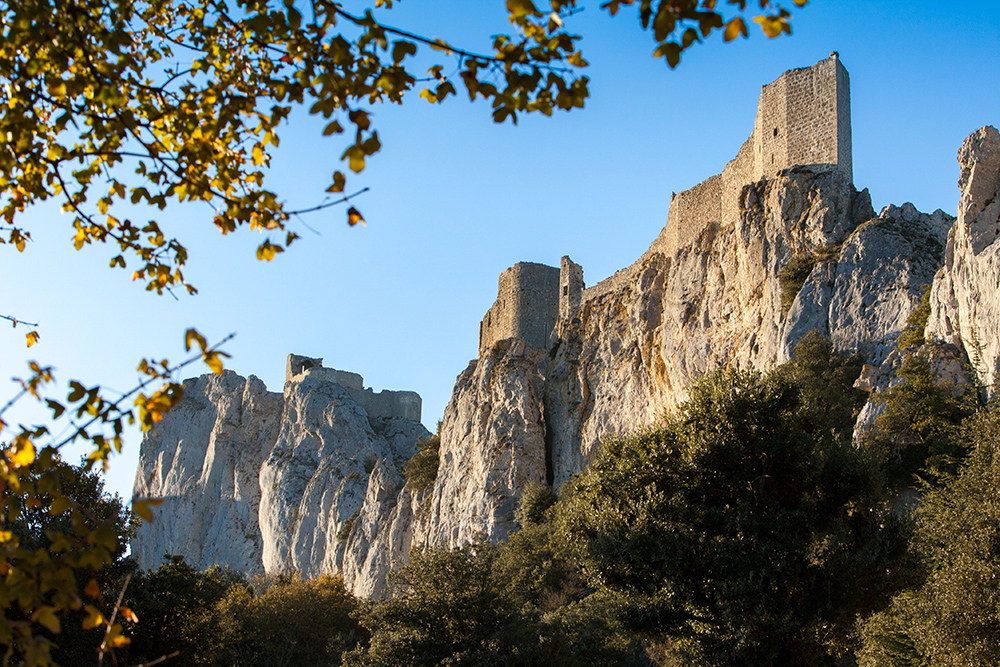
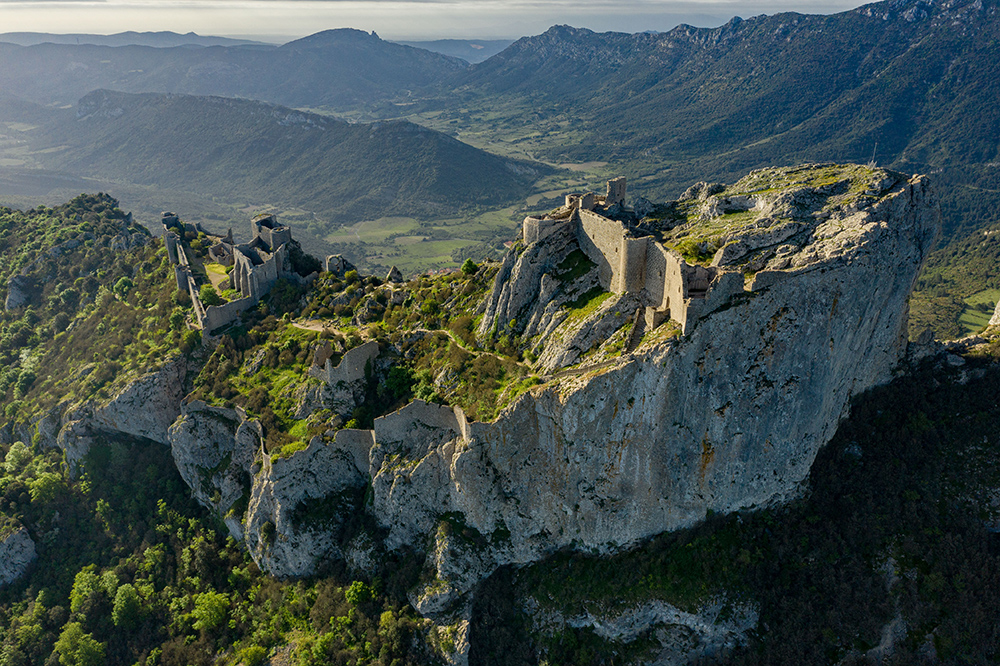
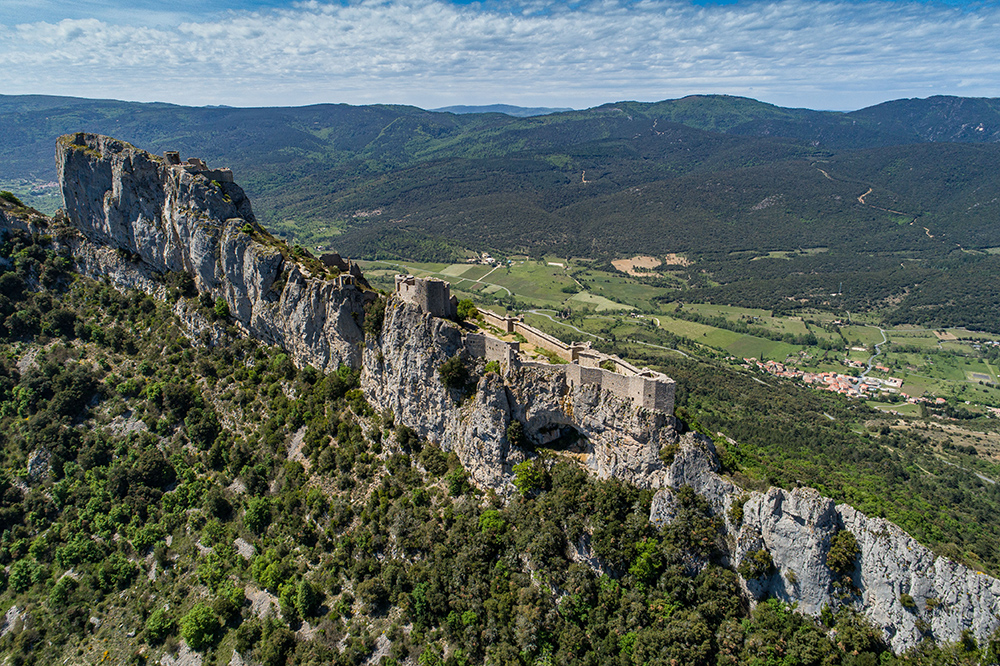
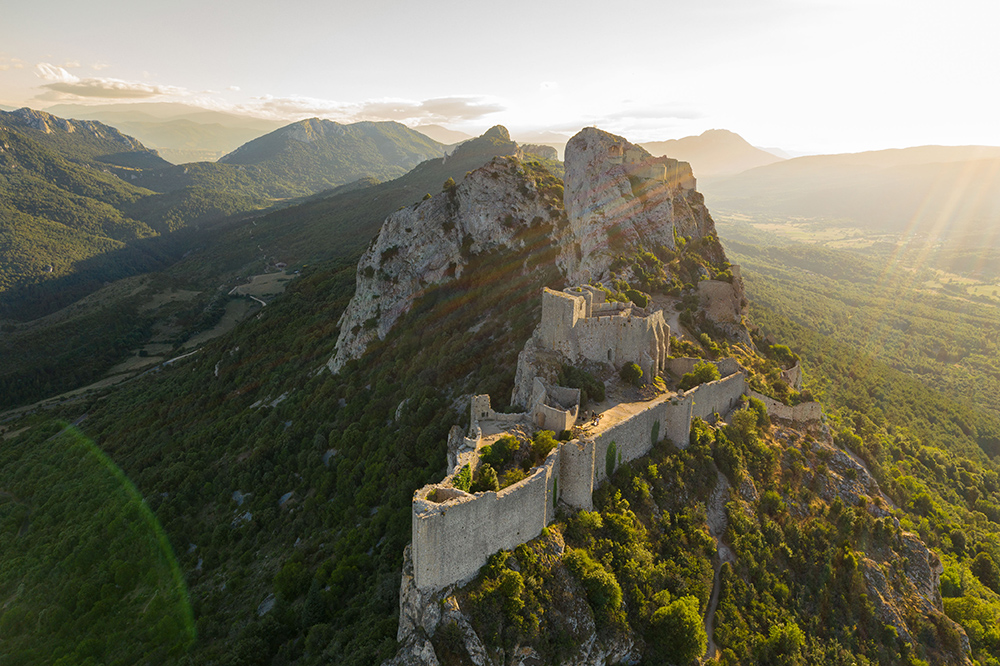
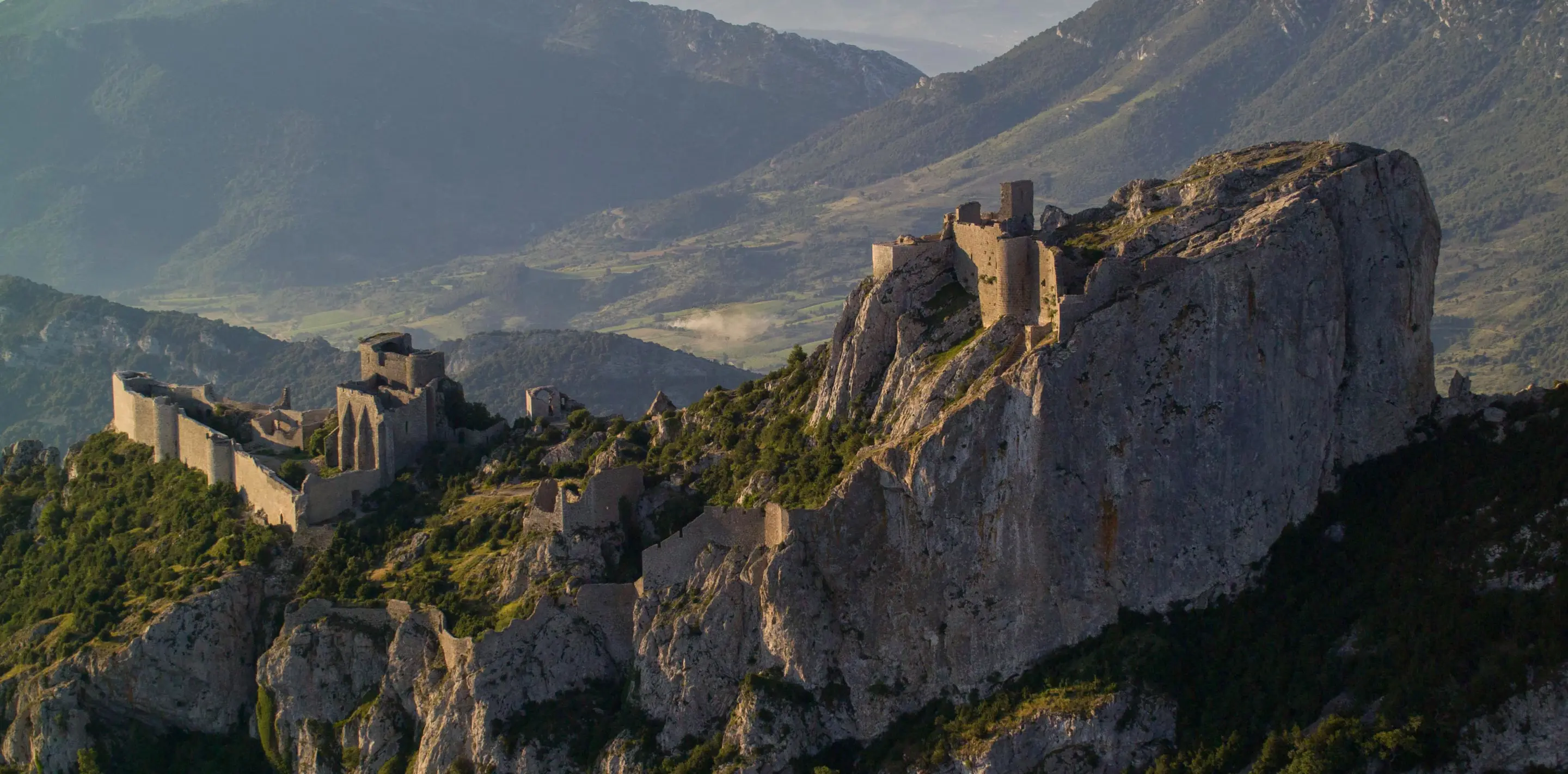
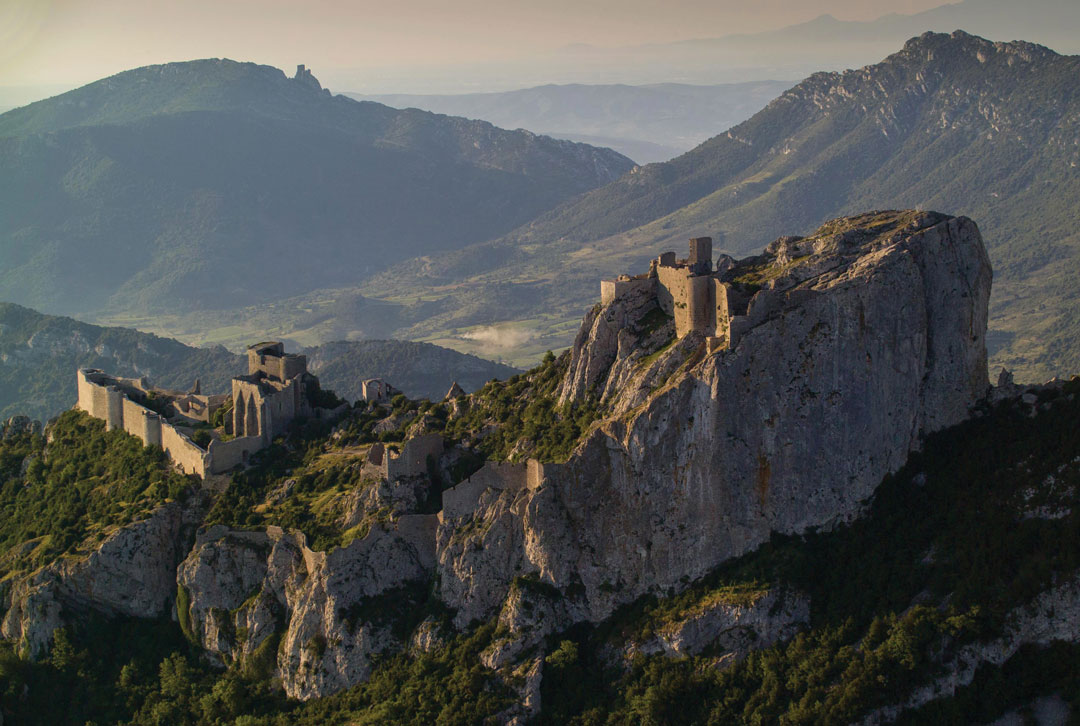
This is undoubtedly the most spectacular and eloquent of the royal fortresses of Languedoc! A majestic stone vessel perched at nearly 800 m altitude, following the contours of a long limestone ridge, dominating the landscape for miles around and extending to the Mediterranean Sea, Peyrepertuse Castle stands as one of the essential links in the defense network initiated in the 13th century to assert the power of the Kingdom of France. The site is located in the municipality of Duilhac-sous-Peyrepertuse.
CURRENT LANDSCAPE SETTING

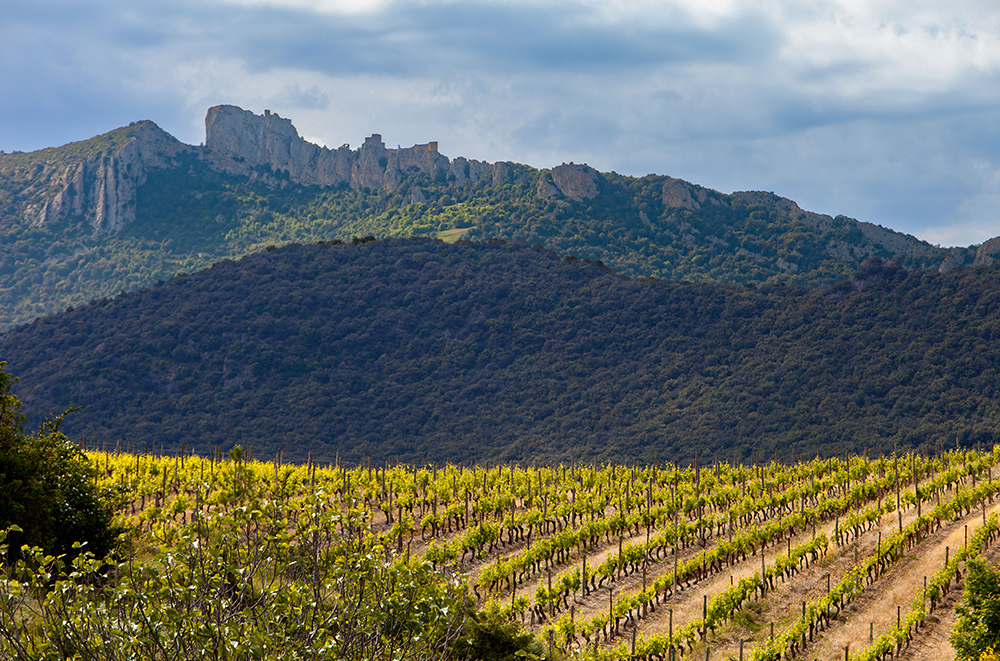
Located in the south of the Aude department, in the immediate vicinity of Roussillon, the fortified complex of Peyrepertuse stands in the extreme south of the southern Corbières, between the Hautes-Corbières to the north and the Fenouillèdes to the south. An essential link in the defense network against Aragon, it monitored access to Languedoc via the coastal plain and thus allowed control of the border area at the Col de Brézou. Like its counterpart Quéribus, Peyrepertuse is situated within a territory characterized by the diversity of its landscapes, including limestone rock barriers, wine valleys, pastures, garrigue, and Mediterranean forests.
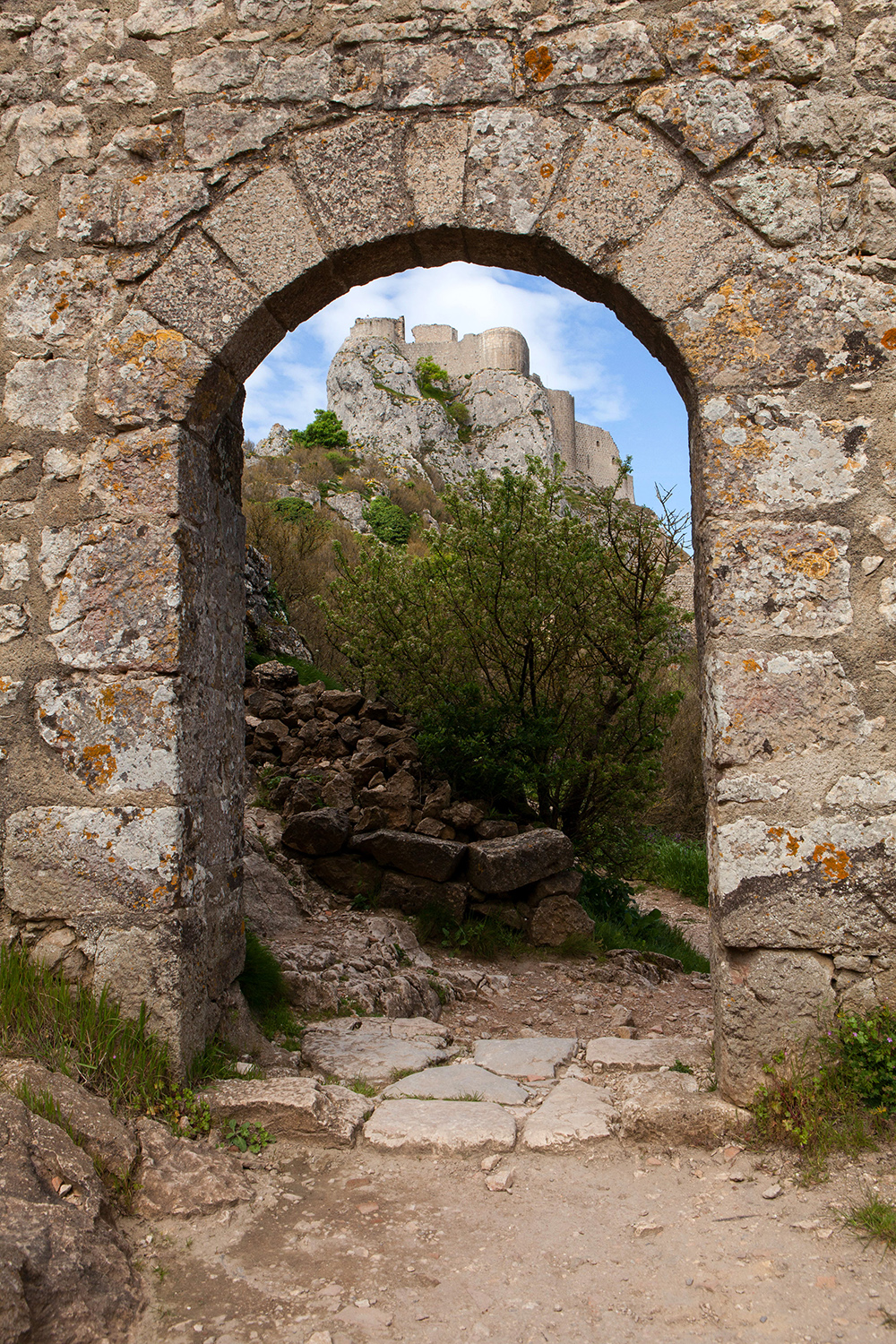
The surrounding plains are watered primarily by the Verdouble and a few intermittent streams. The site is located in a region of geological folds and thrusts that have, over time, produced spectacular forms and reliefs, sometimes punctuated by cavities, and are undoubtedly at the origin of the name Peyrepertuse, which means “pierced stone”.
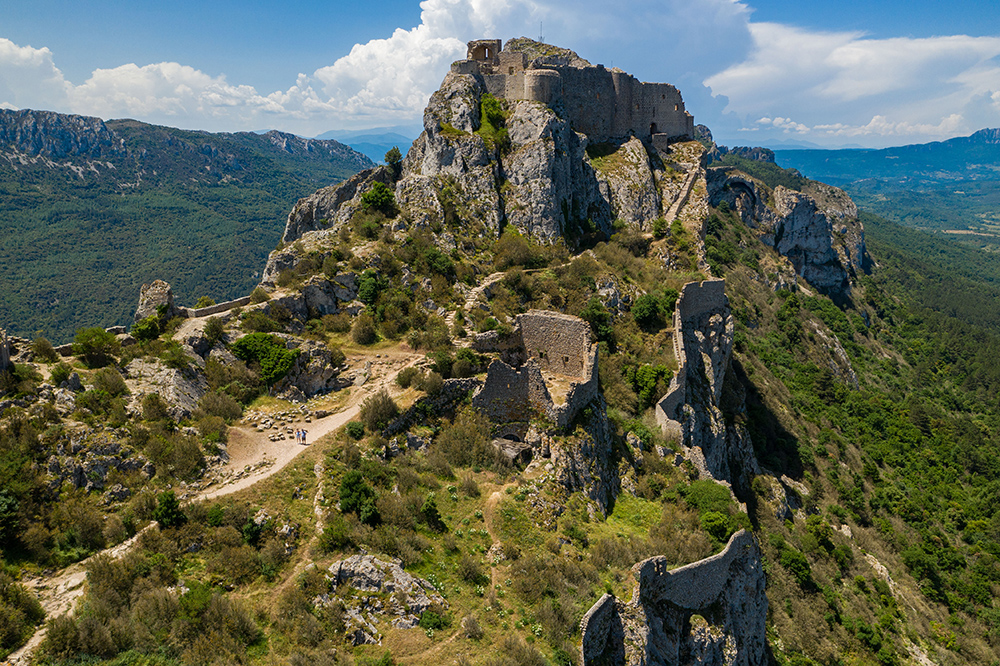
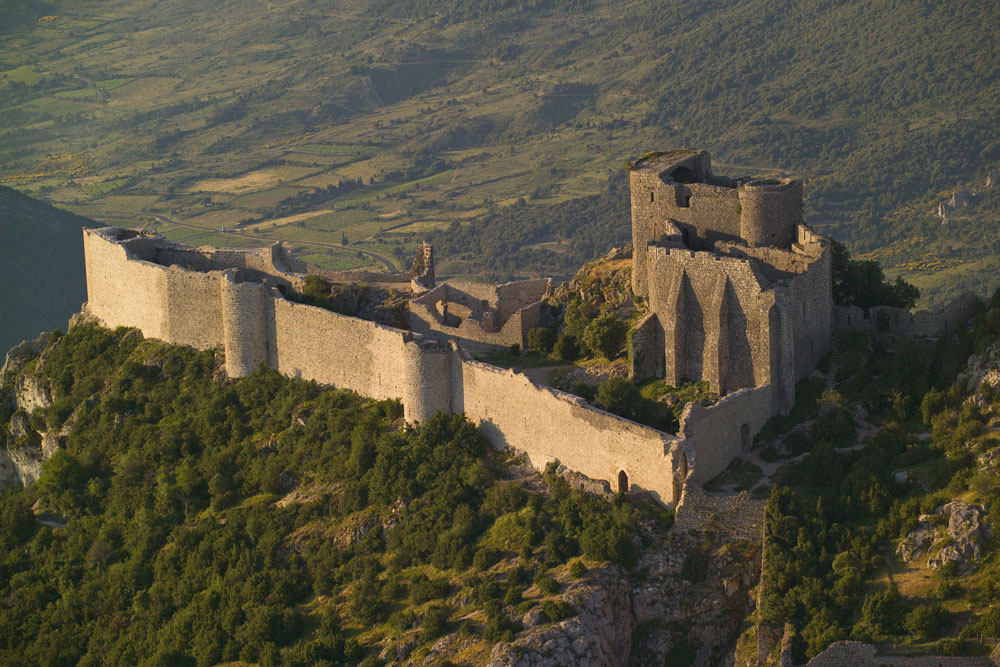
Of remarkable size (300 m long by 50 m wide), the fortress stretches along a limestone ridge that rises between 600 m altitude to the east and up to 850 m at its highest point to the west. Overlooking cliffs of 30 to 40 m, it dominates the villages of Duilhac-sous-Peyrepertuse to the southeast and Rouffiac-des-Corbières to the northeast, offering a panoramic view of the magnificent Corbières landscapes. A 360° panorama that extends beyond to the Fenouillèdes, the Roussillon plain, and the Mediterranean.
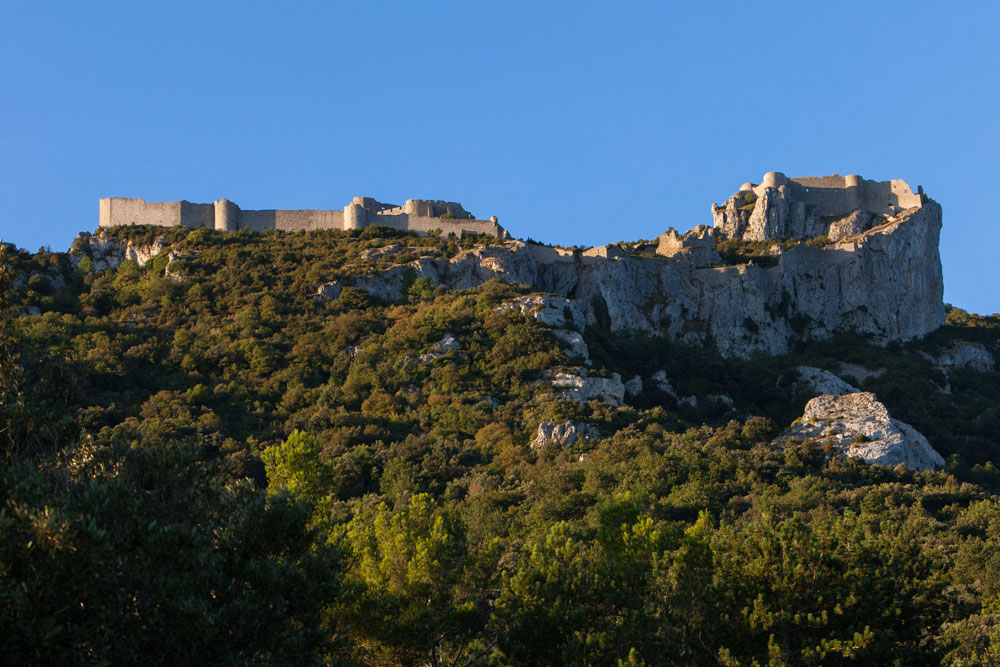
While Peyrepertuse Castle is exceptional in its size and shape, spread along its spur, its most remarkable visual aspect comes from its integration into the rock. Its form literally embraces the base on which it rests, making the castle a natural extension of the ridge it crowns. As the castle merges with the rock, only its silhouette distinguishes it from distant viewpoints.
HISTORY
Dominating the landscape all the way to the Mediterranean Sea, the dizzying ridge of Peyrepertuse has seen many contenders come and go. But it is to King Louis IX of France that we owe this gigantic stone vessel today, undoubtedly the most impressive of the Corbières fortresses.
THE ORIGINS
While traces of human presence have been found in the surrounding plains and reliefs since the Neolithic period, the occupation of the Peyrepertuse site is only attested from the Gallo-Roman period (1st century BCE – 1st century CE) with the discovery, below the summit plateau, of amphora fragments and basalt millstones.
One must wait until 842 for the mention of a pagus Petrepertuse to appear in texts. This appellation suggests that Peyrepertuse then played an administrative and military role in the surrounding territory, without its exact nature and importance being fully ascertainable. The first evidence of a defensive complex on the cliff dates back to October 13, 1020, the date of the signing of the will of Bernard Taillefer, Count of Besalù. Peyrepertuse Castle (castello dicunt Perapertusa) is mentioned there among the numerous possessions he bequeathed to his son, alongside Quéribus Castle and the pech d’Aguilar.
THE ORIGINS
While traces of human presence have been found in the surrounding plains and reliefs since the Neolithic period, the occupation of the Peyrepertuse site is only attested from the Gallo-Roman period (1st century BCE – 1st century CE) with the discovery, below the summit plateau, of amphora fragments and basalt millstones.
One must wait until 842 for the mention of a pagus Petrepertuse to appear in texts. This appellation suggests that Peyrepertuse then played an administrative and military role in the surrounding territory, without its exact nature and importance being fully ascertainable. The first evidence of a defensive complex on the cliff dates back to October 13, 1020, the date of the signing of the will of Bernard Taillefer, Count of Besalù. Peyrepertuse Castle (castello dicunt Perapertusa) is mentioned there among the numerous possessions he bequeathed to his son, alongside Quéribus Castle and the pech d’Aguilar.
A TERRITORY UNDER INFLUENCE
The history of Peyrepertuse is thus part of a turbulent political context, marked by multiple alliances and the complexity of the feudal system. Having come under the tutelage of the Viscount of Narbonne and then within the orbit of the County of Barcelona, the castle was administered by a powerful lineage of lords that emerged at the very beginning of the 11th century. In the early 12th century, the site formed a true castrum, comprising a defensive work, a church, and a community of villagers. During the Barons’ Crusade, following the capture of Montgaillard Castle, not far from Tuchan, Guillaume de Peyrepertuse submitted to Simon de Montfort, leader of the crusaders.
In 1226, after the royal crusade, King Louis VIII granted the viscounty of Fenouillèdes and Peyrepertuse as a fief to Nunyo Sanche, Count of Roussillon. The latter sold Peyrepertuse Castle to the King of France, Louis IX (Saint Louis), in 1239 for the sum of 20,000 Melgorian sous. While the King of France thus secured (first by vassal oath then by purchase) his domination over the Peyrepertusès, he did not thereby gain the loyalty of the local lord. Indeed, Guillaume de Peyrepertuse revolted twice against the king (in 1229 and then in 1240) and, defeated both times, had to submit.
CONSTRUCTION NOTICE
To assert his power over this particularly unstable territory, coveted notably by the Crown of Aragon, Louis IX undertook a gigantic campaign of renovation and expansion of the fortress. This construction project was announced as early as 1242, with the king’s order to the seneschal of Carcassonne “to build a staircase with the greatest possible convenience and at the lowest price” to reach the upper rock of Sant-Jordi. While the restructuring of the lower enclosure and the “old keep” probably occurred before the construction of the upper Sant-Jordi castle, in order to quickly provide a secure defensive block in case of attack, one thing is certain: the construction was in full swing in 1250-1251. This is evidenced by an account book preserved in the Departmental Archives of Gard, which lists all expenses incurred in one year, particularly for the hiring of labor.
In total, some 150 to 200 people worked in shifts on the site, including a master builder, stonecutters, masons, carpenters, plasterers, blacksmiths, muleteers, etc. Often highly skilled labor, sometimes coming from across France. The account book also mentions expenses related to the import of materials (wood, metals, tiles, plaster, etc.). The stone itself was extracted on-site, as evidenced by traces of quarries on the site, particularly visible on the Sant-Jordi rock.
CONSTRUCTION NOTICE
To assert his power over this particularly unstable territory, coveted notably by the Crown of Aragon, Louis IX undertook a gigantic campaign of renovation and expansion of the fortress. This construction project was announced as early as 1242, with the king’s order to the seneschal of Carcassonne “to build a staircase with the greatest possible convenience and at the lowest price” to reach the upper rock of Sant-Jordi. While the restructuring of the lower enclosure and the “old keep” probably occurred before the construction of the upper Sant-Jordi castle, in order to quickly provide a secure defensive block in case of attack, one thing is certain: the construction was in full swing in 1250-1251. This is evidenced by an account book preserved in the Departmental Archives of Gard, which lists all expenses incurred in one year, particularly for the hiring of labor.
In total, some 150 to 200 people worked in shifts on the site, including a master builder, stonecutters, masons, carpenters, plasterers, blacksmiths, muleteers, etc. Often highly skilled labor, sometimes coming from across France. The account book also mentions expenses related to the import of materials (wood, metals, tiles, plaster, etc.). The stone itself was extracted on-site, as evidenced by traces of quarries on the site, particularly visible on the Sant-Jordi rock.
SONS OF CARCASSONNE
Thus fortified and commanded from the seneschalsy of Carcassonne, Peyrepertuse joined in 1258 the network of royal mountain fortresses tasked with protecting the new border with the Kingdom of Aragon, established south of the Corbières by the Treaty of Corbeil. Along with Aguilar, Puilaurens, Quéribus, and Termes, the royal fortress of Peyrepertuse now ranks among the “five sons of Carcassonne”. In the years 1258-1260, the garrison consisted of a castellan, nine sergeants-at-arms, and a chaplain. In 1302, the numbers increased significantly: in addition to the castellan and the chaplain, documents list 21 sergeants, a gatekeeper, a watchman, and even dogs—large mastiffs trained for surveillance and likely released at night to raise the alarm in case of foreign incursion.
A SHIP IN CALM WATERS
Having become one of the most powerful links in the royal defensive system, the imposing stone vessel of Peyrepertuse was nevertheless never besieged. In 1528, its garrison was, however, increased by about thirty men in anticipation of border troubles, without consequence. Peyrepertuse lost its importance from the second half of the 16th century, and its maintenance suffered. In 1597, the Estates of Languedoc requested “the king to repair the castles of Quéribus, Peyrepertuse, Puilaurens, and Termes located on the Spanish border, which were falling into ruin”.
In a state of semi-abandonment, the site appears to have had no military role during Louis XIII’s conquest of Roussillon. With the Treaty of the Pyrenees signed in 1659 and the relocation of the border to the south of Roussillon, Peyrepertuse Castle lost all interest for the King of France. Peyrepertuse regained importance only very temporarily in 1793, when Spanish troops threatened the revolutionary armies. On April 24, 1793, the assembly of the Lagrasse district declared that “in the district of Lagrasse, there are three fortresses: Quéribus, Pierrepertuse, and Viala (Aguilar) […] and that it would be very essential to put them in a state of defense to prevent the Spanish from penetrating the Lagrasse district”.
For this, engineer Champagne was to go on a mission to Perpignan, but the Battle of Peyrestortes in September 1793 averted all danger, and the project was abandoned. Nationalized during the Revolution, Peyrepertuse Castle was purchased in 1820 by Joseph Séguy and Jean-Paul Burjade, residents of Duilhac, and remained abandoned until its acquisition by the municipality of Duilhac at the end of the 19th century.
A SHIP IN CALM WATERS
Having become one of the most powerful links in the royal defensive system, the imposing stone vessel of Peyrepertuse was nevertheless never besieged. In 1528, its garrison was, however, increased by about thirty men in anticipation of border troubles, without consequence. Peyrepertuse lost its importance from the second half of the 16th century, and its maintenance suffered. In 1597, the Estates of Languedoc requested “the king to repair the castles of Quéribus, Peyrepertuse, Puilaurens, and Termes located on the Spanish border, which were falling into ruin”.
In a state of semi-abandonment, the site appears to have had no military role during Louis XIII’s conquest of Roussillon. With the Treaty of the Pyrenees signed in 1659 and the relocation of the border to the south of Roussillon, Peyrepertuse Castle lost all interest for the King of France. Peyrepertuse regained importance only very temporarily in 1793, when Spanish troops threatened the revolutionary armies. On April 24, 1793, the assembly of the Lagrasse district declared that “in the district of Lagrasse, there are three fortresses: Quéribus, Pierrepertuse, and Viala (Aguilar) […] and that it would be very essential to put them in a state of defense to prevent the Spanish from penetrating the Lagrasse district”.
For this, engineer Champagne was to go on a mission to Perpignan, but the Battle of Peyrestortes in September 1793 averted all danger, and the project was abandoned. Nationalized during the Revolution, Peyrepertuse Castle was purchased in 1820 by Joseph Séguy and Jean-Paul Burjade, residents of Duilhac, and remained abandoned until its acquisition by the municipality of Duilhac at the end of the 19th century.
SITE DESCRIPTION
As it appears today, Peyrepertuse Castle essentially dates from the reconstruction work begun under Louis IX in the 13th century and bears witness to the adaptation of Capetian military architecture concepts to the terrain. The lower enclosure, however, retains several elements of the primitive castle, such as the Sainte-Marie church and the dwelling, which today form what is known as the “old keep”. Some alterations that occurred during the 15th-17th centuries have also been identified.
THE LOWER ENCLOSURE AND THE “OLD KEEP”
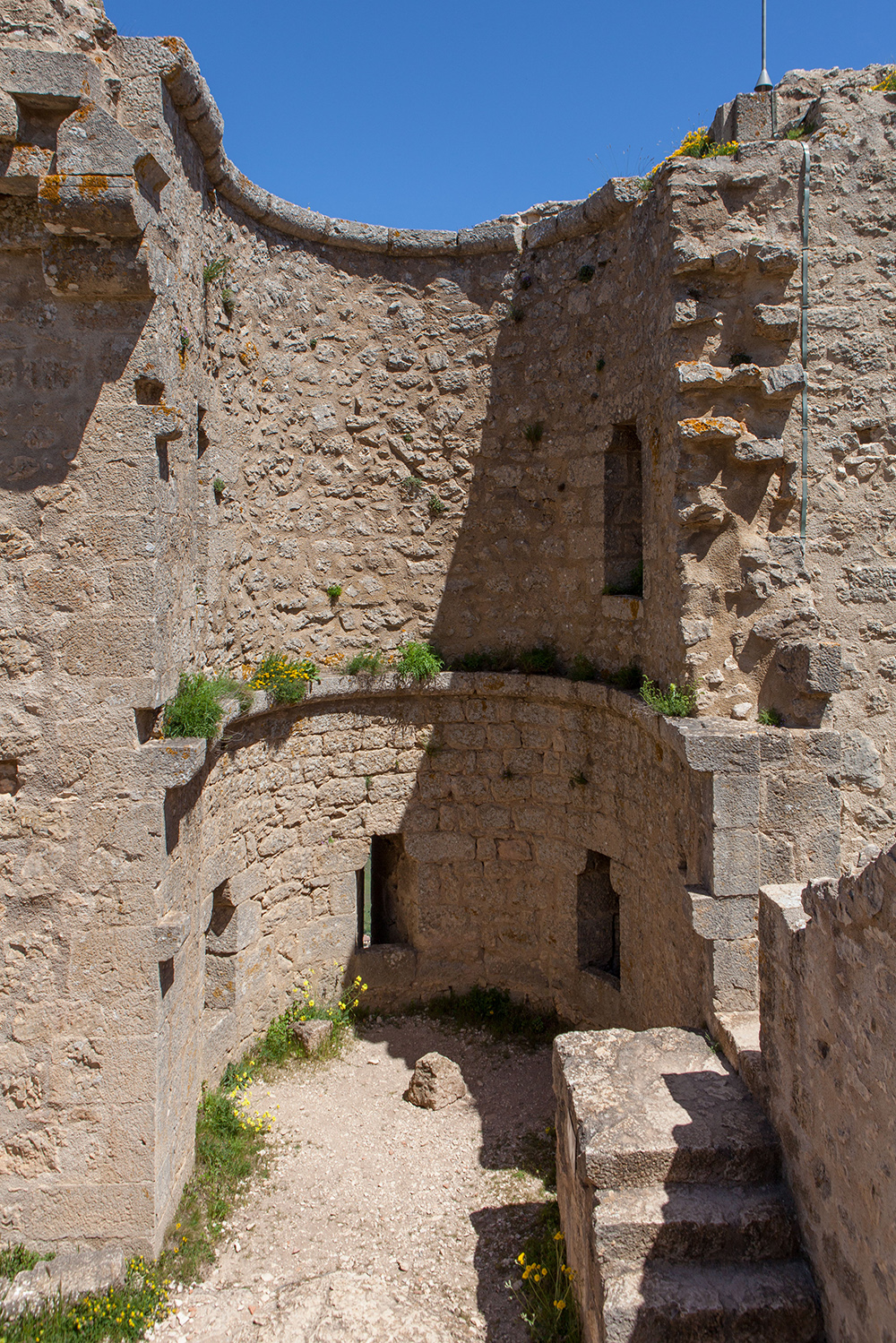
Located in the western part of the inner enclosure, it is surrounded by a quadrangular wall nearly 3 m thick; it is flanked by semi-circular towers, which protect two inner courtyards, two dwellings, two main towers, and a chapel that has since disappeared. The interior buildings, readapted to the new defensive design, are accessible via a twin-towered entrance châtelet, preceded by a barbican and a moat. Completely redeveloped, the former viscountal palace became a true fortress in itself in the 13th century, with its high walls crowned with hoardings, partially restored during the 19th-century renovations. These wooden balconies housed the defenders and allowed them to multiply firing angles, including vertical control of the ramparts.
THE LOWER ENCLOSURE AND THE “OLD KEEP”
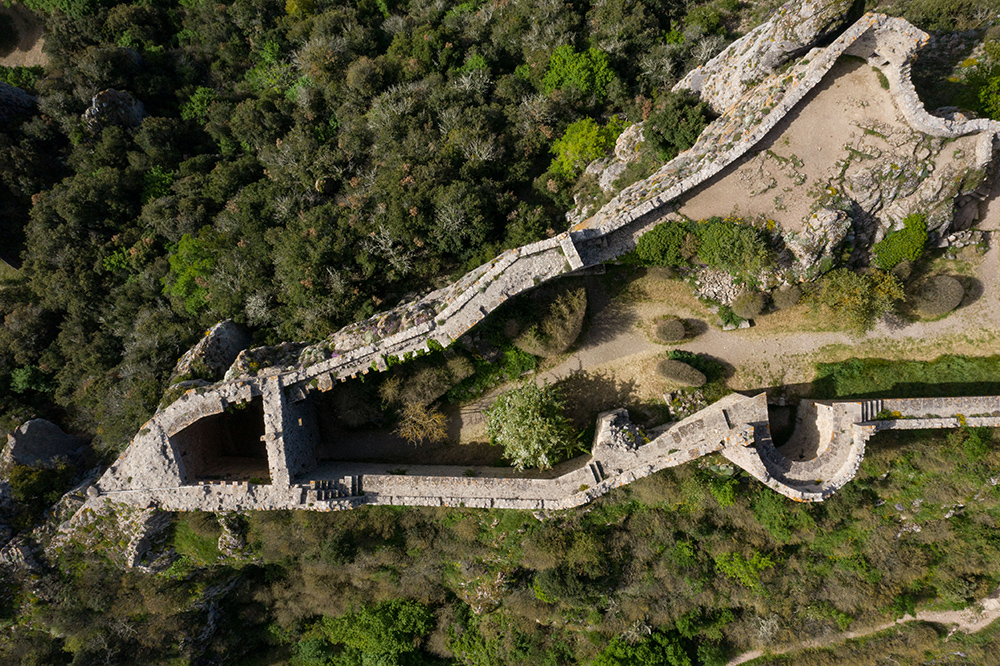
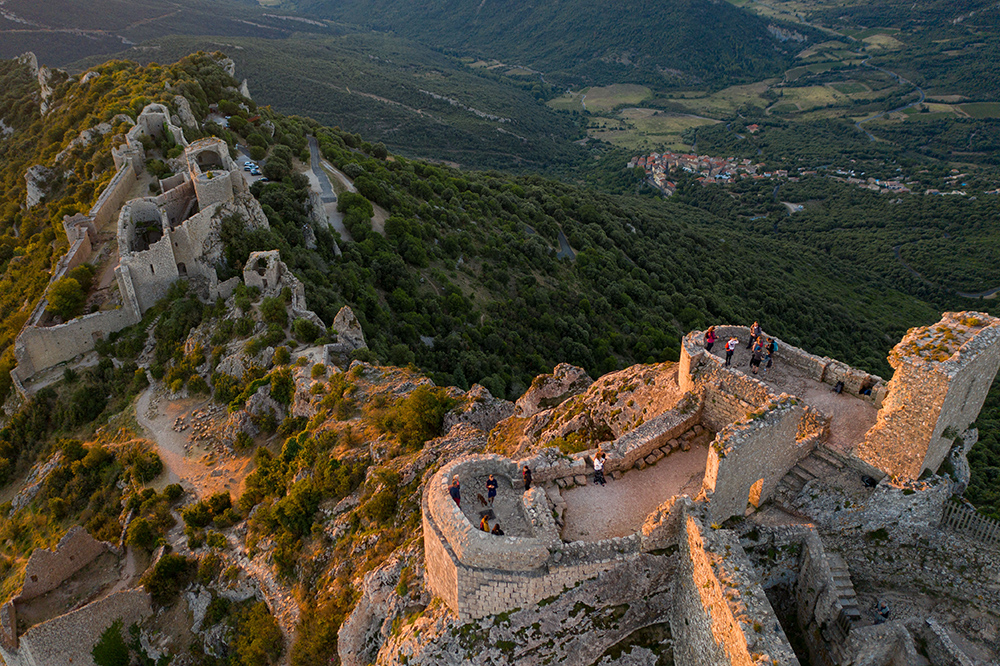
Entirely embracing the ridge, the lower enclosure has the shape of a very elongated triangle. On the north side, the wall is exceptionally well preserved. It stretches uninterrupted for 120 m, flanked by two semi-circular open-gorge towers and topped by a wall-walk reconstructed in the 1990s using original flagstones found at the foot of the rampart. It ends to the east with a triangular spur that gives the fortress its ship-like appearance. Its summit terrace offers an aerial view of the surroundings, with Duilhac in the foreground, then Quéribus, the Tautavel tower, the Roussillon plain, and finally the Mediterranean.
On the south front, between the spur and the “old keep”, a postern opens into the remains of the wall. Protected from the outside by a rocky needle, this small door allowed for discreet escape from the castle if needed. A somewhat acrobatic exit, certainly, but made possible with the aid of ropes and ladders.
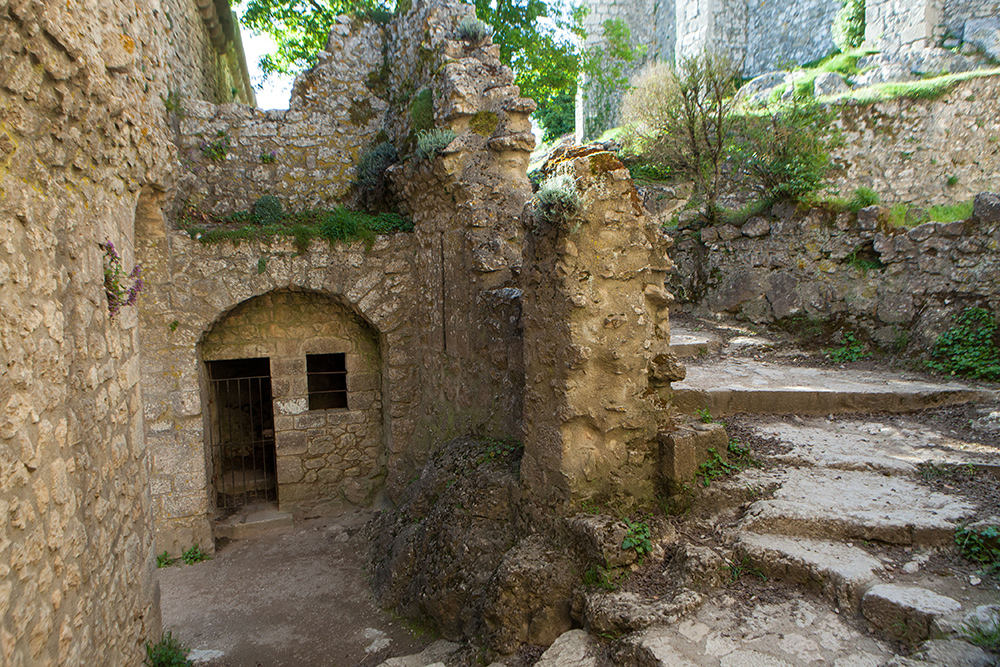
One then walks along some residential buildings, where the remains of a sink, a bench, and a staircase, directly carved into the rock, can be seen.
Perfectly preserved, the “old keep” is the fortified complex formed by the Sainte-Marie church and the dwelling. Built during the feudal era, these two parallel constructions were redeveloped under the authority of Louis IX, reinforced by thick crenellated walls and buttresses. Accessible via a small door topped by a machicolation, the quadrangular dwelling is flanked to the east by a semi-circular tower and to the west by a cylindrical tower housing a cistern. The Romanesque church exudes undeniable charm with its long open-air nave and its apse vaulted in a cul-de-four style. Unearthed during excavations, the altar has been restored to its place.
THE MIDDLE ENCLOSURE
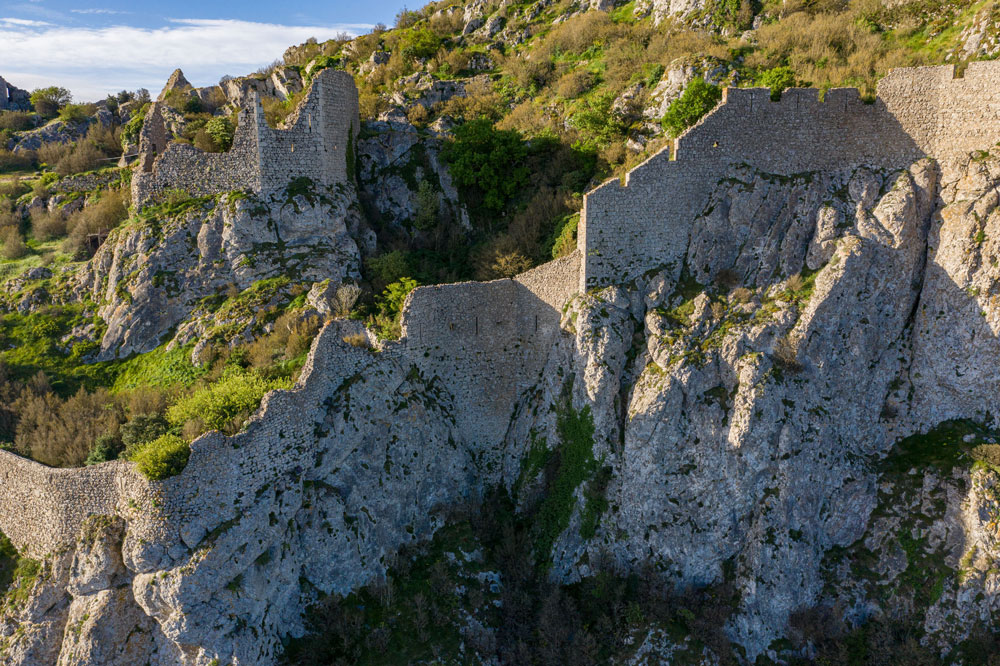
The middle enclosure is built on a platform sloping from south to north. The walls closely follow the jagged edges of the abyss on the north side. Here and there, they are equipped with loopholes for firearms, a late adaptation of the fortress. Below the access path to the Sant-Jordi keep stand the remains of a significant polygonal building overlooking the curtain walls, which probably served as a storage area, ideally located halfway between the “old keep” and Sant-Jordi.
SANT-JORDI CASTLE
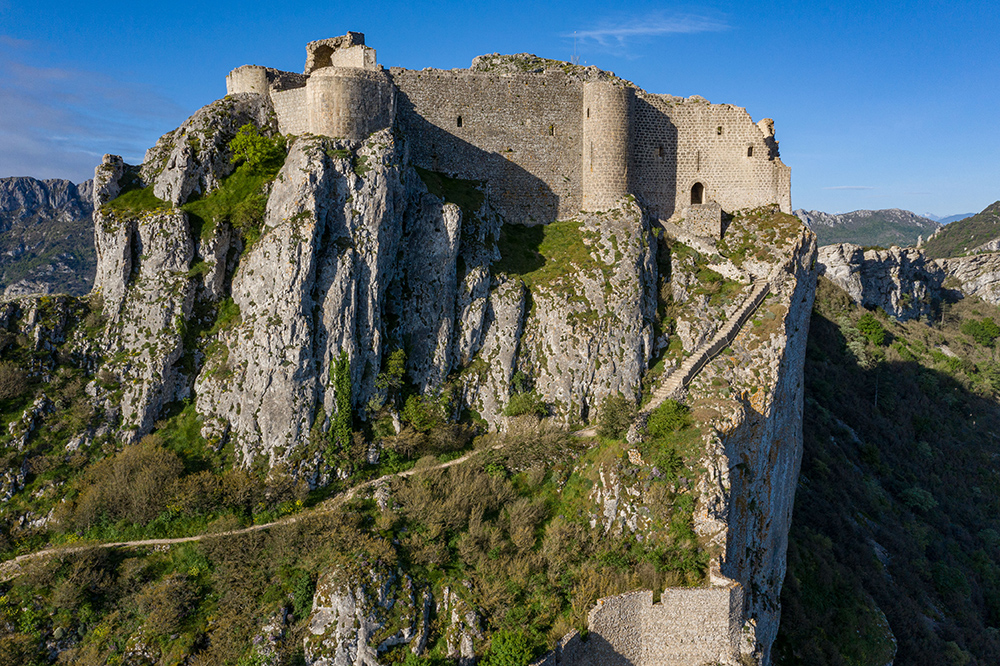
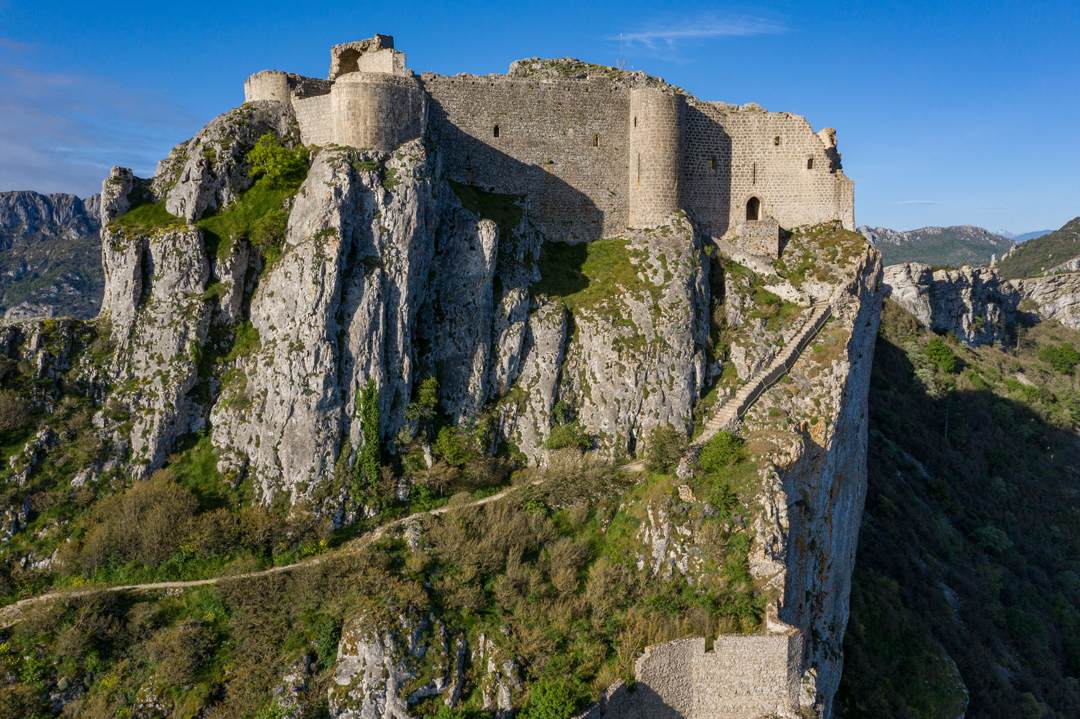
Sant-Jordi is accessed via a dizzying staircase carved into the living rock, which tradition calls the Saint Louis staircase, in homage to the sovereign who ordered its construction in 1242.
Of entirely royal construction, Sant-Jordi is designed as an autonomous castle, which was intended both to ensure the defense of the lower enclosure and the “old keep”, to prevent an attack from the north, and to symbolize the grandeur of Capetian authority.
Behind the imposing wall that bars the summit of the site, flanked by a semi-circular tower, are the remains of several lean-to buildings, which, though ruined, exude quality and comfort. This is evidenced notably by the presence of window seats, a cistern, and traces of fireplaces and an oven.
To the east, a complex of two towers, now razed, retains a second cistern to the north and a chapel dedicated to Saint George (Sant Jordi in Catalan) to the south. From there, an extraordinary panorama opens up over the lower enclosure and the surroundings.
At the rear of the keep, on the south side, the summit of the rock preserves the quarry faces. The cutting lines and the notches made by the quarrymen to extract the blocks are clearly visible.
SANT-JORDI CASTLE
Sant-Jordi is accessed via a dizzying staircase carved into the living rock, which tradition calls the Saint Louis staircase, in homage to the sovereign who ordered its construction in 1242.
Of entirely royal construction, Sant-Jordi is designed as an autonomous castle, which was intended both to ensure the defense of the lower enclosure and the “old keep”, to prevent an attack from the north, and to symbolize the grandeur of Capetian authority.
Behind the imposing wall that bars the summit of the site, flanked by a semi-circular tower, are the remains of several lean-to buildings, which, though ruined, exude quality and comfort. This is evidenced notably by the presence of window seats, a cistern, and traces of fireplaces and an oven.
To the east, a complex of two towers, now razed, retains a second cistern to the north and a chapel dedicated to Saint George (Sant Jordi in Catalan) to the south. From there, an extraordinary panorama opens up over the lower enclosure and the surroundings.
At the rear of the keep, on the south side, the summit of the rock preserves the quarry faces. The cutting lines and the notches made by the quarrymen to extract the blocks are clearly visible.
The fortress in pictures