 Accueil > Discover > Fortresses >
 Termes
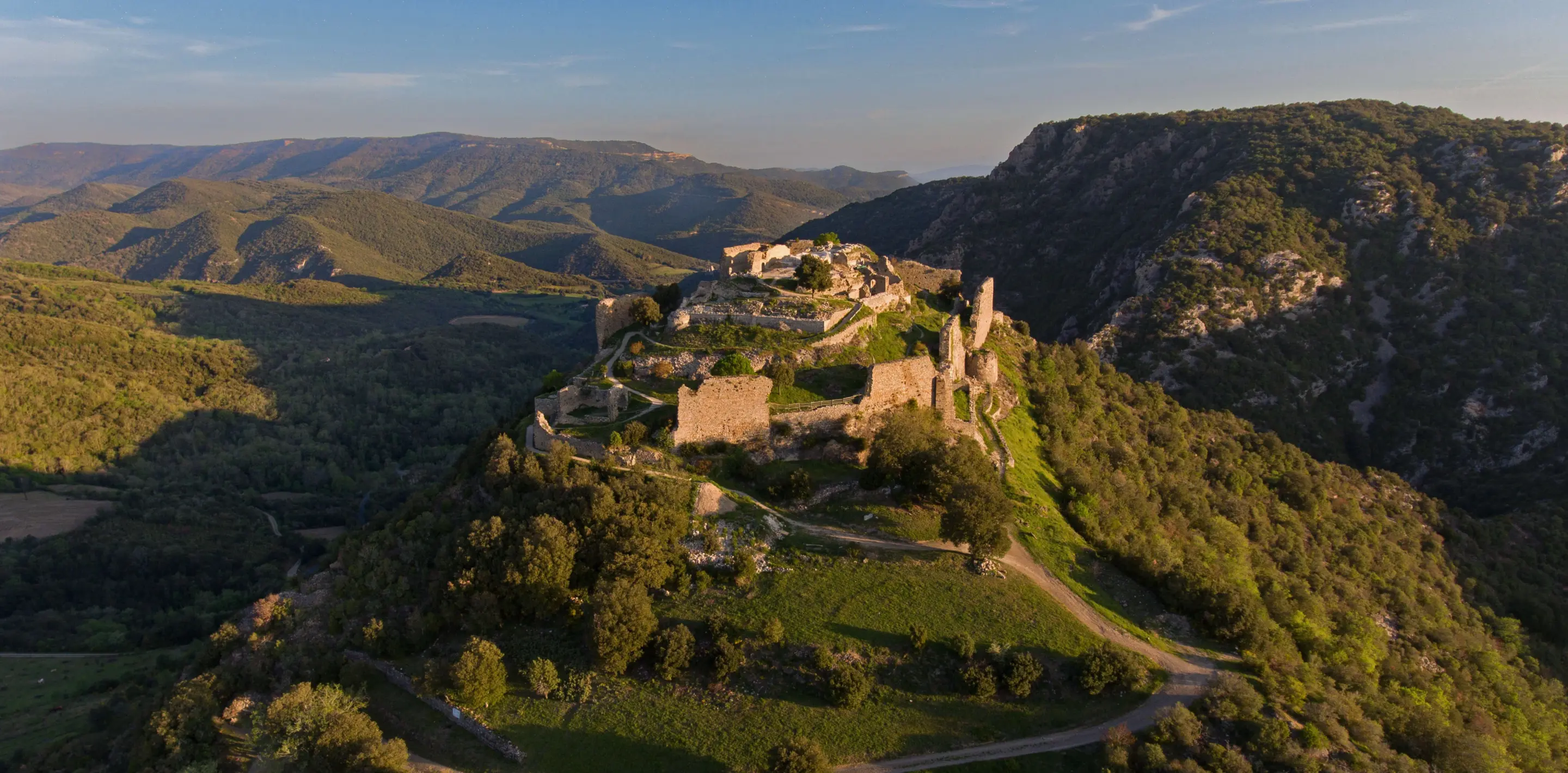
In the heart of the Corbières, Termes Castle rises atop a rocky promontory, surrounded by the winding deep gorges through which the Sou river flows. This exceptional natural defensive position did not escape the notice of either the local lords or the King of France in the 13th century.
CURRENT LANDSCAPE SETTING

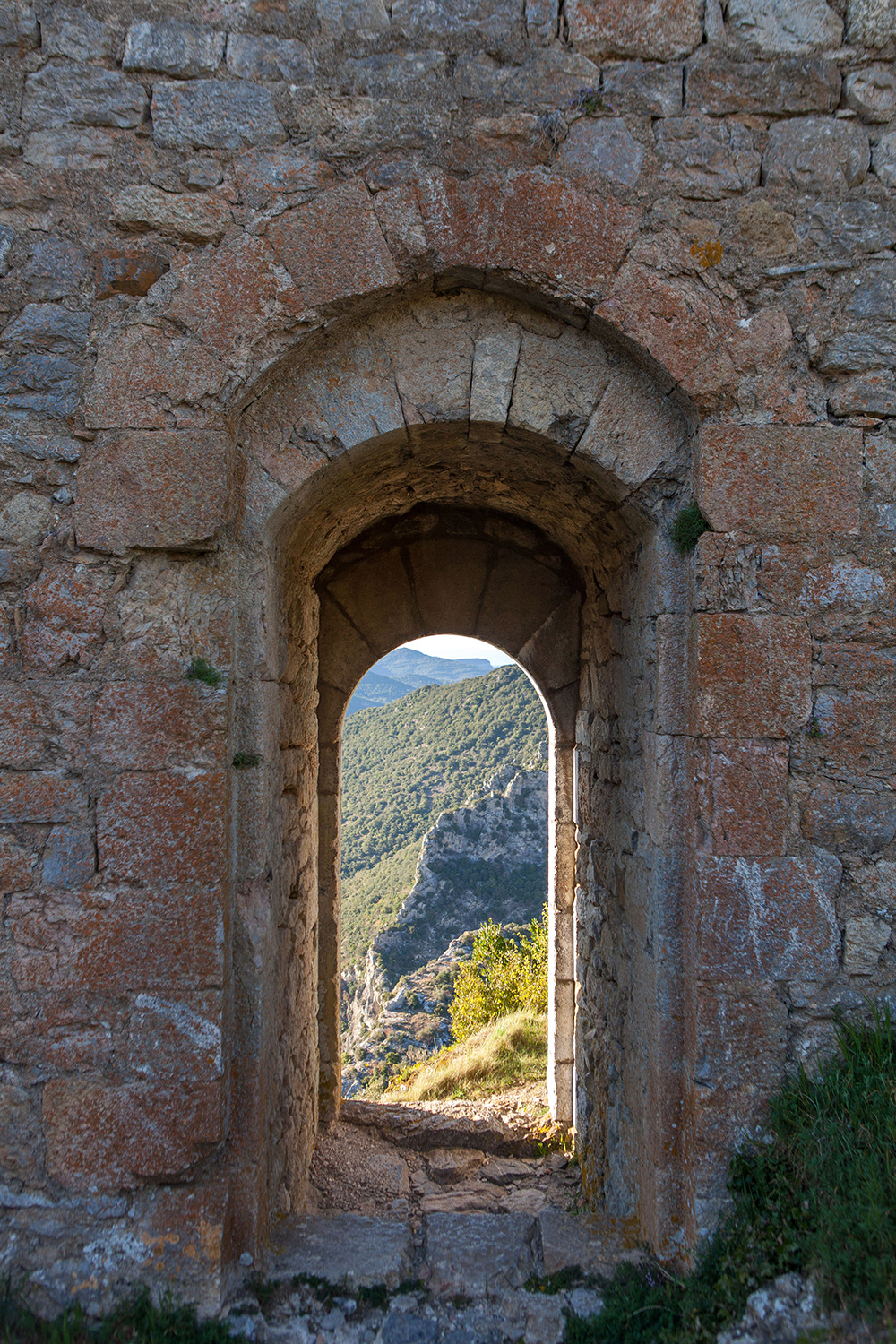
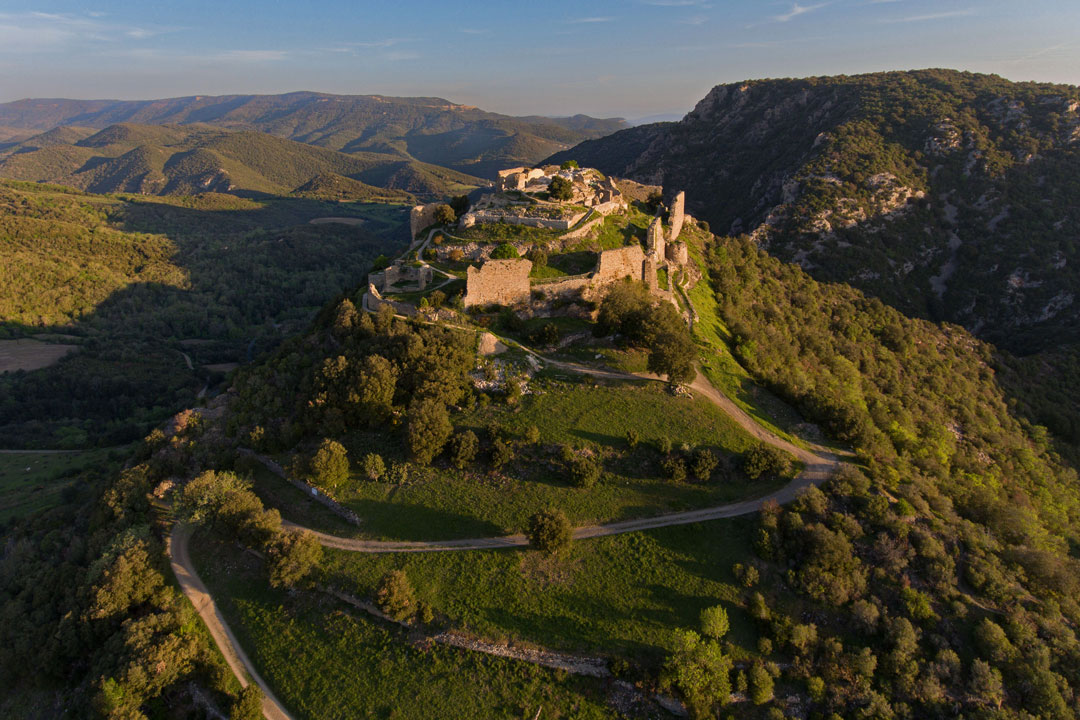
The remains of Termes Castle crown the summit of a rocky escarpment, in a magnificent setting that offers a breathtaking view of the Hautes-Corbières. It is situated in a landscape characteristic of this region, between carved limestone gorges and valleys covered with Mediterranean vegetation.
Rising to an altitude of 460 m to the east of the charming village of Termes, the promontory is bordered by two deep gorges carved by the Sou river: the Gorges du Termenet and the Gorges de Coyne-Pont, which form the natural defense of the fortress. Listed as remarkable natural sites since 1942, these two gorges constitute protected areas and contribute to the scenic and heritage value of the site. Each possesses its own particularity: narrow and dizzying for the Gorges du Termenet, downstream from the village; featuring a natural amphitheater for the Gorges de Coyne-Pont, upstream from the village. Several hiking trails crisscross their surroundings, notably the famous GR 36, and canyoning has become popular in the Gorges du Termenet.
The castle is thus surrounded by three very steep and abrupt slopes, and is only accessible from its south side. Opposite the castle rises a limestone rocky outcrop overlooking the gorges, on which an ancient fortified structure, the Termenet, once stood.
Another landscape feature of Termes Castle is its heavily wooded environment, characterized by typical Mediterranean vegetation. This dense, undulating green setting, stretching as far as the eye can see, accentuates the visual impact of the castle and the mineral appearance of its ruins, which, given their state of preservation, sometimes blend in with the surrounding rocky escarpments. The immediate surroundings of the castle are dominated by garrigue.

HISTORY
A stronghold of an important lordship in the Middle Ages, Termes was the first fortress in the Corbières to enter the royal domain in the 13th century. Perched above deep gorges, it served as a lookout for four centuries.
A POWERFUL LORDLY FAMILY
First mentioned in the 11th century as a castrum, Termes Castle was the stronghold of a powerful lordly family, the Termes, who ruled over the Termenès (Terminis, from the Latin word terminus: limit), a territory comprising about sixty villages. The lords of Termes swore allegiance to the Viscounts of Trencavel from at least the end of the 11th century and throughout the 12th century. They are also known for supporting Cathar dissent: several disputes opposed them at that time to the Abbey of Lagrasse, and Benoît de Termes is an illustrious figure in the Cathar hierarchy. The lords derived their wealth from the exploitation of mines (copper, silver, lead, and iron), which were numerous in these Corbières reliefs and attested since Antiquity.
Among the other eminent members of this great family are Raymond de Termes, who held the castrum upon the arrival of the crusaders in 1210, and his son, Olivier de Termes (c. 1200-1274), owner of Aguilar Castle and considered one of the best knights of his time. True to his family’s legacy, he fought the French crusaders and distinguished himself in numerous battles, but, as a shrewd strategist, he did not hesitate to successively support the great powers of his time – Viscounts of Trencavel, Counts of Toulouse, King of Aragon – until he finally entered the service of the King of France, Louis IX (Saint Louis), and joined the crusaders in the Holy Land.
A POWERFUL LORDLY FAMILY
First mentioned in the 11th century as a castrum, Termes Castle was the stronghold of a powerful lordly family, the Termes, who ruled over the Termenès (Terminis, from the Latin word terminus: limit), a territory comprising about sixty villages. The lords of Termes swore allegiance to the Viscounts of Trencavel from at least the end of the 11th century and throughout the 12th century. They are also known for supporting Cathar dissent: several disputes opposed them at that time to the Abbey of Lagrasse, and Benoît de Termes is an illustrious figure in the Cathar hierarchy. The lords derived their wealth from the exploitation of mines (copper, silver, lead, and iron), which were numerous in these Corbières reliefs and attested since Antiquity.
Among the other eminent members of this great family are Raymond de Termes, who held the castrum upon the arrival of the crusaders in 1210, and his son, Olivier de Termes (c. 1200-1274), owner of Aguilar Castle and considered one of the best knights of his time. True to his family’s legacy, he fought the French crusaders and distinguished himself in numerous battles, but, as a shrewd strategist, he did not hesitate to successively support the great powers of his time – Viscounts of Trencavel, Counts of Toulouse, King of Aragon – until he finally entered the service of the King of France, Louis IX (Saint Louis), and joined the crusaders in the Holy Land.
THE SIEGE OF TERMES
At the beginning of the 13th century, the castrum of Termes consisted of a perched castle and a terraced village below, protected by a primitive enclosure, traces of which have been found halfway up the current site. It was at the foot of this fortified complex that Simon de Montfort arrived in 1210, leading the Barons’ Crusade, which had already captured Carcassonne and Minerve. Control of the powerful lordship of Termes was indeed among the strategic objectives of the crusaders before they could establish themselves in the rest of the country. But while the siege of Carcassonne lasted only 15 days, this one promised to be much more difficult: the castle was well-supplied, and Raymond de Termes commanded a formidable garrison of 400 soldiers, twenty knights, and, a rare occurrence, an engineer specializing in war machines.
The crusaders’ small numbers seemed derisory against the steep rocks crowned with walls. However, the siege engines managed to open a breach in the first line of defense of the suburb. The besieged, due to lack of water, eventually abandoned the site. This siege, which lasted nearly four months, is recounted in detail in the chronicles of Pierre des Vaux-de-Cernay, a close associate of Simon de Montfort.
The fall of the fortress had a great impact and caused the collapse of resistance in the Corbières. The castle was given by Simon de Montfort to one of his companions, Alain de Roucy.

ROYAL RESTRUCTURING
In 1224, Amaury de Montfort, son of Simon, ceded Termes Castle to the Archbishop of Narbonne. However, this donation was ineffective due to the defeat of the crusaders following the “reconquest” led by the Occitan lords. The castle therefore returned to the hands of the lords of Termes. During the royal crusade, launched in 1226, Olivier and Bernard de Termes finally submitted to King Louis VIII, and a royal garrison was installed in the castle. In 1255, this garrison comprised fifteen sergeants.
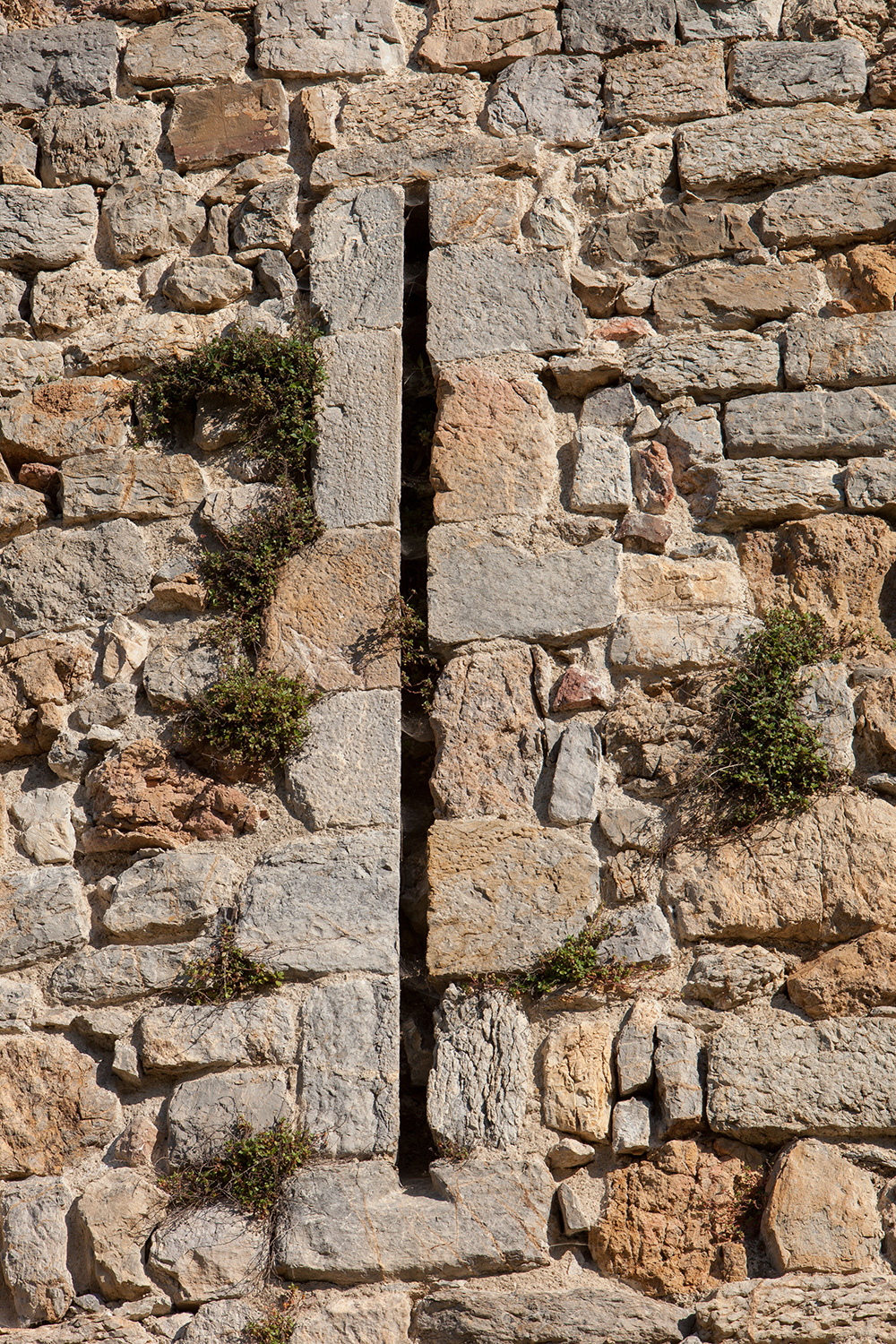
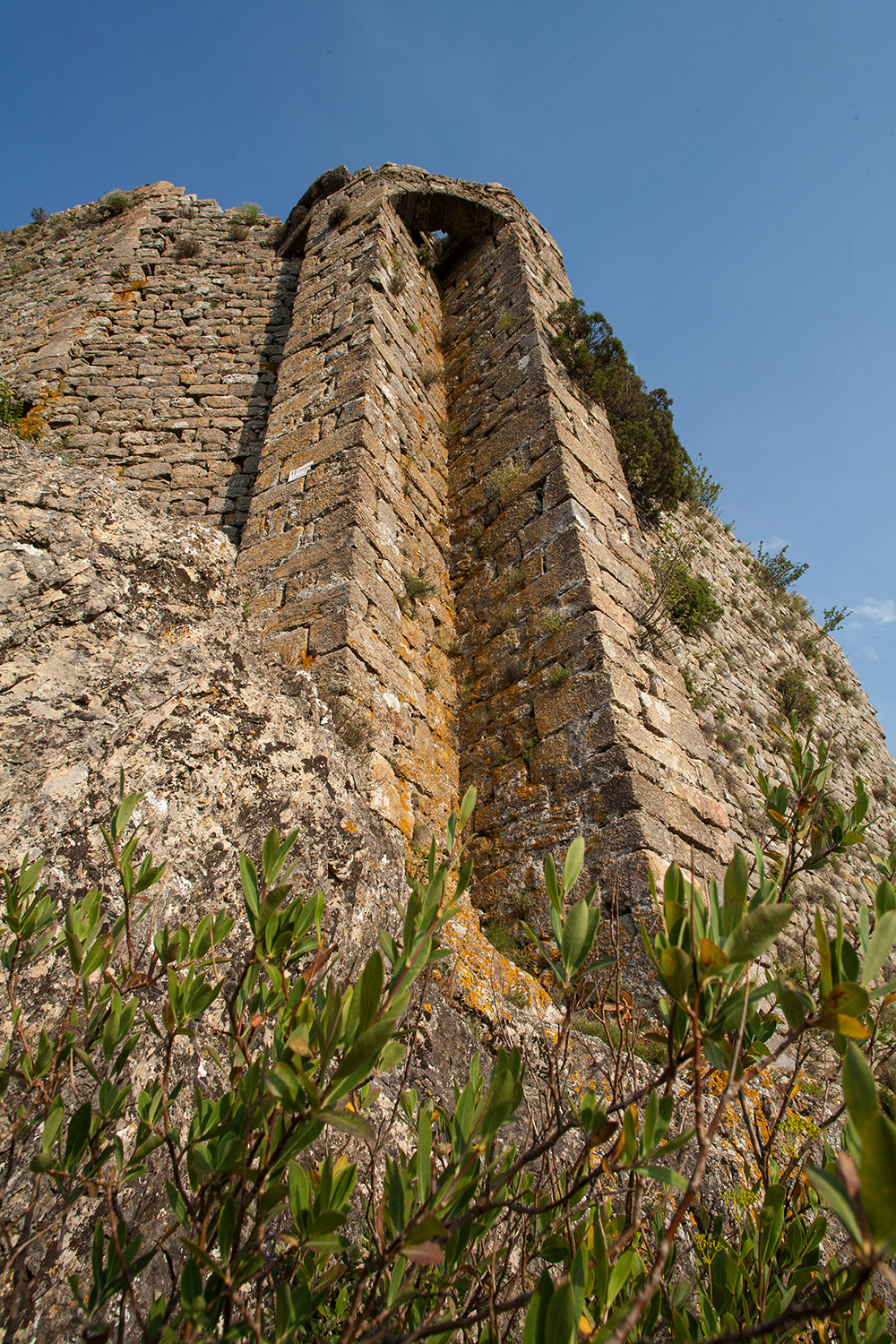
Following the Treaty of Corbeil in 1258, which established the new Franco-Aragonese border south of the Corbières, the king planned the immediate restructuring of Termes. In 1260, the castral village was moved to the valley to clear the approaches to the castle. The reconstruction of the fortress probably began during this same period, according to the principles of Capetian military architecture. While some elements of the primitive castle are preserved within the inner enclosure, the outer wall unequivocally demonstrates the intervention of royal builders with its circular towers, pierced with stirrup arrow slits and sometimes adorned with bossed stones.
This powerful new fortress thus became an essential link in the network of mountain sentinel castles designed by the King of France around the City of Carcassonne. Along with Aguilar, Peyrepertuse, Puilaurens, and Quéribus, Termes is ranked among the “five sons of Carcassonne”. In 1302, it housed a castellan, a chaplain, a gatekeeper, a watchman, a squire, and ten sergeants.
ROYAL RESTRUCTURING
In 1224, Amaury de Montfort, son of Simon, ceded Termes Castle to the Archbishop of Narbonne. However, this donation was ineffective due to the defeat of the crusaders following the “reconquest” led by the Occitan lords. The castle therefore returned to the hands of the lords of Termes. During the royal crusade, launched in 1226, Olivier and Bernard de Termes finally submitted to King Louis VIII, and a royal garrison was installed in the castle. In 1255, this garrison comprised fifteen sergeants.
Following the Treaty of Corbeil in 1258, which established the new Franco-Aragonese border south of the Corbières, the king planned the immediate restructuring of Termes. In 1260, the castral village was moved to the valley to clear the approaches to the castle. The reconstruction of the fortress probably began during this same period, according to the principles of Capetian military architecture. While some elements of the primitive castle are preserved within the inner enclosure, the outer wall unequivocally demonstrates the intervention of royal builders with its circular towers, pierced with stirrup arrow slits and sometimes adorned with bossed stones.
This powerful new fortress thus became an essential link in the network of mountain sentinel castles designed by the King of France around the City of Carcassonne. Along with Aguilar, Peyrepertuse, Puilaurens, and Quéribus, Termes is ranked among the “five sons of Carcassonne”. In 1302, it housed a castellan, a chaplain, a gatekeeper, a watchman, a squire, and ten sergeants.
A PLANNED DEMOLITION
During the following centuries, throughout the various wars affecting the Kingdom of France, the castle maintained its defensive role, still housing a garrison of seven men in the 16th century and still supplied with arms and ammunition after the conquest of Roussillon in the mid-17th century. However, in 1652, the King of France, considering that the stronghold of Termes was no longer of any use, ordered its demolition by forced labor.
In April 1653, given the population’s lack of eagerness, the work was entrusted to a contractor from Limoux. Explosives, judiciously placed under the key elements of the fortress, rendered the castle militarily unusable and left it in ruins.
The contractor recovered a large part of the dismantled materials (wood, stones, tiles, etc.), while arms and ammunition were temporarily stored at Villerouge Castle. The compensation due to the castellan amounted to 6,800 livres, and the cost of demolition was 6,200 livres, paid by the Diocese of Narbonne.
SECRETS GRADUALLY UNVEILED
In 1989, the castle was classified as a historical monument and purchased by the municipality of Termes, which then undertook its preservation and opened it to the public in 1992.
Since then, extensive excavation and clearing campaigns have removed several hundred cubic meters of rubble, gradually revealing the secrets of the castle’s architecture and history.
Recently, in 2015, the foundations of the primitive keep were unearthed, which had long remained buried under four meters of earth at the summit of the site.
These discoveries, which help to better understand the original layout of the site, also provide a scientific framework for consolidation and restoration work.
SECRETS GRADUALLY UNVEILED
In 1989, the castle was classified as a historical monument and purchased by the municipality of Termes, which then undertook its preservation and opened it to the public in 1992. Since then, extensive excavation and clearing campaigns have removed several hundred cubic meters of rubble, gradually revealing the secrets of the castle’s architecture and history. Recently, in 2015, the foundations of the primitive keep were unearthed, which had long remained buried under four meters of earth at the summit of the site. These discoveries, which help to better understand the original layout of the site, also provide a scientific framework for consolidation and restoration work.
SITE DESCRIPTION
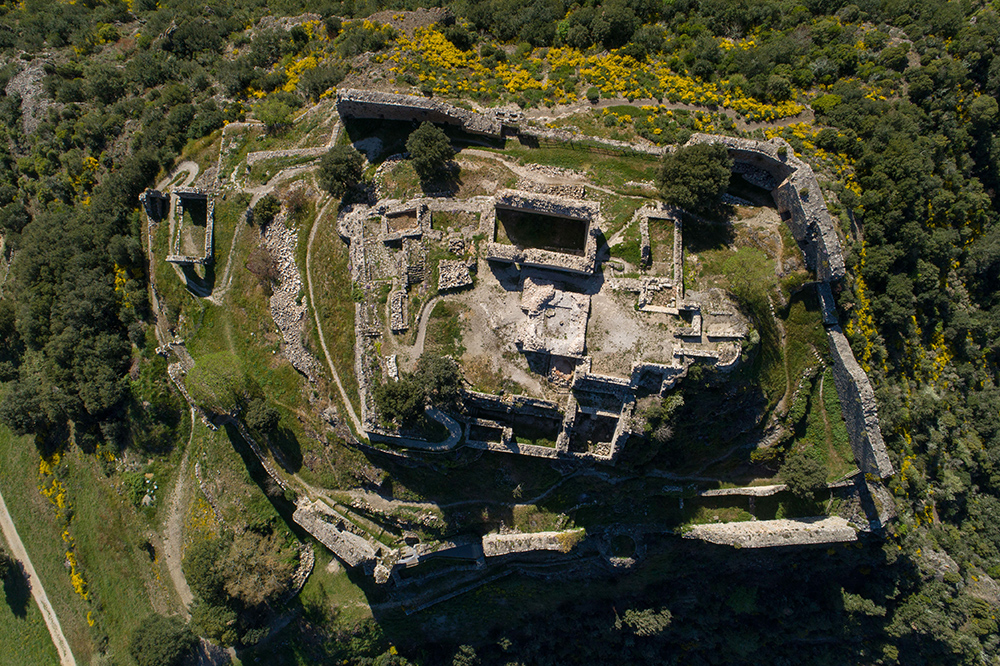
Despite the castle’s demolition by explosives in the 17th century, archaeological work has made it possible to identify the general organization of the fortress, whose royal remains (13th century) coexist with those of the ancient lordly castle (10th-12th centuries).
OVERVIEW
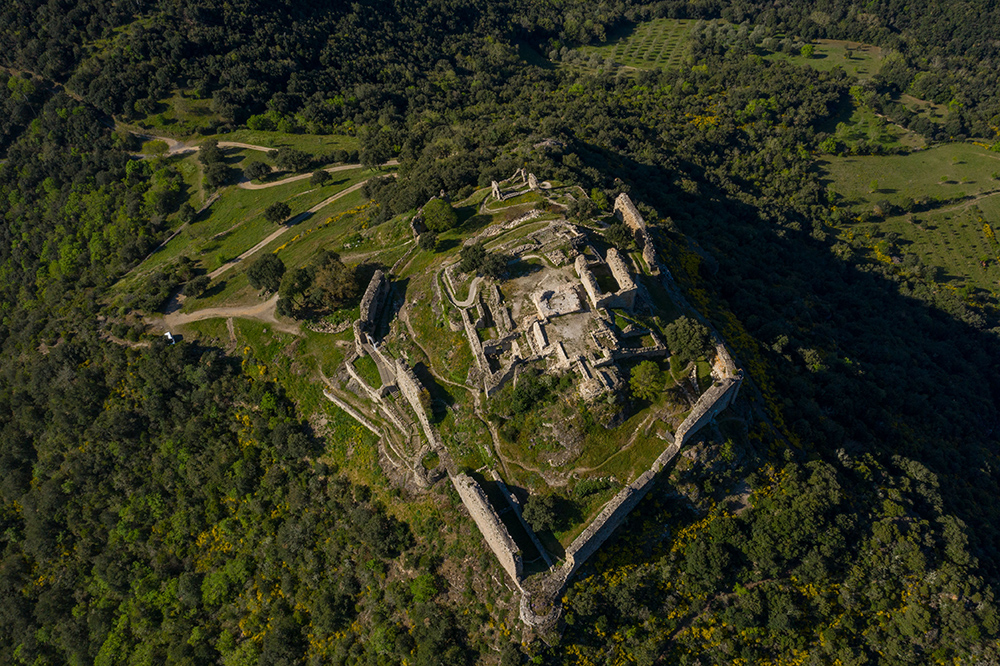
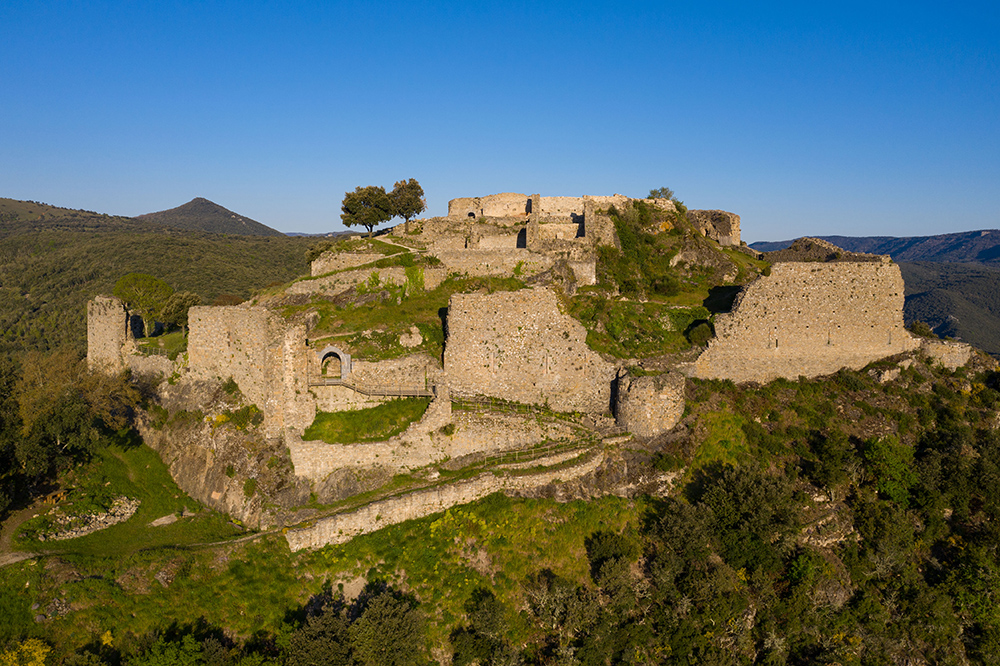
Built on a platform surrounded on three sides by a deep ravine, the castle is only accessible from its south side.
The site essentially consists of two concentric enclosures, preceded by two lines of walls located halfway up the southern slope, probable remains of the fortifications of the ancient castral village, moved to the valley in 1260.
OVERVIEW
Built on a platform surrounded on three sides by a deep ravine, the castle is only accessible from its south side. The site essentially consists of two concentric enclosures, preceded by two lines of walls located halfway up the southern slope, probable remains of the fortifications of the ancient castral village, moved to the valley in 1260.
THE INNER ENCLOSURE
Built by royal engineers from the mid-13th century onwards, the lower enclosure surrounds the hilltop, forming an irregular parallelogram. It is accessible via a ramp, whose zigzag path forced the enemy to walk alongside the wall pierced with stirrup arrow slits, thus exposing them to fire from defenders stationed on the rampart walk. Several gates defended the main entrance, formerly preceded by a barbican and now marked by a broken arch restored in the 2000s. The entrance was also protected by a watchtower, located in the southeast corner, and by the circular tower of the eastern curtain wall, whose bossed stones clearly illustrate the intervention of the royal engineers. At the northern corner, a similarly shaped tower, but with smooth stone blocks, completes the defense of the eastern front.
Behind this section of wall stood residential or service buildings, sometimes on several floors, as shown by the rows of corbels and putlog holes that supported floors and roofs. The northwest corner of the enclosure, overlooking the Gorges du Termenet, is pierced by a postern gate and fortified by a watchtower whose base remains, resting on two buttresses at the edge of the rock.
The heavily ruined western curtain wall features, halfway from the southwest corner, the base of a quadrangular structure at ground level pierced with four openings: these are the remains of the latrines, which rose vertically and descended to the foot of the castle. The structure also likely served for rainwater drainage.
From the “guardroom,” a rectangular structure located in the southwest corner, returning towards the main entrance, one passes two significant sections of wall of considerable thickness (over 2 m). Here, royal engineers doubled the ancient ramparts of the primitive castle to ensure the fortress’s solidity and power.
The lists (outer bailey), the open-air space separating the two enclosures, were designed to trap the enemy if they breached the first wall, but they also served for grazing animals and storing equipment. The residential buildings were located in the upper part of the castle, behind the second enclosure.
THE UPPER ENCLOSURE
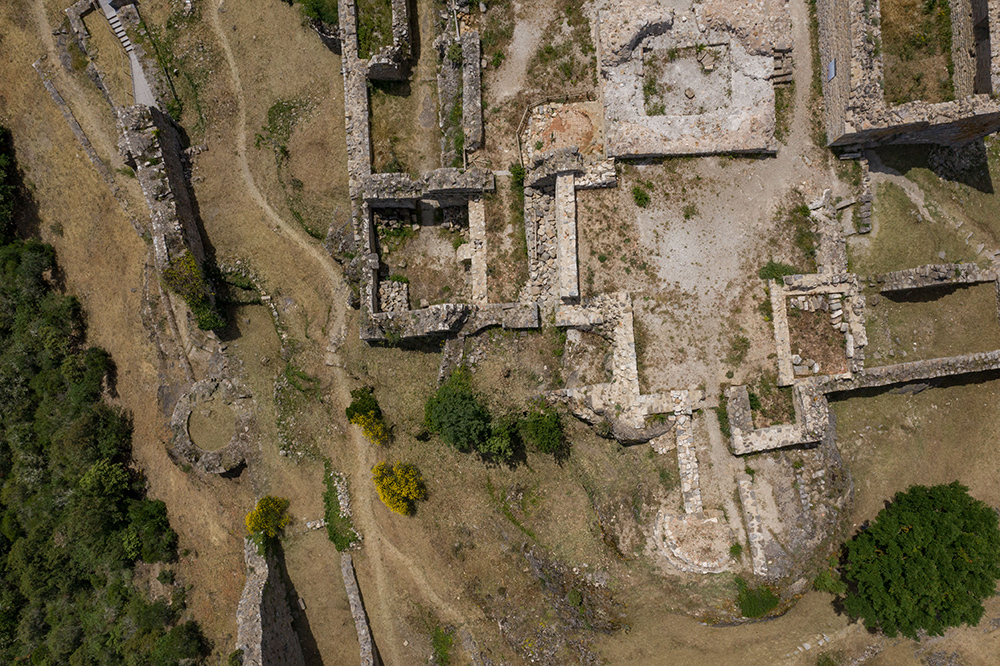
It is not always easy at first glance to navigate among the remains of walls and structures that occupy the upper part of the castle, especially since some date from the primitive lordly castle and others from the royal redevelopment! However, recent archaeological research, in conjunction with consolidation work, allows for an understanding of the main lines of this second enclosure’s organization. It was in this way, notably, that the foundations of the primitive keep were unearthed in 2015, recognizable by its square base at the top of the hill. The thickness of the excavated walls, reaching nearly 2 m, suggests a rather tall structure, 15 to 20 m high, likely with three floors.
The remains of three cisterns have also been identified on the summit part of the castle. Their function is attested by the tile-dust mortar coating the walls (a mixture of lime and tile powder ensuring waterproofing), but also by the discovery of a stone tank designed to filter rainwater (now visible at the castle reception). The rainwater collection system had to be particularly efficient on such a fortified and isolated site, ensuring garrisons a supply of drinking water, but also the sanitation of the interior buildings, often dark and damp.
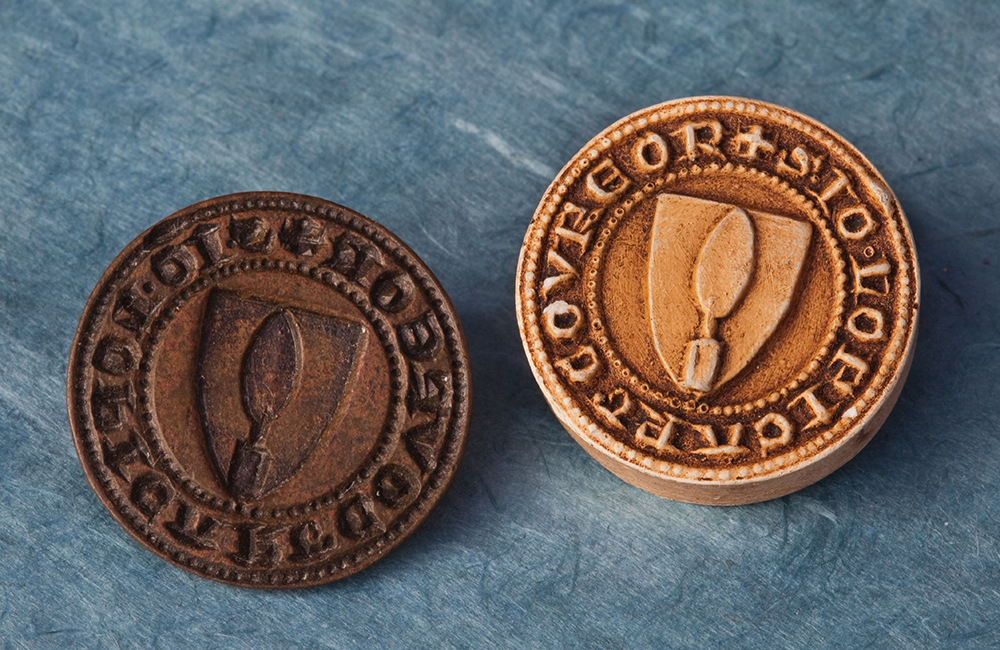
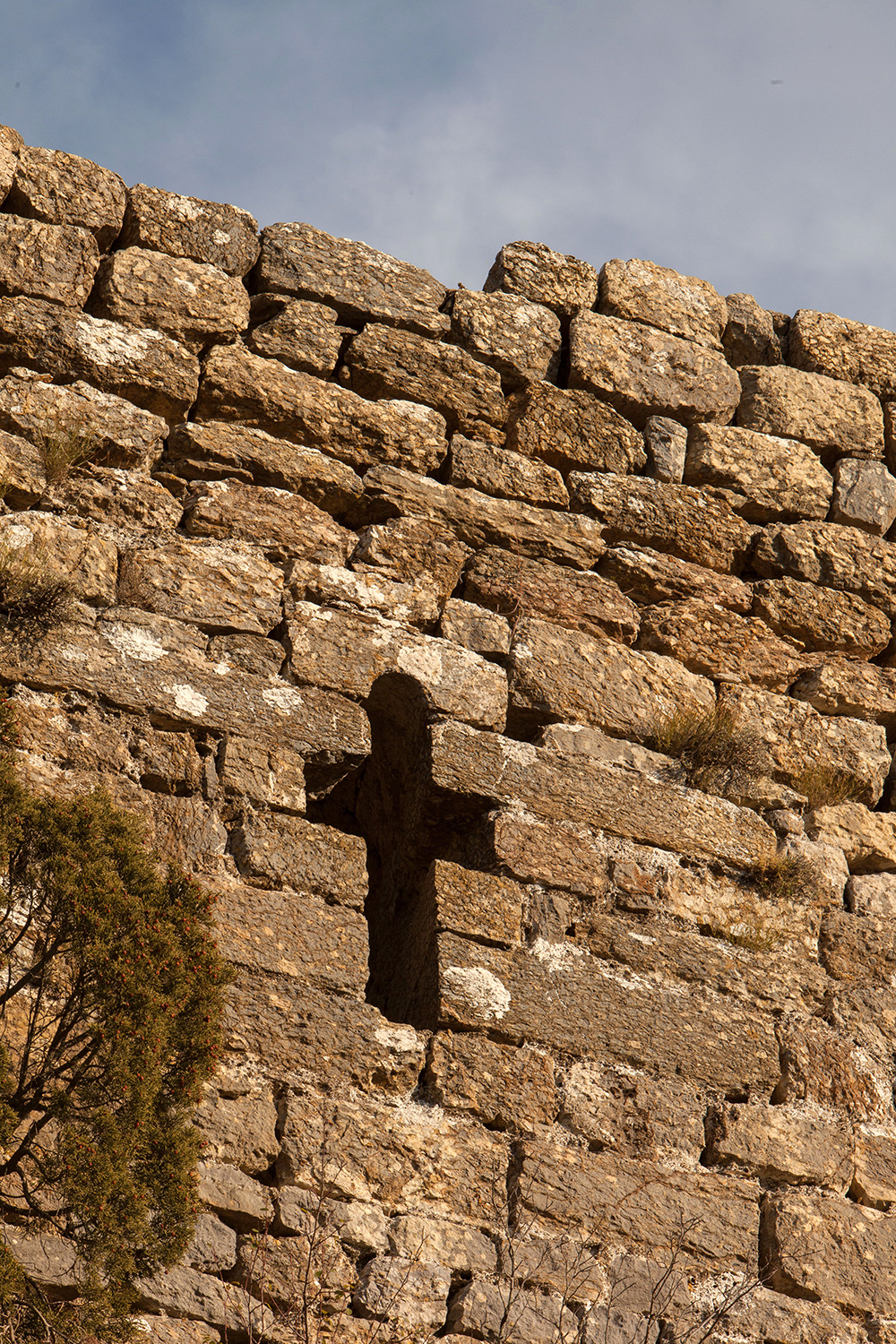
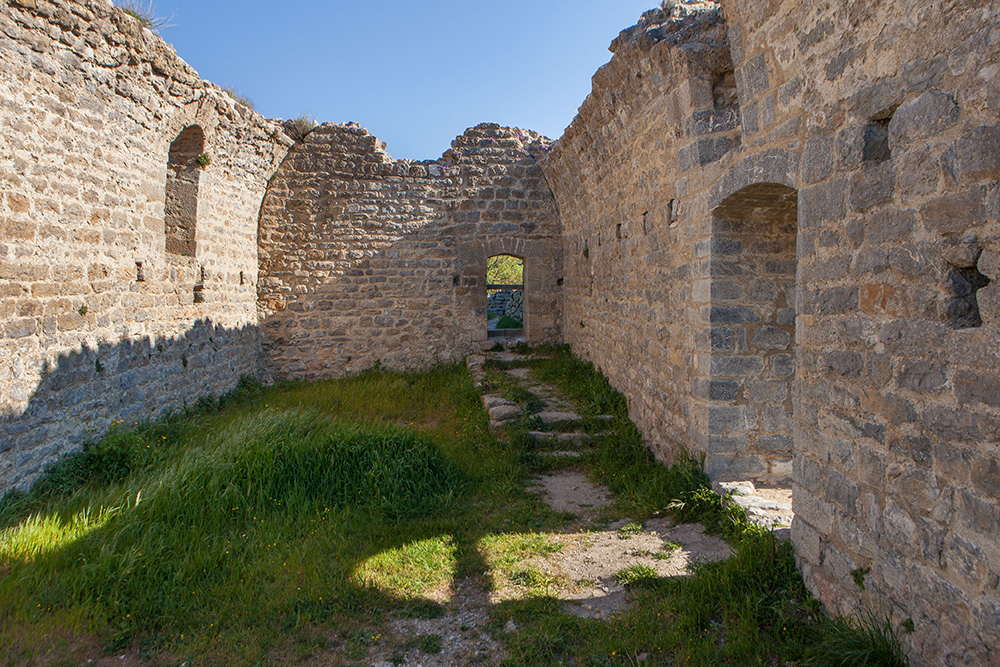
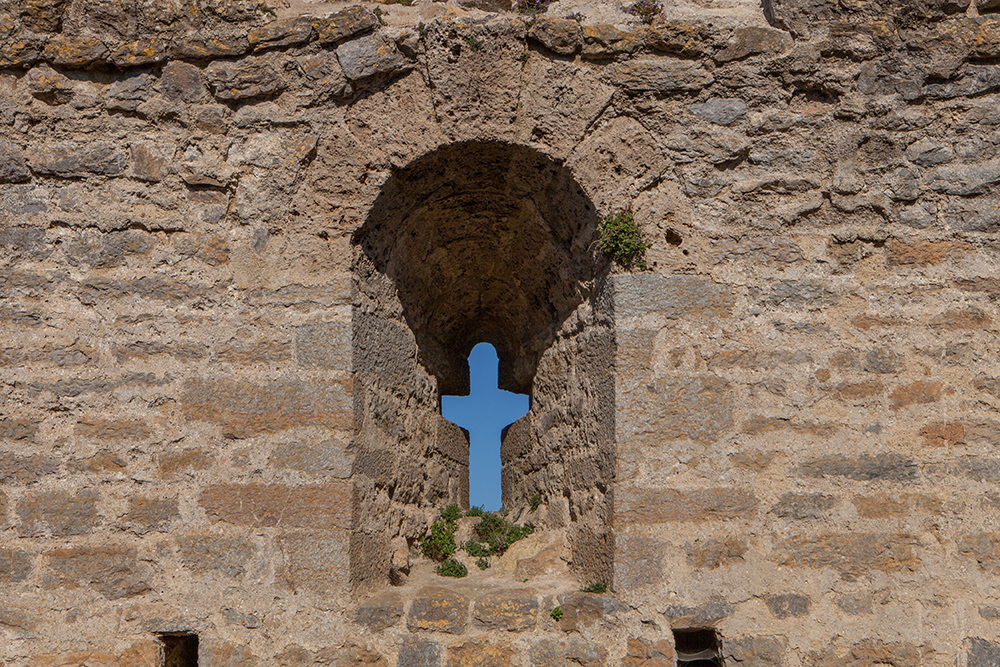
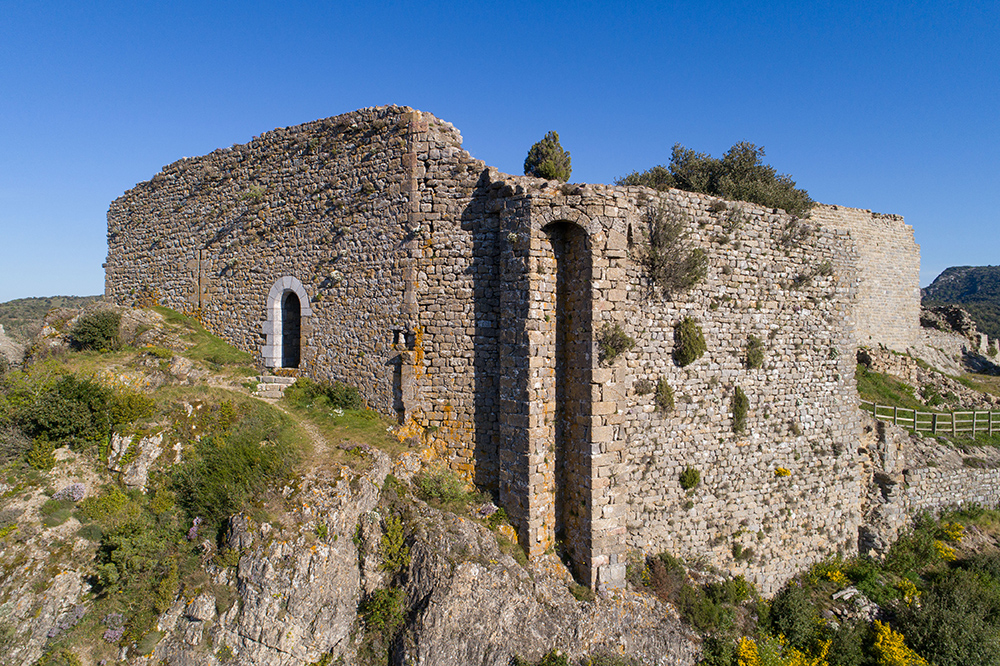
Among the other notable remains of the second enclosure, we can mention the “chapel,” a rectangular structure formerly vaulted with a broken barrel vault, which owes its name to the cruciform window pierced in the eastern wall. Its construction dates from the royal worksite in the 13th century, as attested by the bronze seal of the roofer Jean le Picard discovered during excavations. He was one of many artisans who came to work in the South on behalf of the royal authority.

THE UPPER ENCLOSURE
It is not always easy at first glance to navigate among the remains of walls and structures that occupy the upper part of the castle, especially since some date from the primitive lordly castle and others from the royal redevelopment! However, recent archaeological research, in conjunction with consolidation work, allows for an understanding of the main lines of this second enclosure’s organization. It was in this way, notably, that the foundations of the primitive keep were unearthed in 2015, recognizable by its square base at the top of the hill. The thickness of the excavated walls, reaching nearly 2 m, suggests a rather tall structure, 15 to 20 m high, likely with three floors.
The remains of three cisterns have also been identified on the summit part of the castle. Their function is attested by the tile-dust mortar coating the walls (a mixture of lime and tile powder ensuring waterproofing), but also by the discovery of a stone tank designed to filter rainwater (now visible at the castle reception). The rainwater collection system had to be particularly efficient on such a fortified and isolated site, ensuring garrisons a supply of drinking water, but also the sanitation of the interior buildings, often dark and damp.
Among the other notable remains of the second enclosure, we can mention the “chapel,” a rectangular structure formerly vaulted with a broken barrel vault, which owes its name to the cruciform window pierced in the eastern wall. Its construction dates from the royal worksite in the 13th century, as attested by the bronze seal of the roofer Jean le Picard discovered during excavations. He was one of many artisans who came to work in the South on behalf of the royal authority.
The fortress in pictures