
Les acteurs du territoire ont participé à des ateliers de co-construction.
 Accueil > Actualités >
 On March 19, in Puilaurens, the first participatory workshop was held, dedicated to developing the future interpretive scheme for the serial property Royal Fortresses of Languedoc, a candidate for inscription on the UNESCO World Heritage List of UNESCO → This first meeting brought together elected officials, technicians, heritage professionals, and association representatives, focusing on two key moments: a morning of collective reflection on the current strengths and limitations of discovering the sites, followed by a field visit.
Propose concrete tools for enhancing the fortresses
Led by the World Heritage Mission Association (AMPM) and launched in early 2025, this study aims to build a heritage interpretation strategy for the entire fortress network, by proposing concrete tools for their enhancement, while respecting their uniqueness and the expectations of the territories. In this context, the participants – welcomed by Jacques Galy, Mayor of Puilaurens – were invited to take part in a day of exchange and collective reflection on the challenges of the future interpretive scheme.
The morning unfolded in several stages, beginning with a presentation of the serial property and the application framework, led by David Maso, architecture and archaeology project manager at AMPM. He reviewed the main stages of the application, the specificities of the property, and the foundations of its outstanding universal value.
Reflect collectively and co-construct with local stakeholders
Next, the teams in charge of the study – Atelier 963, Sonia Fontaine, Chroniques Conseil, and Arscènes – detailed the objectives of the interpretive scheme, as well as the method chosen to co-construct it with local stakeholders.
Participants were engaged in two workshops that allowed for observations to emerge regarding the current strengths and weaknesses of discovering the sites, and for collective reflection on the challenges of the interpretive scheme. Through these discussions, they expressed their expectations and priorities for the project’s continuation. Among the concerns raised were: site accessibility, the risk of over-tourism, the resources needed to implement future actions, and the necessity of preserving the landscapes and the identity of the places.
In the afternoon, participants were invited to discover two sites: the Lapradelle-Puilaurens station, as part of a programming study presented by Karine Duhil, and then the Château de Puilaurens, during a guided tour by David Maso and Lénaïc Raclot.
The consultation committee will reconvene in autumn 2025 to support the next stages of the study. This first workshop marks the beginning of a collaborative effort that will continue until summer 2026.
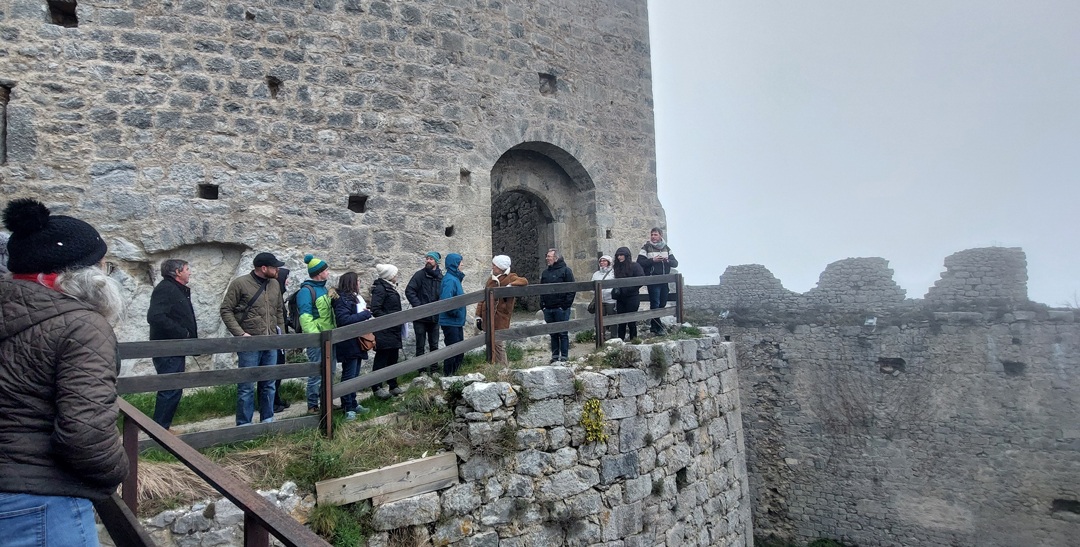
In the afternoon, participants went to discover the Château de Puilaurens.
Photo credits: AMPM, Atelier 963


