
 Accueil > Discover > Fortresses >
 Queribus
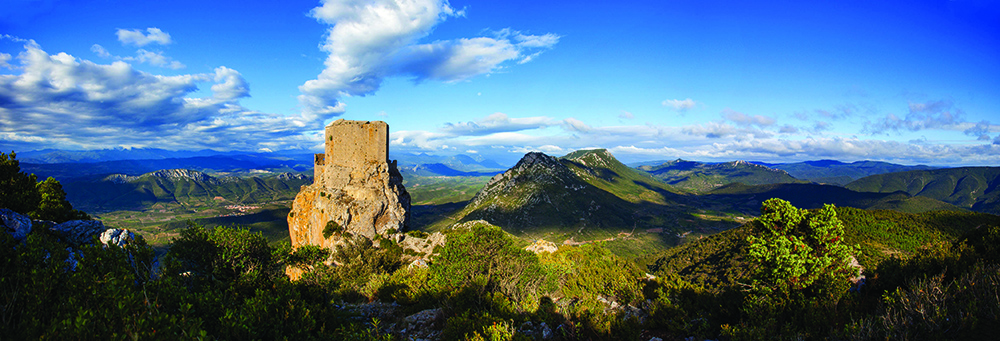
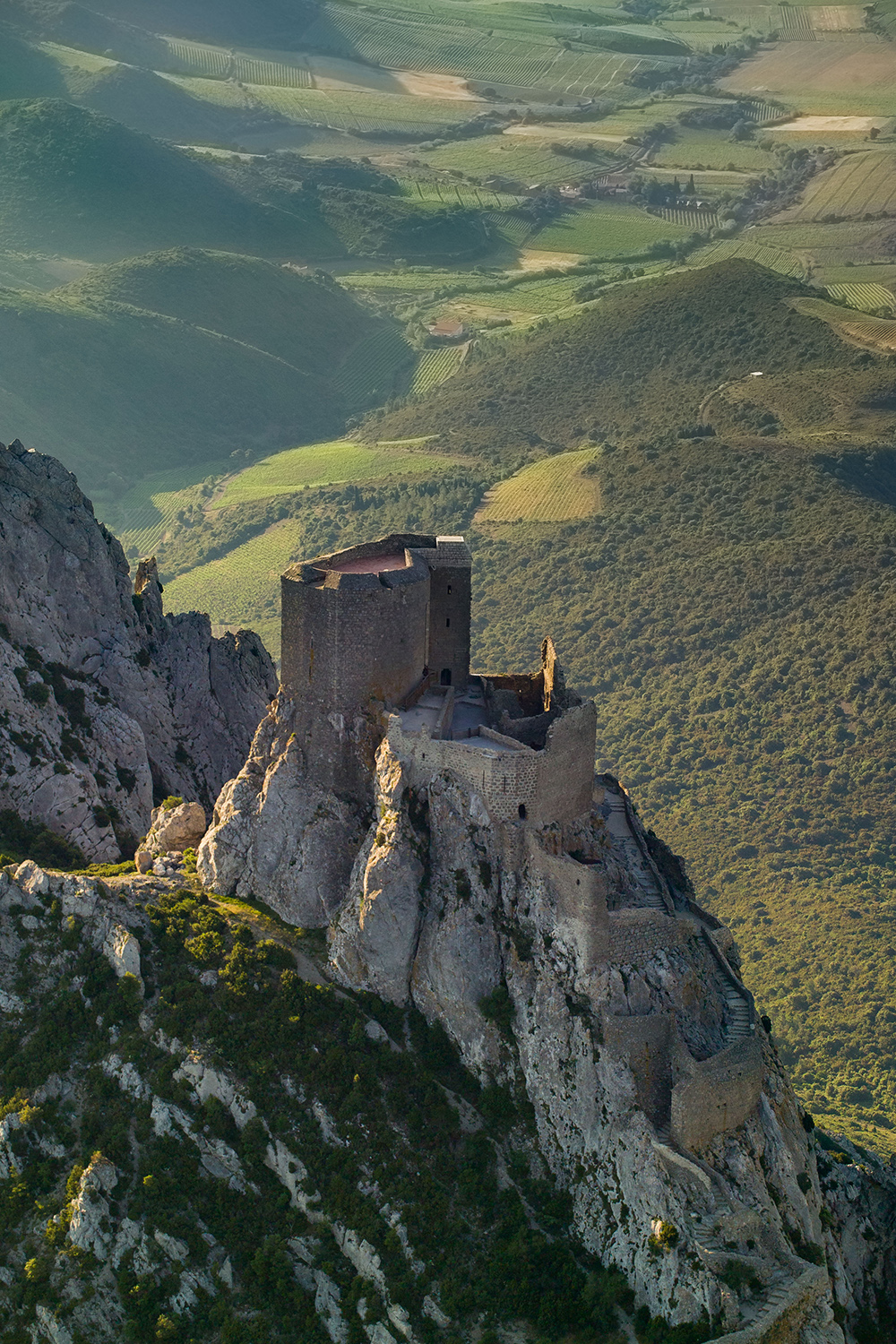
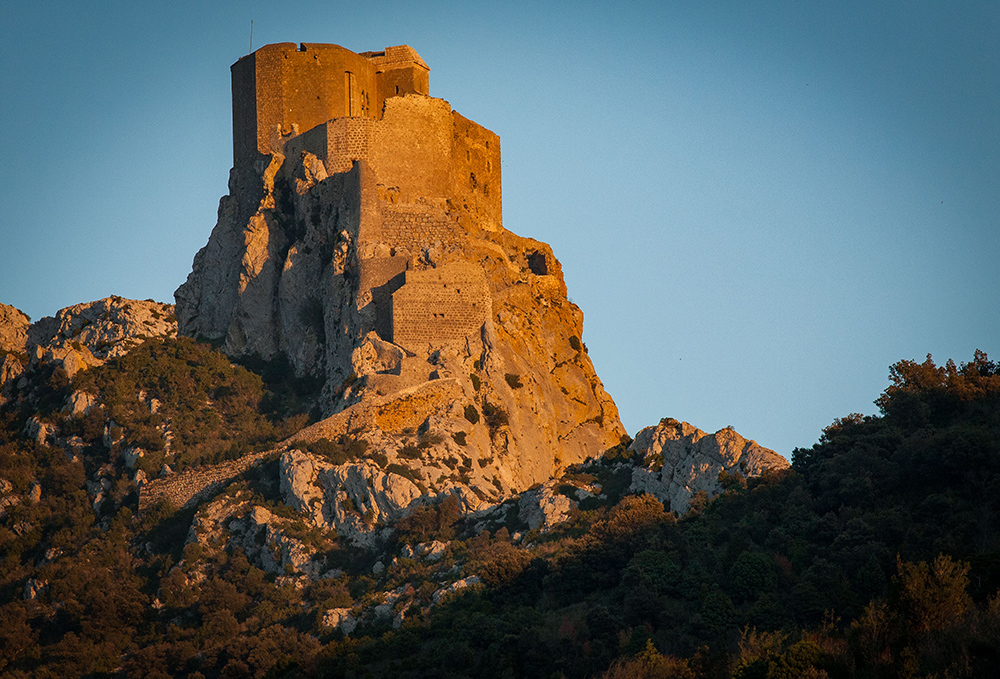
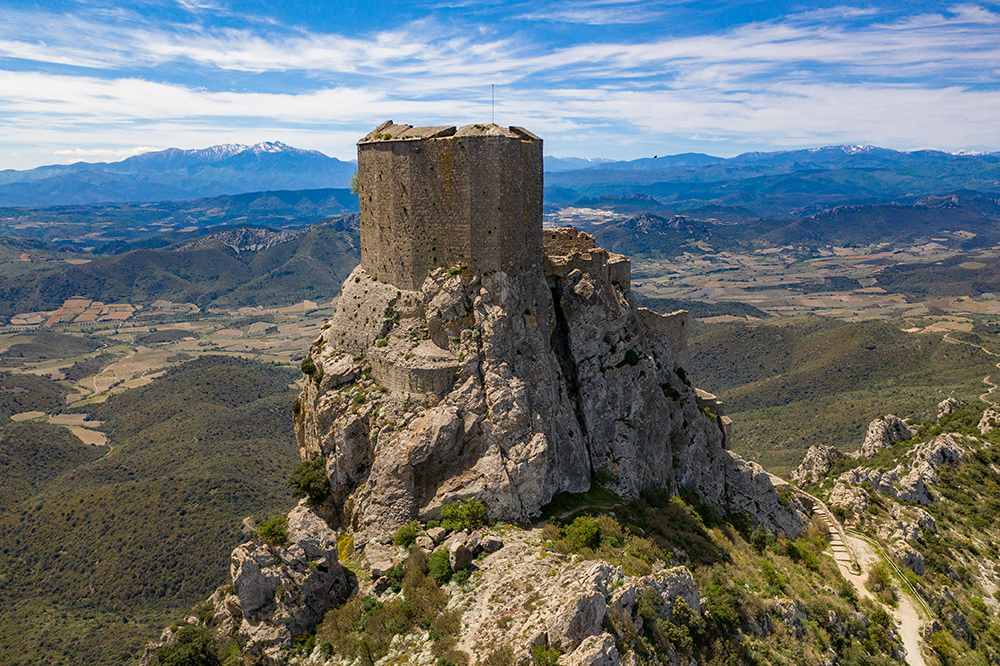
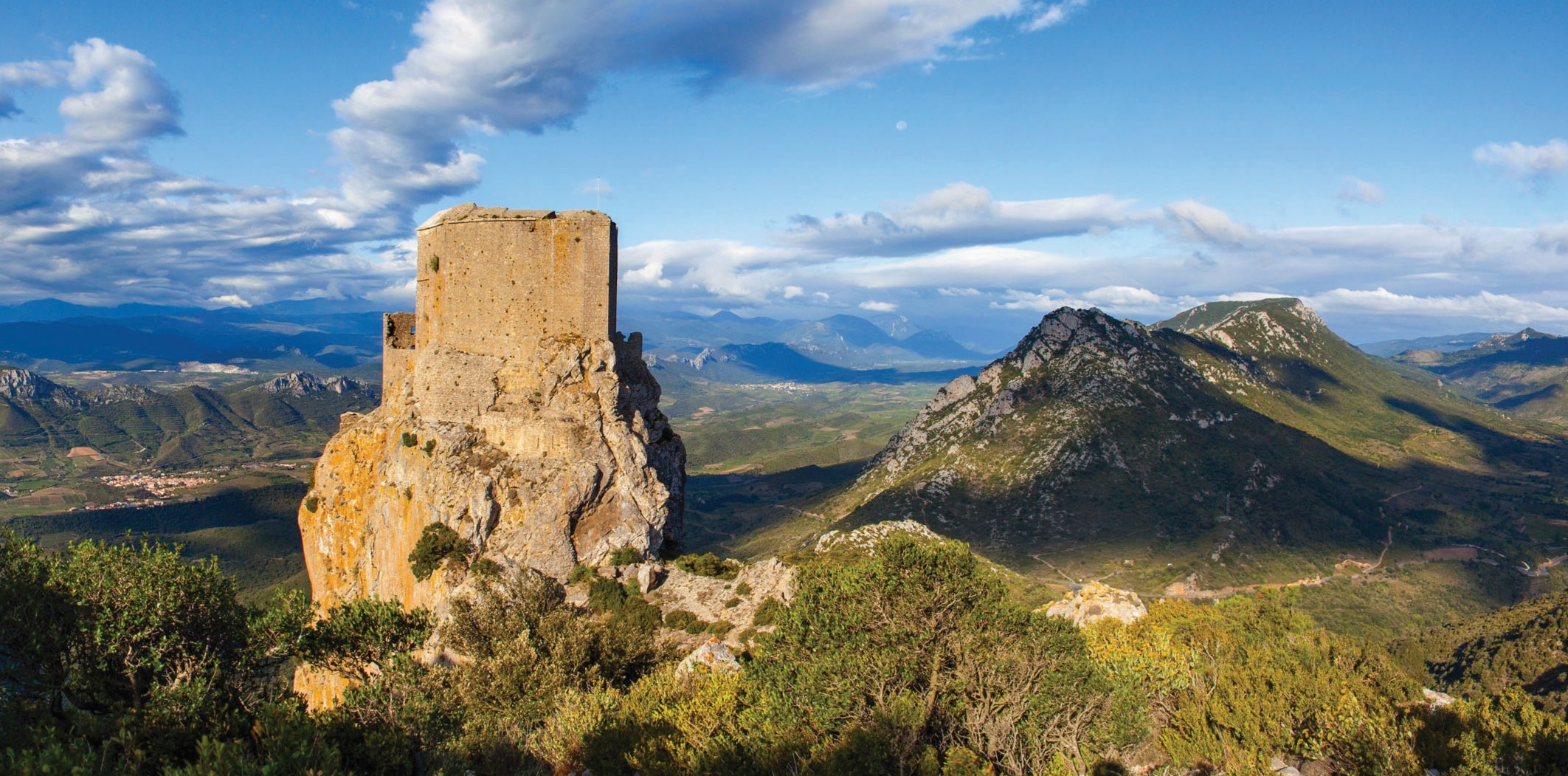
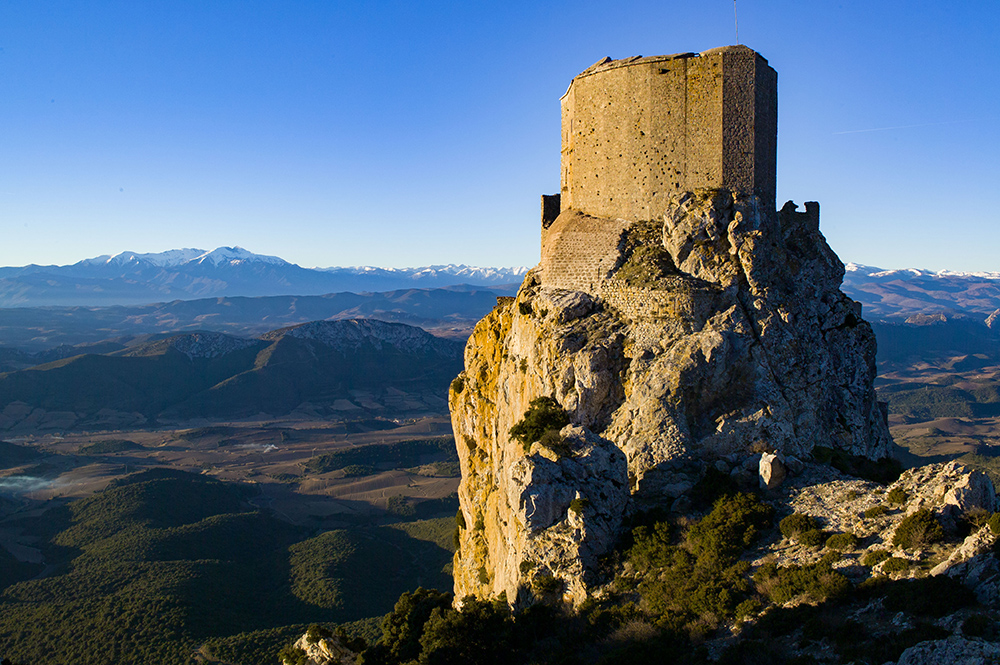
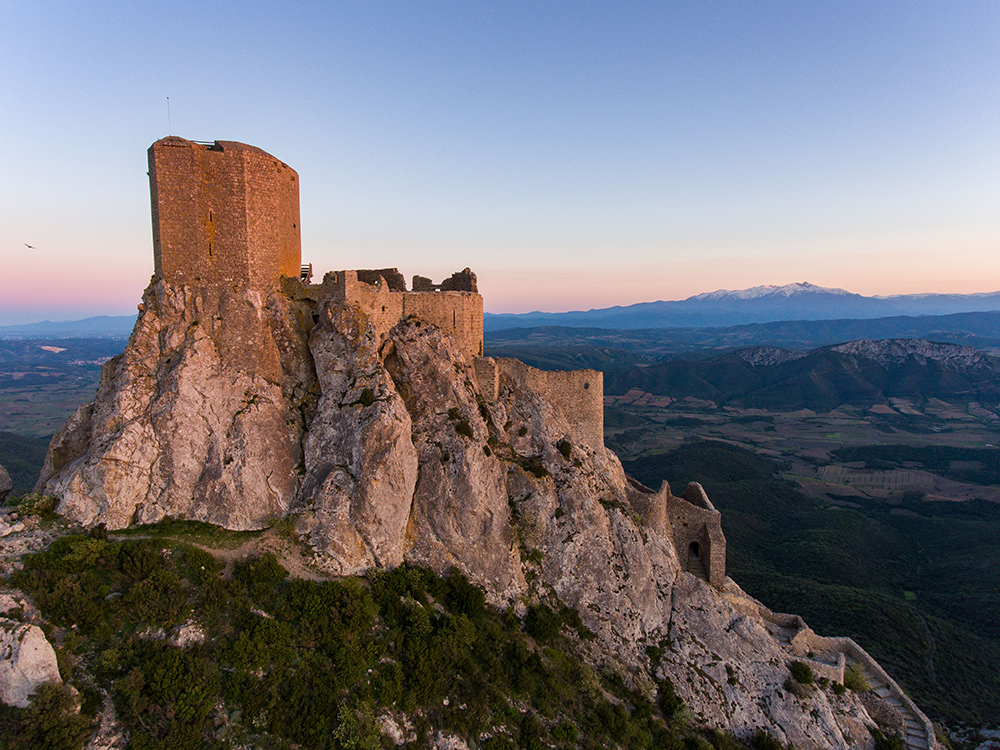
A true eagle’s nest perched at an altitude of 728 m on a rocky peak at the southern tip of the Hautes-Corbières, Quéribus Castle has watched over the vast Roussillon plain for centuries. This strategic position, at the borders of the ancient kingdoms of France and Aragon, earned it the status of a royal fortress by Saint Louis in the 13th century. The site is located in the commune of Cucugnan.
CURRENT LANDSCAPE SETTING

Quéribus Castle stands on a rocky peak of 728 m, located on the ridge line of the southernmost barrier of the Corbières massif. This limestone barrier, stretching from east to west from Tautavel to the Pic de Bugarach, forms the natural border between the Hautes-Corbières to the north and Fenouillèdes to the south, as well as between the Aude and Pyrénées-Orientales departments. It is a territory with a rugged topography, resulting from the collision of tectonic plates some 65 million years ago.
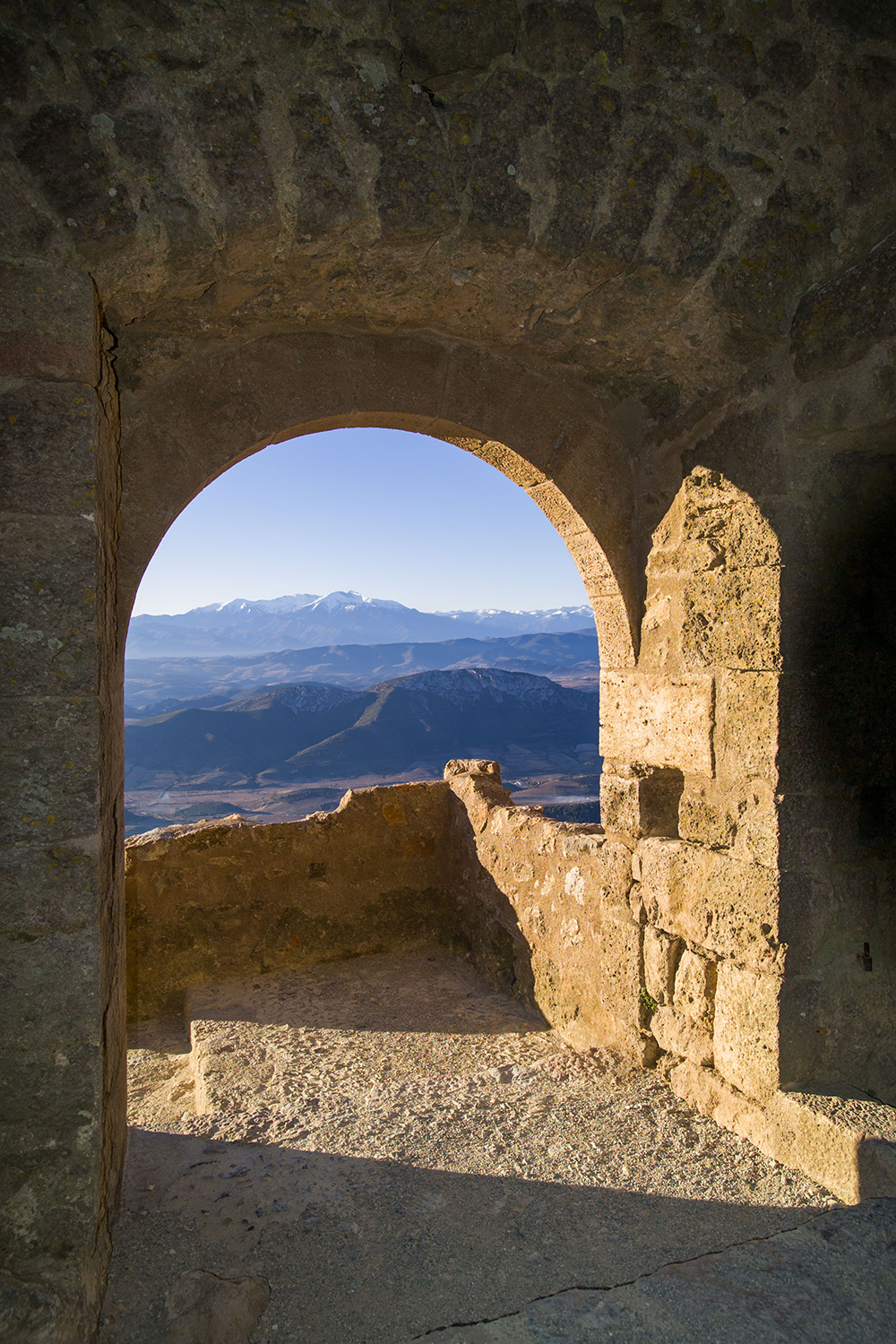
Guarding the Grau de Maury, a rare passage through the cliff, Quéribus overlooks the Maury valley to the south, where the border with the Kingdom of Aragon once lay. This valley is bordered to the south by the Fenouillèdes massif, an outpost of the Pyrenees, from which the snow-capped peaks of Canigou, the highest point of Roussillon (2,785 m), appear in the distance. To the east, the vast Roussillon plain opens up, extending to the Mediterranean Sea. To the north, on the Corbières side, Quéribus protects the Cucugnan valley.
This exceptional 360° panorama, which extends over a radius of more than 35 km, thus allows one to take in a great diversity of landscapes, alternating between mountain ridges, deep wine valleys, garrigue-covered slopes, and evergreen oak woodlands.
HISTORY
An impressive eagle’s nest overlooking the Roussillon plain all the way to the Mediterranean Sea, Quéribus Castle long defended the southern lands before protecting those of the north, integrated into the defensive network of the Kingdom of France in the 13th century.
QUÉRIBUS, LAND OF ARAGON
The first mention of Quéribus (Querbucio) appears in the year 1020 in the will of Bernard Taillefer, Catalan Count of Besalù, among the possessions he bequeathed to his eldest son Guilhem. In 1111, the domains of the Count of Besalù were united with those of the County of Barcelona, then integrated into the Kingdom of Aragon in 1162, following the marriage of Raymond Berengar IV, Count of Barcelona, and Petronilla, heiress to the Aragonese crown. Quéribus thus became one of the northernmost castles of the new and powerful Aragonese kingdom.
QUÉRIBUS, LAND OF ARAGON
The first mention of Quéribus (Querbucio) appears in the year 1020 in the will of Bernard Taillefer, Catalan Count of Besalù, among the possessions he bequeathed to his eldest son Guilhem. In 1111, the domains of the Count of Besalù were united with those of the County of Barcelona, then integrated into the Kingdom of Aragon in 1162, following the marriage of Raymond Berengar IV, Count of Barcelona, and Petronilla, heiress to the Aragonese crown. Quéribus thus became one of the northernmost castles of the new and powerful Aragonese kingdom.
LAST BASTION OF RESISTANCE
Left aside from the conflicts of the crusades of 1209 and 1226, Quéribus would be one of the last castles in the Corbières to fall into the hands of the King of France, along with Puilaurens. After the Treaty of Meaux-Paris in 1229, and even more so after the failure of Viscount Trencavel’s revolt in 1240, the castle indeed served as a refuge for Cathars and ‘faidits’ – these Languedocian lords dispossessed of their lands for supporting “heresy.”
One of them, Chabert de Barbaira, held the stronghold on behalf of the Lord of Fenouillèdes in the years 1241-1242. If King Louis IX of France then decided to besiege Quéribus, it was less to reduce this “nest of heretics” than to secure his position against the domains of the Crown of Aragon.
The operation was led by the Seneschal of Carcassonne, with the support of Olivier de Termes, one of Chabert’s former ‘faidit’ companions who had since rallied to Saint Louis. The siege lasted less than a month, and in May 1255, Chabert de Barbaira handed over the castle to the King of France in exchange for his freedom.


IN THE HANDS OF THE KING OF FRANCE
Having become a royal fortress, Quéribus Castle was endowed with a garrison composed of a castellan and twenty sergeants, and the king ordered a complete restructuring of the site to strengthen its military role. Thus enlarged and topped with a proud Keep, Quéribus could now fully assume its role as a watchtower on the new border with Aragon, established by the Treaty of Corbeil in 1258. Monitoring the distant lands as far as Perpignan and the coast, it guarded the Grau de Maury, one of the rare passages through the cliff, and formed the advanced post of Peyrepertuse, located 4 km as the crow flies to the northwest.
The dominion of the King of France over Quéribus was maintained over the years, as evidenced by Charles V’s letter addressed to the castellan in 1372, instructing him that “he is bound to watch day and night in our castle […], to provision it with food and everything necessary for its guard and its defense.” In 1473, however, Quéribus was besieged and retaken by the troops of the King of Aragon. Louis XI would take two years to reconquer the site.
IN THE HANDS OF THE KING OF FRANCE
Having become a royal fortress, Quéribus Castle was endowed with a garrison composed of a castellan and twenty sergeants, and the king ordered a complete restructuring of the site to strengthen its military role. Thus enlarged and topped with a proud Keep, Quéribus could now fully assume its role as a watchtower on the new border with Aragon, established by the Treaty of Corbeil in 1258. Monitoring the distant lands as far as Perpignan and the coast, it guarded the Grau de Maury, one of the rare passages through the cliff, and formed the advanced post of Peyrepertuse, located 4 km as the crow flies to the northwest.
The dominion of the King of France over Quéribus was maintained over the years, as evidenced by Charles V’s letter addressed to the castellan in 1372, instructing him that “he is bound to watch day and night in our castle […], to provision it with food and everything necessary for its guard and its defense.” In 1473, however, Quéribus was besieged and retaken by the troops of the King of Aragon. Louis XI would take two years to reconquer the site.
THE ADVENT OF ARTILLERY
During the 15th and 16th centuries, several significant redevelopments were undertaken at Quéribus to respond to advancements in artillery. The adaptation of the fortress to firearms notably resulted in the addition (or modification) of the first two enclosures.
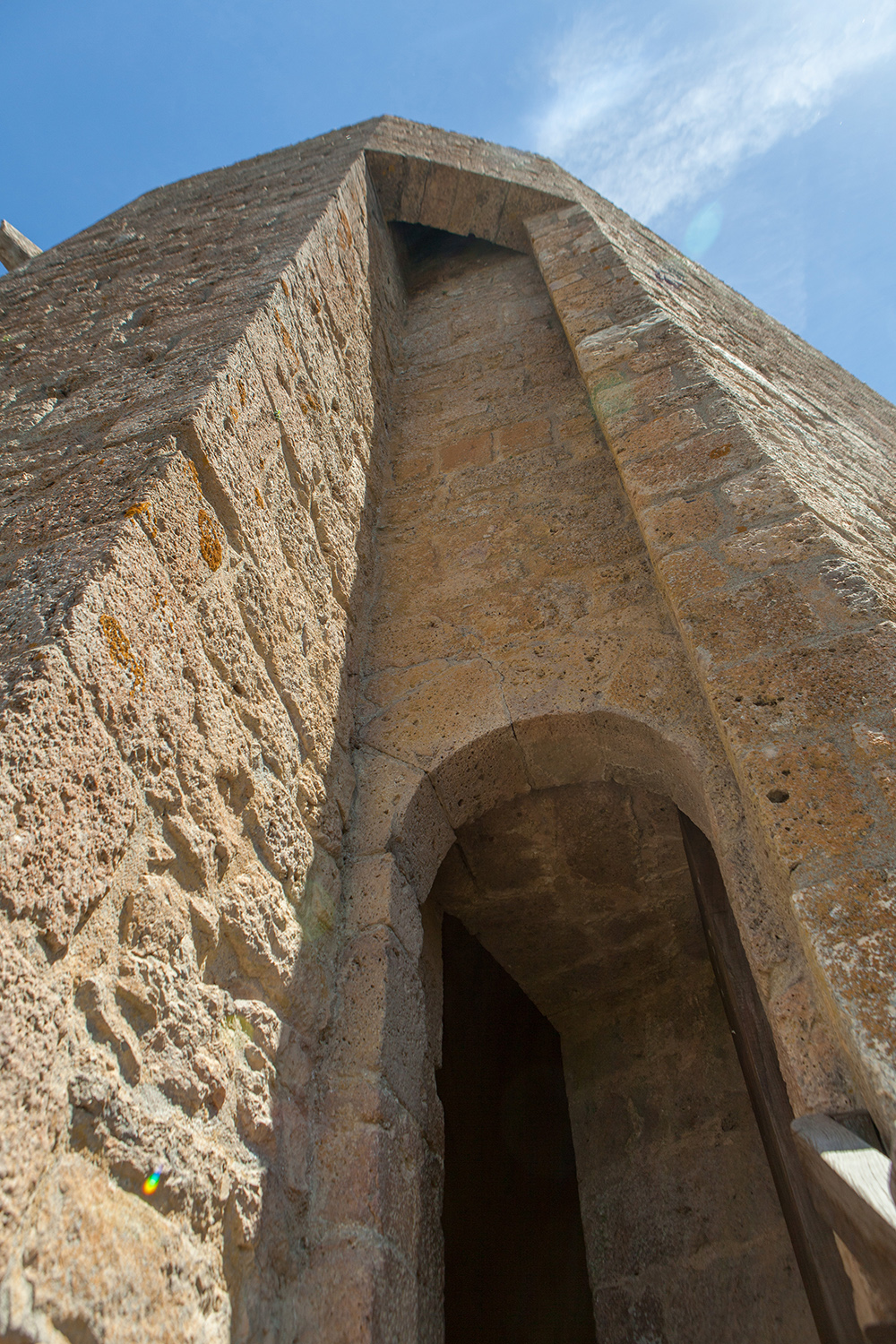
Pierced with gunports, they were also rounded at the corners to ensure better resistance to cannonballs. The keep itself was lowered to offer less firing surface and reinforced with a thick stone casing, which gives it its polygonal shape today.
In 1659, the Treaty of the Pyrenees, which ceded Roussillon to France, caused the castle to lose all strategic interest. Lacking maintenance, it fell into ruin; only the keep remained habitable, according to a 1685 document. However, a garrison was maintained there until the Revolution.
SITE DESCRIPTION
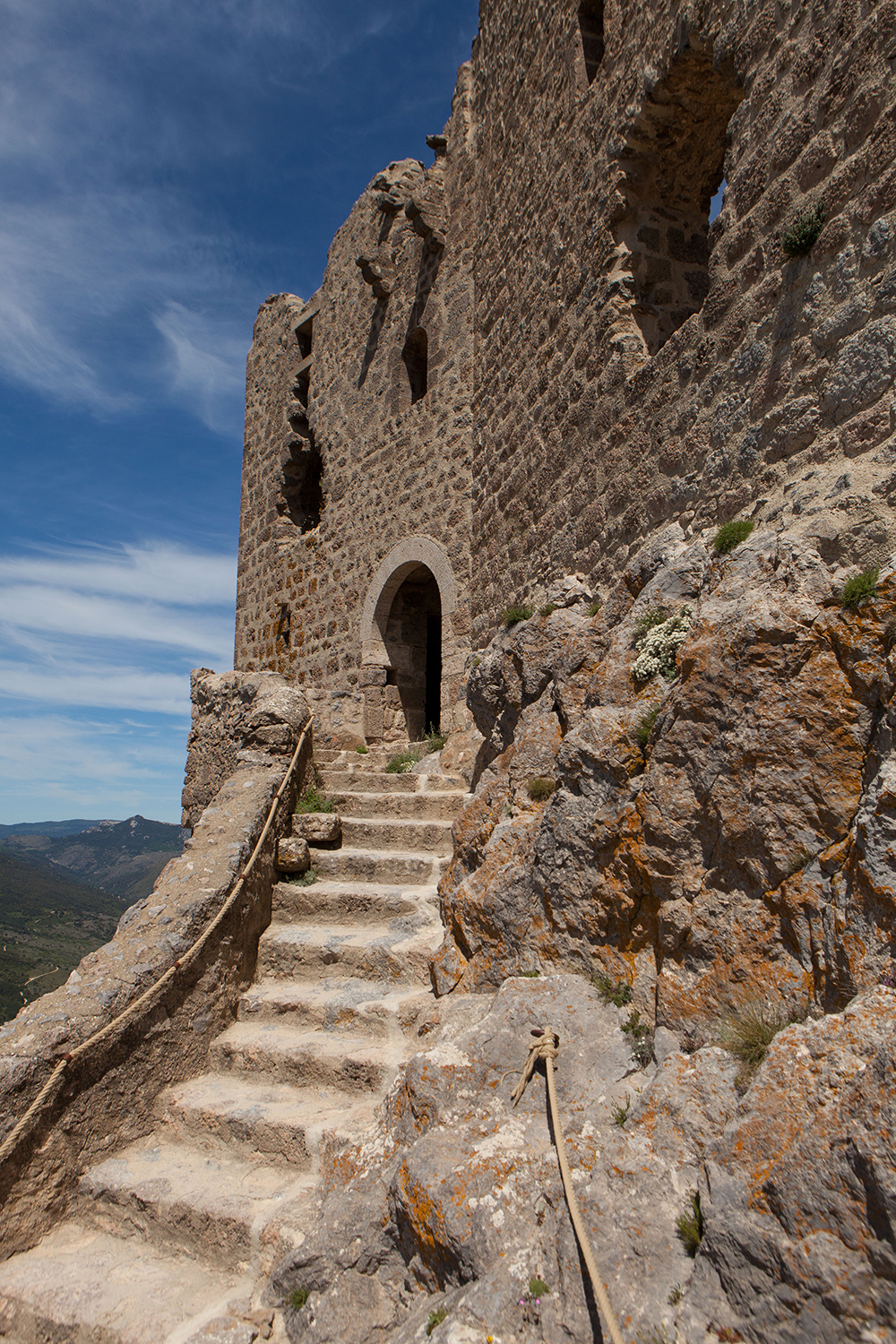
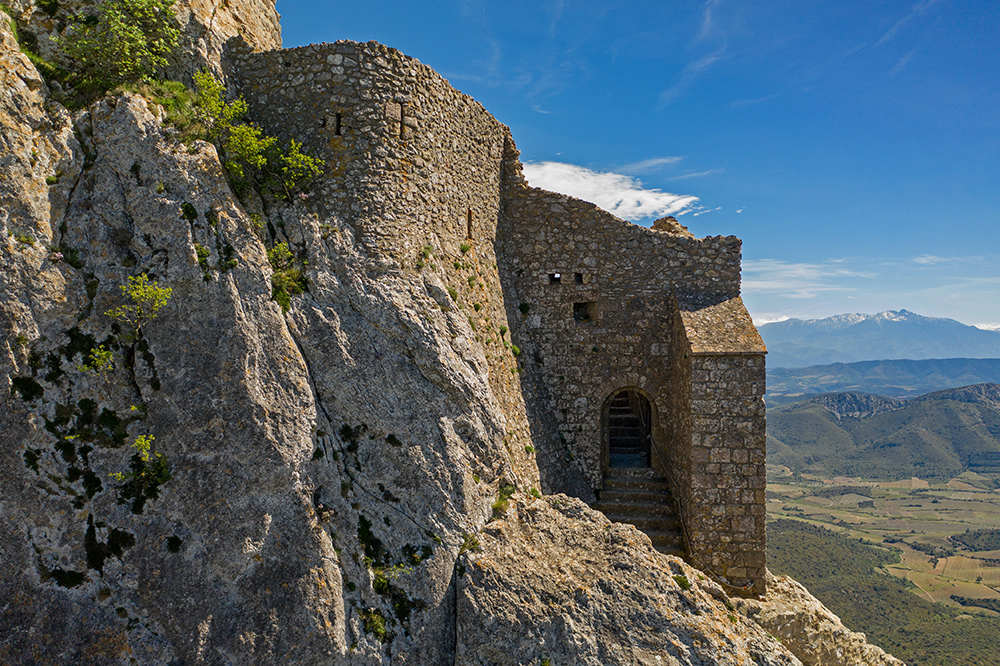
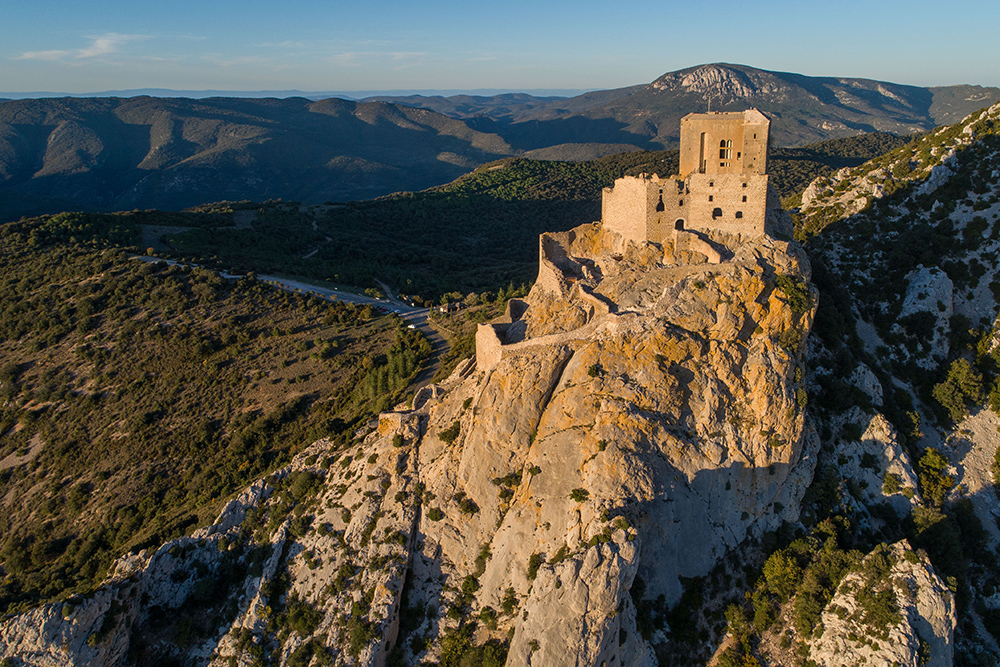
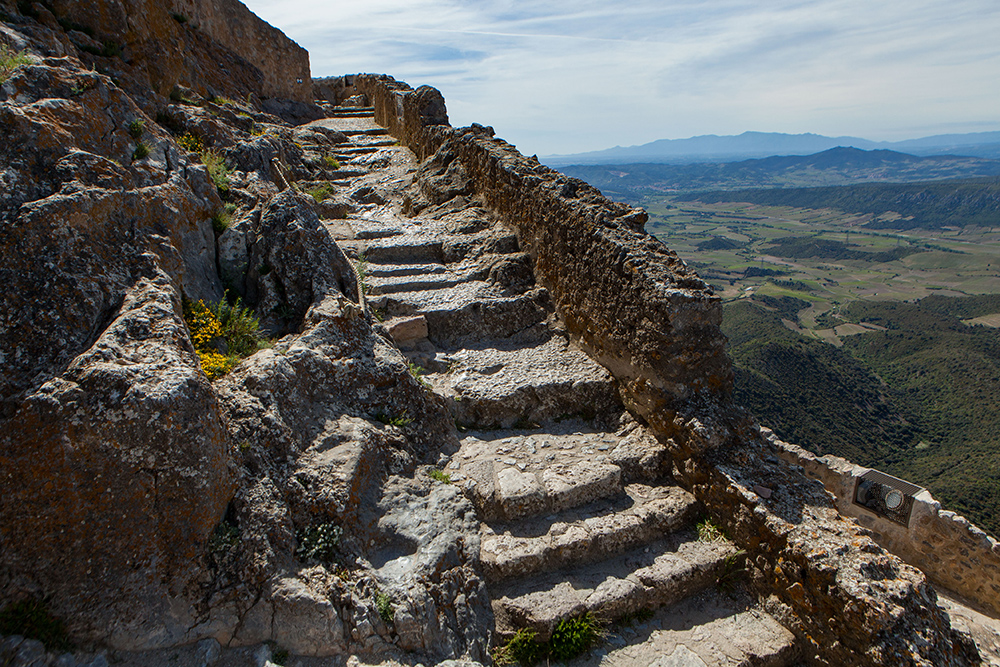
The access path, starting from the Grau de Maury, rises to the pass located to the southeast, then turns west towards the first chicaned defensive walls. It ends with wide stairs at the foot of the entrance gate. Built in tiers on the rocky peak, the fortress consists of three successive enclosures, commanding one another, and an imposing keep perched at the summit.

THE FIRST ENCLOSURE
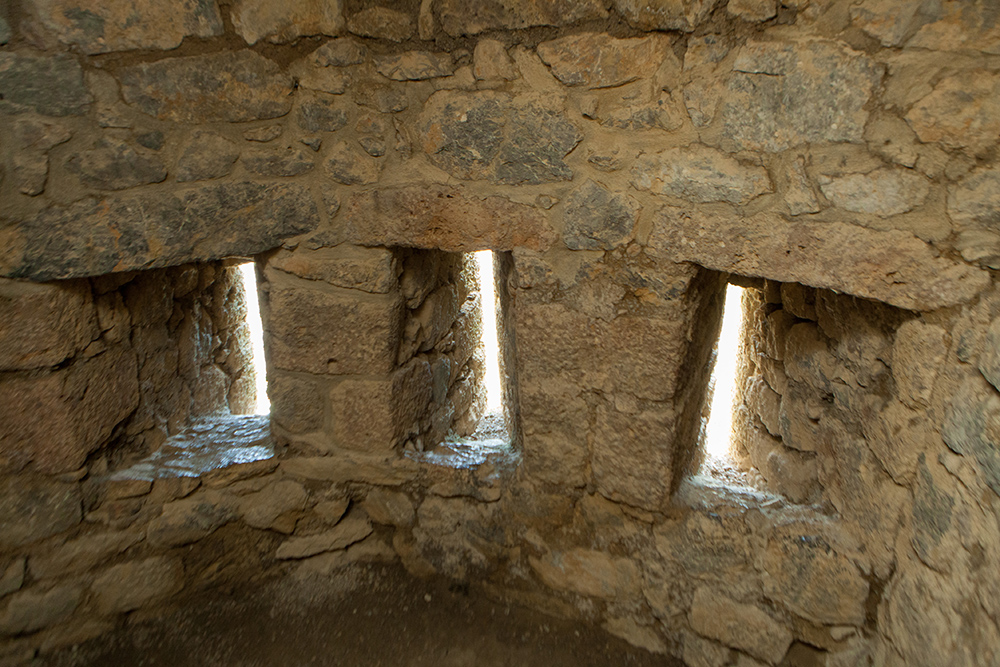
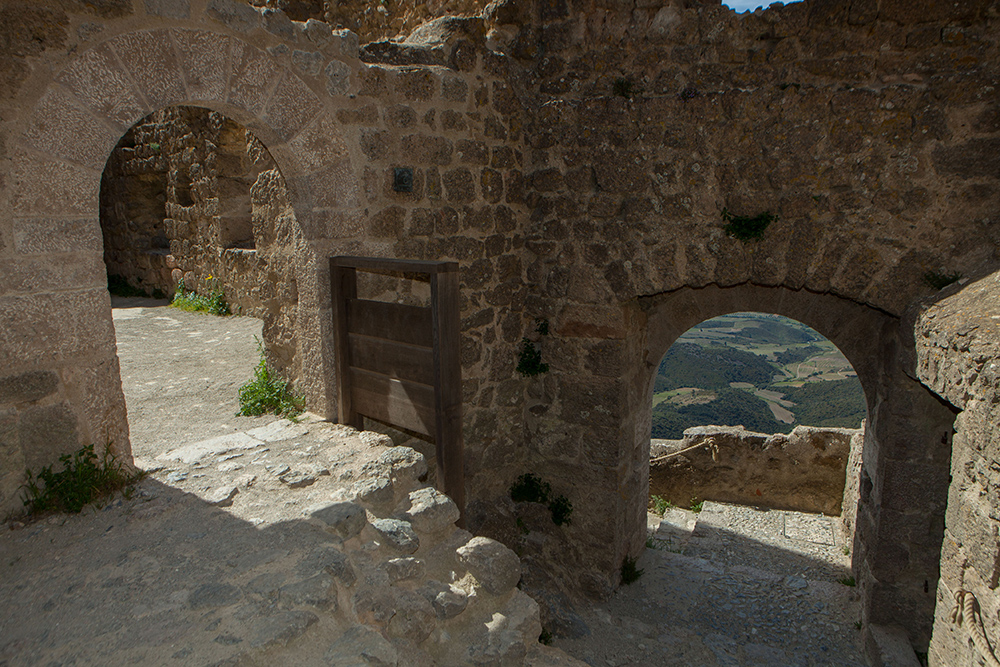
The lower enclosure forms a medium-sized compound, protected to the west by a wall pierced with loopholes and to the south by the sheer rock face. Special mention must be made of the shield wall. Of late construction (15th or 16th century), it is defended by gunports and adorned with embedded stone cannonballs, testifying to the abandonment of catapults at that time in favor of firearms. The entrance gate, topped by a Murder-hole, opens onto a wind-swept staircase.
THE FIRST ENCLOSURE
The lower enclosure forms a medium-sized compound, protected to the west by a wall pierced with loopholes and to the south by the sheer rock face. Special mention must be made of the shield wall. Of late construction (15th or 16th century), it is defended by gunports and adorned with embedded stone cannonballs, testifying to the abandonment of catapults at that time in favor of firearms. The entrance gate, topped by a Murder-hole, opens onto a wind-swept staircase.
THE SECOND ENCLOSURE
The second enclosure, also of small dimensions, houses a large hall that was likely used to quarter part of the garrison and which 17th-century texts refer to as the “barracks.” The still visible arcades attest to the presence of an upper floor.
Opposite this building, at the foot of the third enclosure, appear the remains of an old cistern partly excavated into the rock. The fortress thus possessed several cisterns, arranged in cascades on the slope, allowing for optimal rainwater collection.
THE THIRD ENCLOSURE
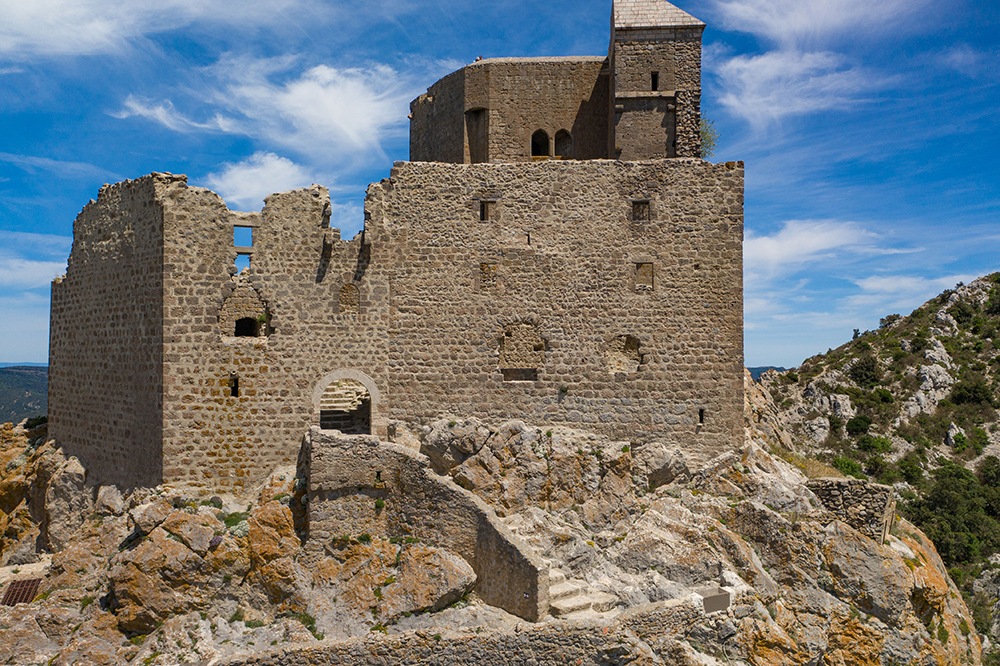
Accessible via a gate defended by a Brattice, the third enclosure is by far the most important. It is organized around a courtyard surrounded by buildings to the south and west, and the keep to the east. The first vaulted room located to the west, partly carved into the rock, appears to have served as a powder magazine.
While the large, carefully cut stone blocks attest to an initial royal-era construction, the vault was indeed added in the 15th or 16th century, probably to safely store gunpowder, and this in the most protected part of the castle. The presence of two large windows ensuring ventilation confirms this hypothesis. The second vaulted room houses a cistern. To the south stand the remains of the main building, which originally comprised several floors.
THE THIRD ENCLOSURE
Accessible via a gate defended by a Brattice, the third enclosure is by far the most important. It is organized around a courtyard surrounded by buildings to the south and west, and the keep to the east. The first vaulted room located to the west, partly carved into the rock, appears to have served as a powder magazine.
While the large, carefully cut stone blocks attest to an initial royal-era construction, the vault was indeed added in the 15th or 16th century, probably to safely store gunpowder, and this in the most protected part of the castle. The presence of two large windows ensuring ventilation confirms this hypothesis. The second vaulted room houses a cistern. To the south stand the remains of the main building, which originally comprised several floors.
the fortress in pictures