
The OUV
 Accueil > Discover >
 The Definition of “Outstanding Universal Value”

To be inscribed on the World Heritage List, any nominated property must demonstrate that it possesses “Outstanding Universal Value” (OUV). The property must be representative of a heritage common to all humanity, but it must also be distinguished by characteristics (the “attributes”) that differentiate it from other similar properties. In other words, it must ‘speak to everyone’ while being unlike any other.
To help define this rather theoretical concept, selection criteria have been established by UNESCO → Today, there are ten; for example, the property must represent a masterpiece of human creative genius; be an area of exceptional natural beauty; bear witness to an important exchange of influences in the fields of architecture, arts, or landscapes…
But meeting one of these criteria is not enough; the nominated property must also demonstrate its integrity (it must be sufficiently complete for its OUV to be understood) and its authenticity (if it is complete, it must be in its original state and not due to reconstruction); and to ensure that it truly presents unique characteristics, it is compared with other similar properties worldwide, through an international comparative analysis.
The Royal Fortresses of Languedoc, a ‘Serial Property’
The Royal Fortresses of Languedoc are proposed for inscription on the World Heritage List as a ‘serial property’, bringing together, around the castle and ramparts of Carcassonne, the castles of Aguilar, Lastours, Montségur, Peyrepertuse, Puilaurens, Quéribus, and Termes.
The eight monuments comprising the property therefore do not apply for inscription individually, but form a single, indivisible ensemble.
The eight fortresses are distributed between the departments of Aude and Ariège, in the Occitanie region (France). The serial property forms a discontinuous area covering 76.45 hectares and is spread across a sector marked by the Montagne Noire to the north, the Corbières to the south, the Pyrenees to the west, and the Roussillon plain or the Mediterranean coast to the east.
The boundaries of the property include for each component: the fortress, the terrain, base, or rocky spur on which the fortification is built, and known ancillary remains (chicanes, castral villages, barbicans, chapel, old quarries…).
The buffer zone of the property extends over an area of 9,407 hectares. It encompasses the landscape setting of the property, defined according to geomorphological elements (ridgelines, valleys, passes), built structures (small forts, market towns, mines…), geographical landmarks (rocky ridgelines and/or emblematic mountains), and historical routes.
The Foundations of the OUV of an Unparalleled Ensemble of Fortifications
The Establishment of the Fortified Network
Located in the south of France, in the Occitanie region, between the southern limit of the Massif Central and the eastern part of the Pyrenees, the cultural property proposed for inscription consists of the most remarkable elements of the fortification system established in the 13th century by the kings of France to assert their authority over the newly conquered territory of Carcassonne. It comprises a selection of seven castles: Aguilar, Lastours, Montségur, Peyrepertuse, Puilaurens, Quéribus, and Termes, associated with the castle and ramparts of Carcassonne. The selected series presents the best-preserved and most authentic sites of this ensemble of royal fortresses.
In the 1230s, following the Albigensian Crusade, the kings of France asserted their authority between the Rhône and Garonne rivers. Due to its geographical choke point position, Carcassonne quickly emerged as the main strategic stronghold of their new domains. They made it the center of a seneschalty, an administrative territory governed directly by the king’s representative: the seneschal.
But after twenty years of wars, exactions, and burnings, the country was far from subdued. In the rugged terrain of the Corbières, the Montagne Noire, or the Pyrenean foothills, rebellious lords continued armed struggle. In the cities, faced with religious repression led by the Inquisition, numerous revolts broke out. Furthermore, the south of the conquered territory was in direct contact with the powerful Kingdom of Aragon, which was rather hostile to France.
To control this difficult context, the kings of France launched an intensive fortification campaign. Carcassonne was made impregnable: its ancient wall was rebuilt and modernized, a second enceinte encircled by moats was added, and, within the city, the old viscounts’ palace was replaced by a castle whose defenses were turned against the town. In the same impetus, to control the territory, about twenty castles were confiscated from local lords and entirely transformed into royal garrison strongholds.
Architectural Exchanges and Innovations
These royal fortresses were built according to the principles of Capetian military architecture, which, in the 13th century, was at the forefront of innovation. This model of fortification, which had not yet reached Languedoc, is characterized by the geometric regularity of the enceintes, the proliferation of round towers with arrow slits, the presence of keep-towers integrated into the defense, dwellings built against the curtain walls, and the remoteness of residential areas.
However, to effectively occupy the entire territory, the royal fortresses had to be established in place of the most strategic southern castles, most often built on rocky ridges. The Capetian architectural model, originally designed for the plains of northern France, therefore had to adapt here to steep terrain, forcing master builders, masons, and carpenters to achieve architectural feats.
The monuments in the series, by their location atop cliffs, all demonstrate the king’s will to assert his power through spectacular constructions. The same applies to Carcassonne, whose enormous defensive system presents the complete repertoire of Capetian innovations.
Built with considerable resources, for the same purpose, by the same teams, and in a relatively short period, the castles in the series exhibit remarkable homogeneity both in their overall design and in their architectural detail. This new way of conceiving castles was quickly and widely adopted in the region, both by the king’s vassals and by neighboring principalities.
Testimony to a Pivotal Moment in Medieval Europe
This establishment by the royal administration, in the 13th century, of a vast system of territorial and border control testifies to the Capetian will to form a great European state. The fortified network of the seneschalty of Carcassonne particularly illustrates the expansionist will of the kings of France towards the Mediterranean world and the Iberian kingdoms. This ensemble of fortresses remained in its military function until the Treaty of the Pyrenees, which, in 1659, formalized the French victory over Spain and shifted the border southward.
Furthermore, the royal fortresses of Languedoc are an early and successful example of centralized military and administrative management for a territory distant from the seat of royal power.
This territorial organization, based on an imposing fortified ensemble, served as a model for the great European kingdoms then under construction.
An Exceptional Ensemble
This serial property, exceptional in its homogeneity and preservation, constitutes a rare example of a territorial defense system for the 13th century and the beginning of the following century. It serves as a reference example in the geopolitical space of Western Europe and the Mediterranean Middle East of the 13th and 14th centuries.
Little modified by history, the royal fortresses continue today to stand out within spectacular and preserved natural landscapes.
Attributes and Criteria
This ensemble of monuments therefore indeed presents Outstanding Universal Value which, to meet the expectations of the World Heritage Convention, must be based on a series of attributes, allowing it to be inscribed under at least one of the selection criteria defined by UNESCO. The serial property has five attributes:
1: A Large-Scale Central Stronghold
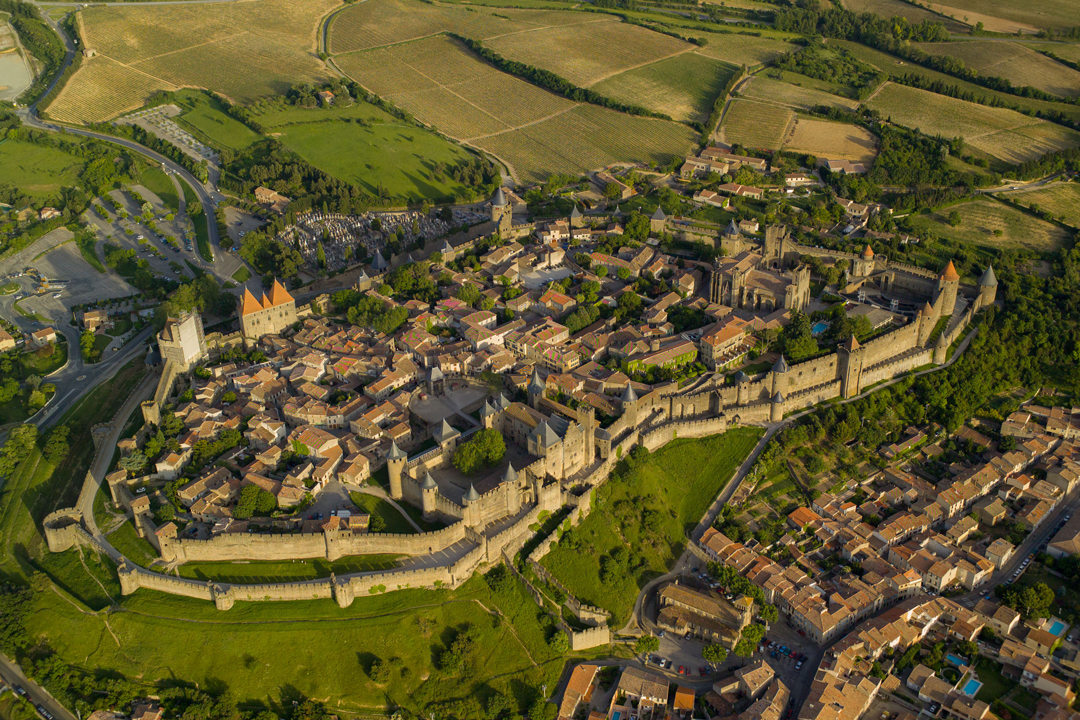
The entire military system is organized around Carcassonne. The fortifications of the City constitute a command center, with the seneschal’s castle at its heart. Carcassonne’s defensive system is very complete thanks to 19th-century restorations, carried out under the direction of Viollet-le-Duc and based on genuine scientific study. The Historic Fortified City of Carcassonne has already been inscribed on the World Heritage List since 1997.
2: A New Defensive System Designed on a Territorial Scale
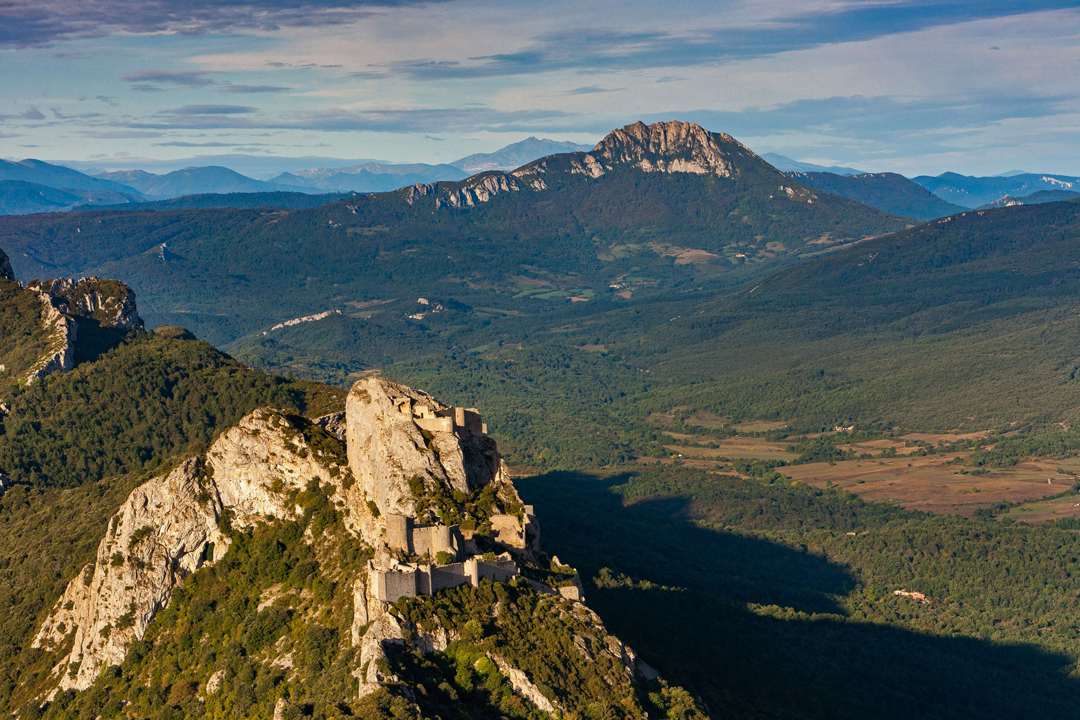
The castles in the series are part of a network built by the royal administration throughout the territory of the seneschalty to impress rebellious populations and protect the new southern border of the Kingdom of France against Aragon.
3: A Homogeneous Overall Construction Program
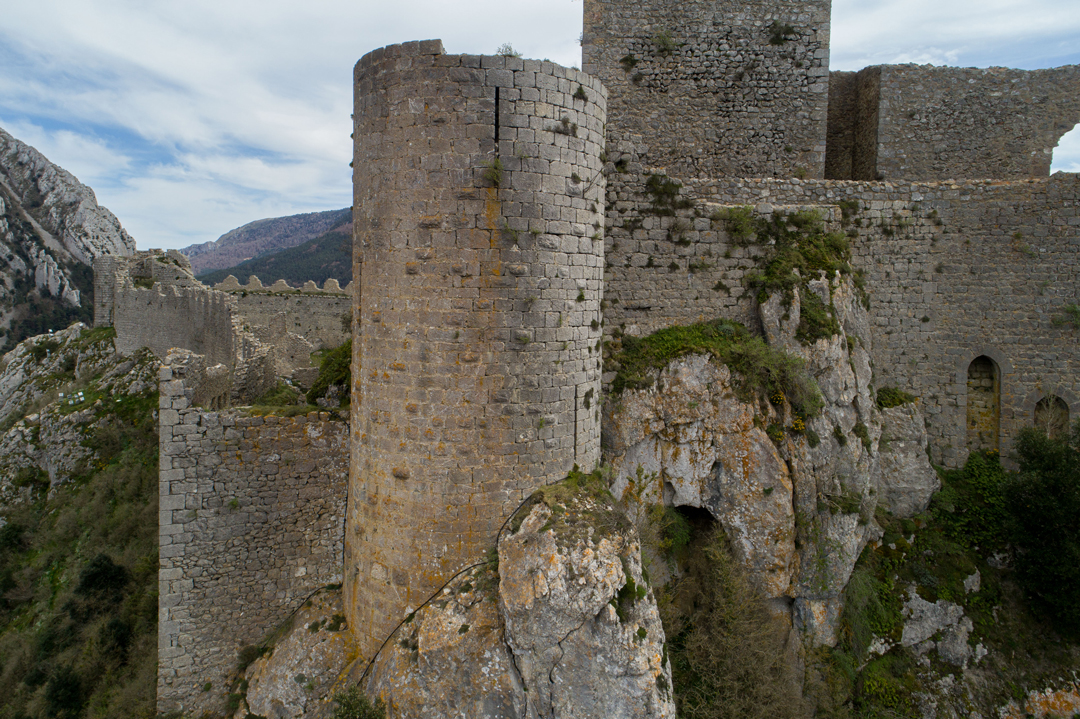
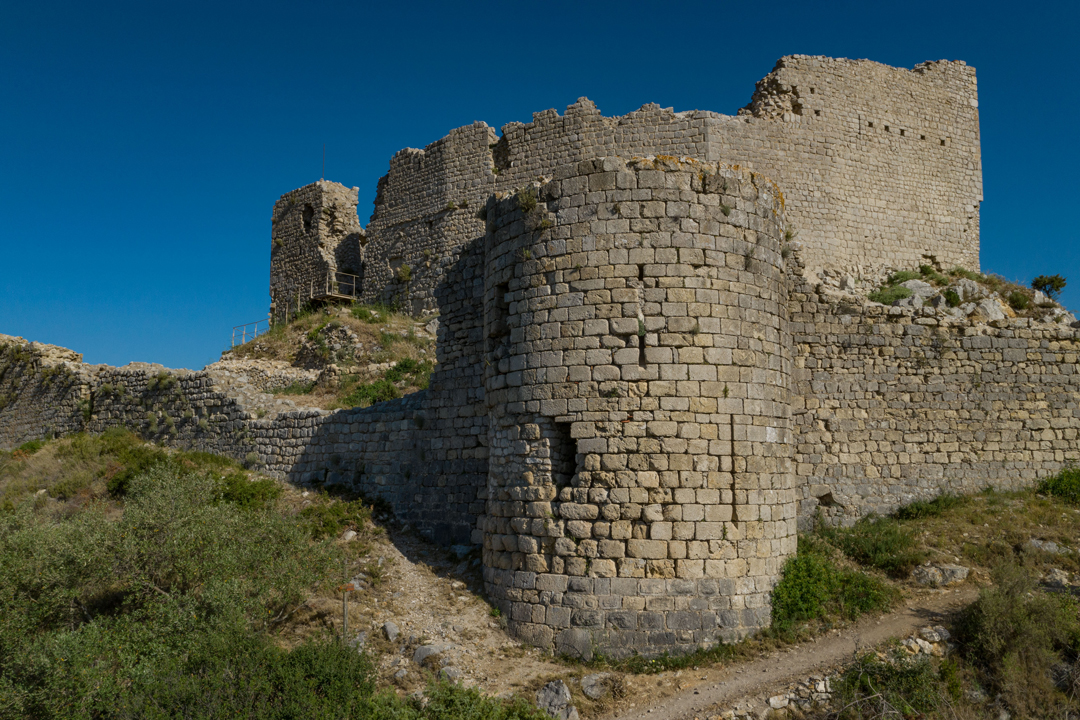
The fortresses are built according to the principles of 13th-century Capetian military architecture. These castles are built under royal patronage, with significant financial resources, as part of parallel construction projects carried out in a relatively short period, which gives the series great architectural unity.
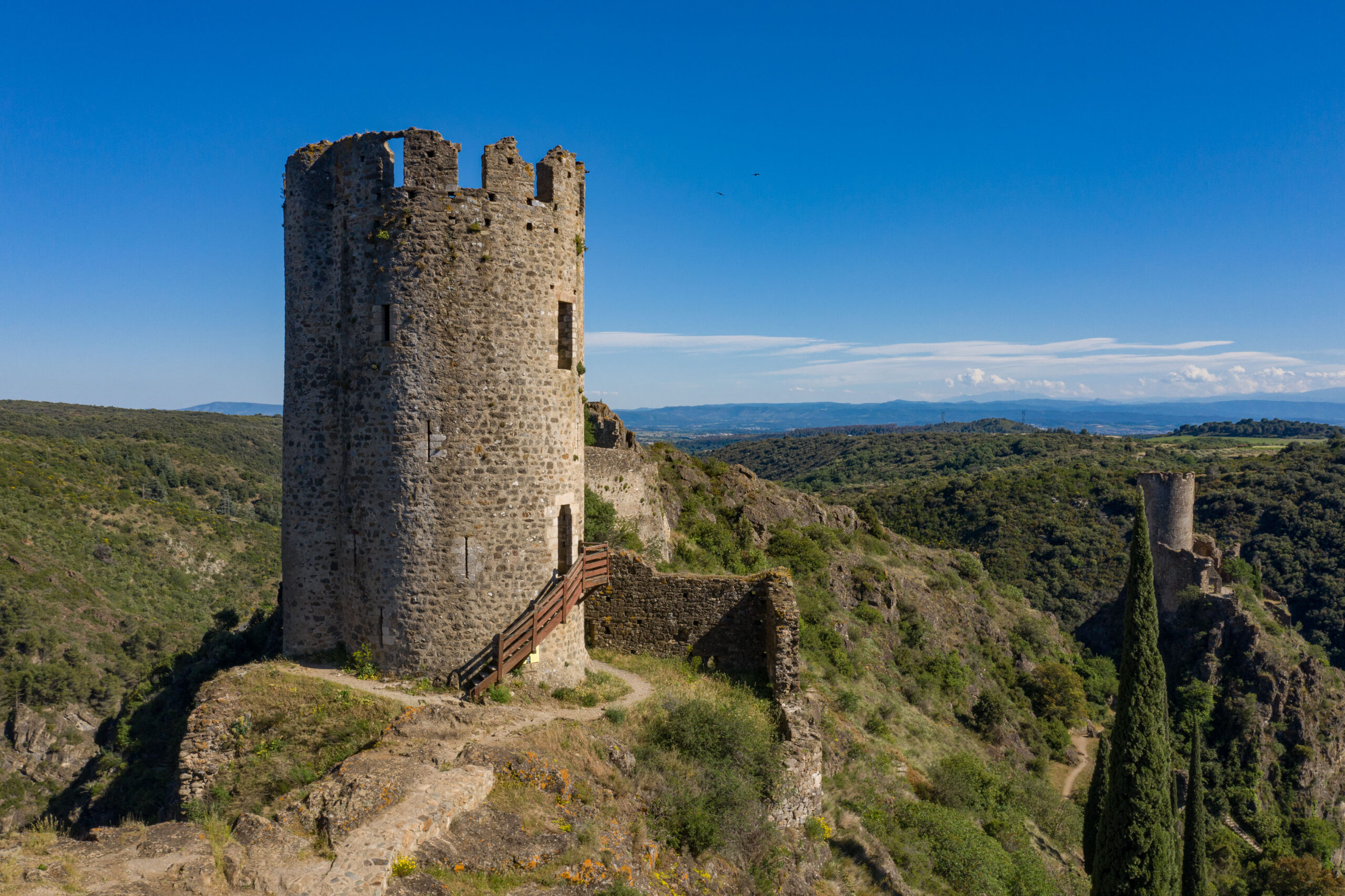
4: Ridge Sentinel Castles
The sites were chosen by the royal administration, from among the feudal strongholds of the region, based on their strategic locations and their steep, easily defensible positions.
The fortification principles originally developed for the plains of northern France had to be adapted here to rocky peaks, forcing master builders, masons, and carpenters to achieve architectural feats to adapt the construction to the rock.
These monuments are also intended to be seen, embodying royal power through their scale and spectacular appearance.
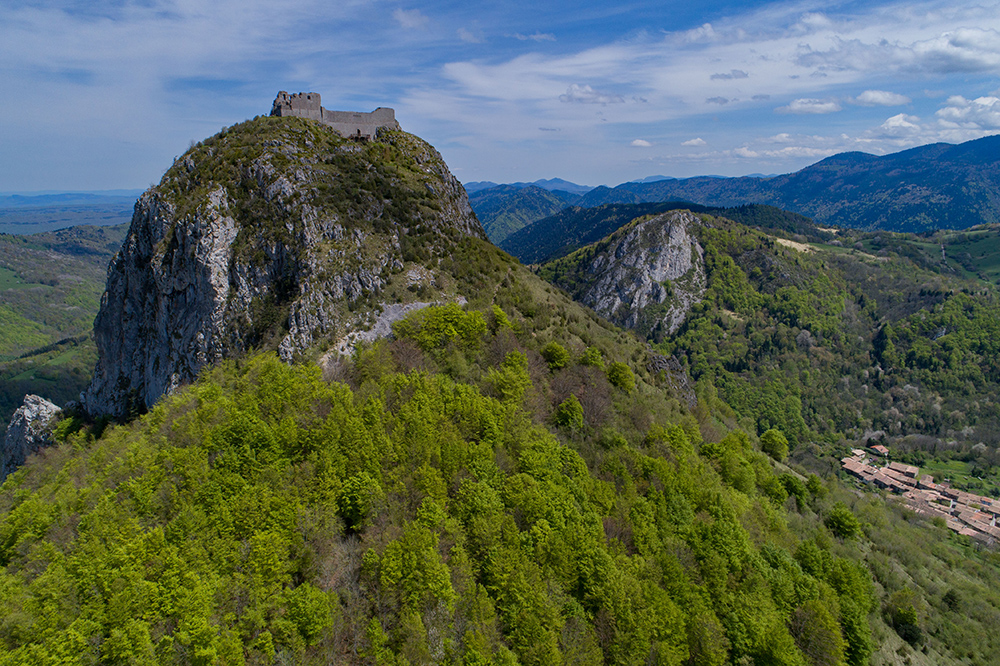
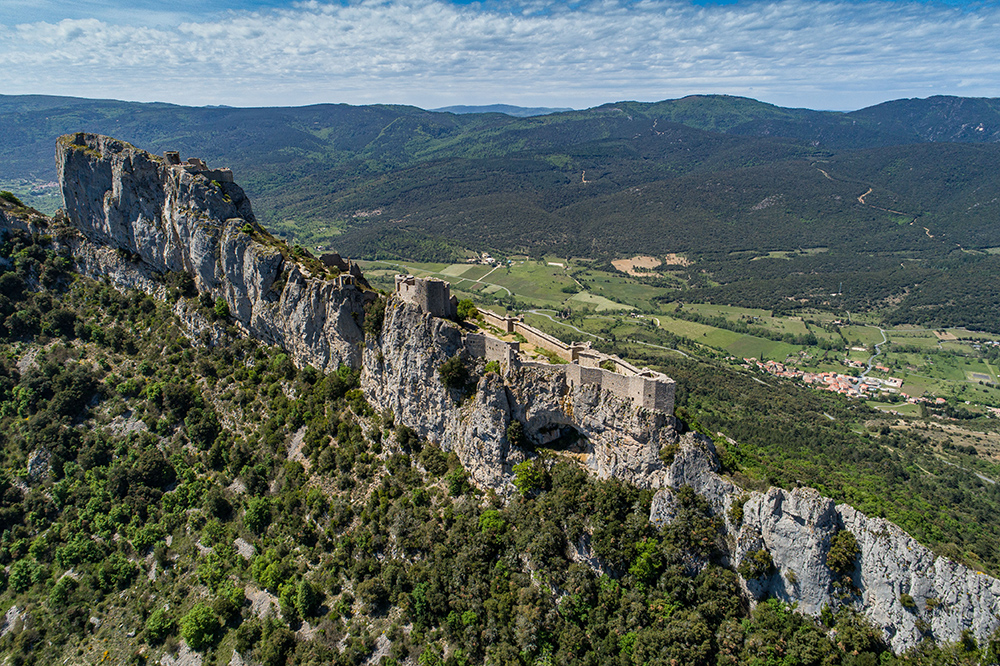

5: Great Preserved Visual Quality
Their steep position makes them impressive visual landmarks today within preserved landscapes little modified by man since the 13th century.
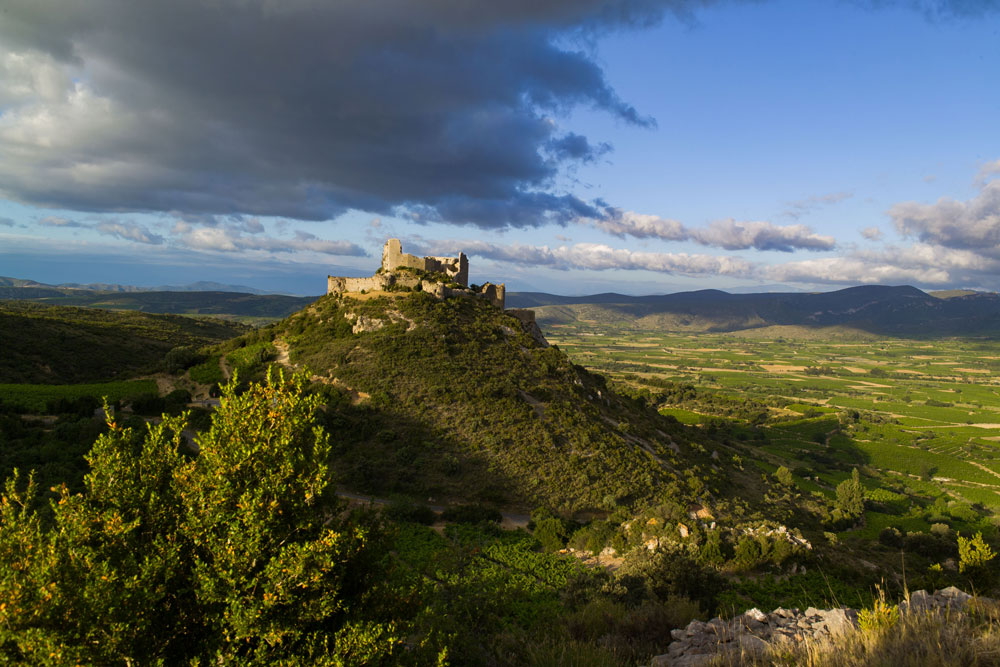
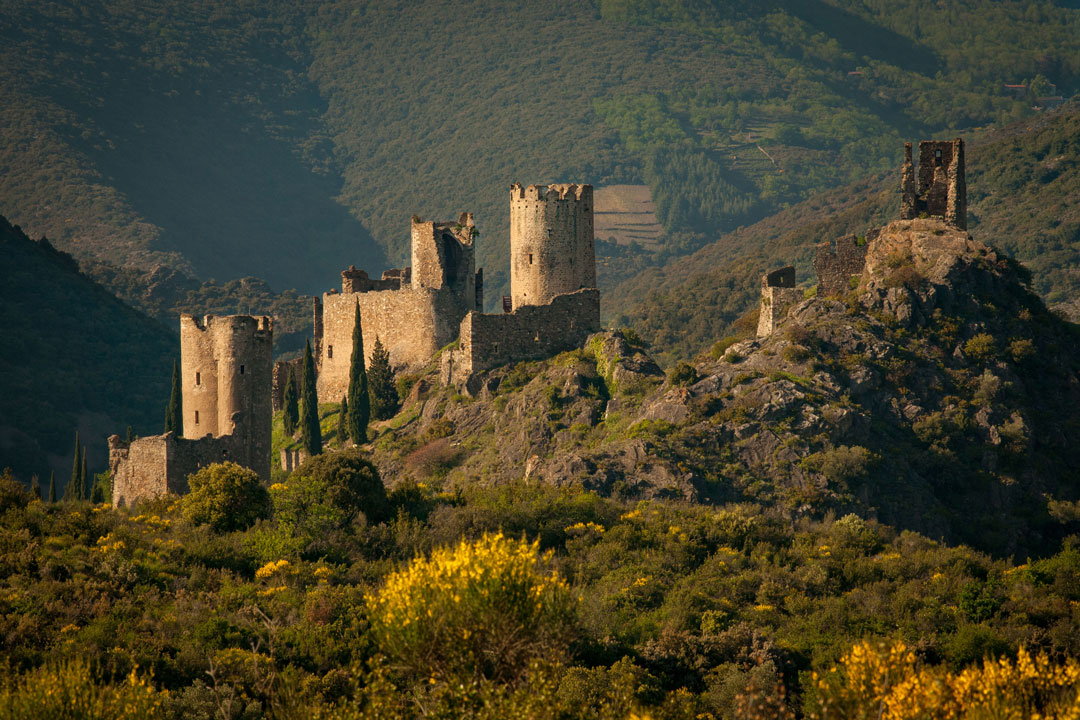
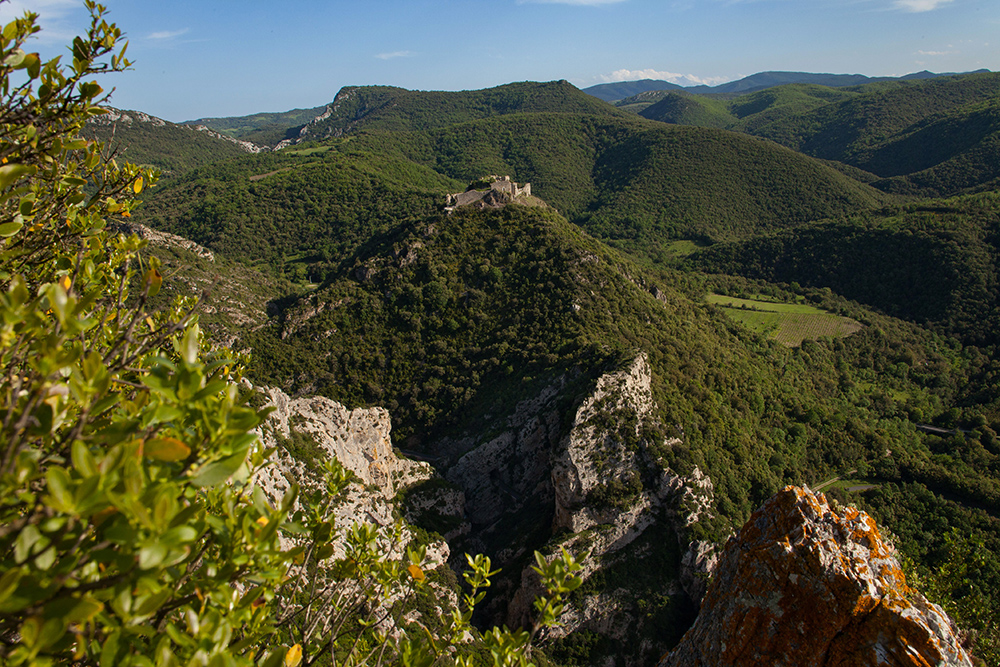
These five characteristics allow the Royal Fortresses of Languedoc to meet two of UNESCO’s criteria:
Criterion (II)
(To exhibit an important interchange of human values, over a span of time or within a cultural area of the world, on developments in architecture or technology, monumental arts, town-planning or landscape design).
With the establishment of the seneschalty, Capetian military architecture became dominant in the Languedoc lands where it had not yet penetrated. However, the royal seneschals, in a concern for efficiency, adopted the territorial occupation logic of the southern lords by dispersing their fortresses in the heart of the relief zones. They therefore established themselves in place of the country’s main feudal strongholds, built on rocky peaks. The royal master builders therefore had to adapt the Capetian architectural model, originally designed for the plains of northern France, to difficult terrain.
As such, the serial property constitutes, for the 13th and 14th centuries, a remarkable milestone in the broad movement of diffusion of Capetian military architecture from Western Europe towards the Mediterranean and the Middle East.
Criterion (IV)
(To be an outstanding example of a type of building, architectural or technological ensemble or landscape which illustrates (a) significant stage(s) in human history).
The fortress system of the seneschalty of Carcassonne marks the assertion of French royal power during the conquest of regions located on the southern borders of the kingdom. It particularly illustrates the expansion strategy of the kings of France towards the Mediterranean world and the Iberian kingdoms, which would lead to four centuries of conflicts and active diplomacy.
The entire ensemble of fortresses is administered from Carcassonne Castle by the seneschal, the king’s direct representative. This planning by the royal administration of a vast centralized system of territorial and border control is characteristic of the Capetian ambition to form a great European state.
To support the demonstration of the Outstanding Universal Value of the serial property, it is also necessary to justify its state of integrity and authenticity.
From the list of royal castles of the seneschalty of Carcassonne from the 13th and 14th centuries, the monuments constituting the serial property were selected according to precise criteria taking into account the notions of integrity and authenticity, as well as the individual contribution of each fortress to the Outstanding Universal Value of the ensemble.
Integrity: Is the serial property sufficiently complete to clearly illustrate the OUV?
The integrity of the City’s military elements has already been recognized through the inscription on the World Heritage List, in 1997, of the Historic Fortified City of Carcassonne, following its comprehensive restoration by E. Viollet-le-Duc in the second half of the 19th century. This restoration, carried out on the basis of rigorous archaeological study, highlighted the preeminence of Capetian military architecture in the fortifications of Carcassonne.
The most recent archaeological studies on the enceintes and Carcassonne Castle indeed confirm this integrity of the 13th and 14th-century walls, the 19th-century additions having been mainly limited to the upper parts.
For their part, the selected castles are sufficiently well preserved, individually, to each be fully representative of a royal mountain fortress of the 13th or early 14th century.
The series is emblematic of the various missions assigned to these fortresses: protecting Carcassonne, controlling economic resources and communication routes, erasing the memory of local feudal lineages, and defending the new border.
Authenticity: Does the serial property owe its integrity to reinventions or abusive restitutions?
The overall authenticity of the series is attested by several levels of scientific analysis.
Archival documents testify to construction projects carried out in parallel on these sites, under royal supervision, in the second half of the 13th century. They also inform us about their centralized management from Carcassonne Castle. The study of the monuments’ construction highlights the architectural commonalities of the monuments as well as their adaptation to the supporting rocks. Furthermore, archaeological research confirms the purely military function of the buildings as well as the dating of the royal construction phases (mid-13th century to early 14th century).
The sites were maintained by the royal administration in their primary military function until the Peace of the Pyrenees (1659), but without notable transformations, apart from the creation of a few openings for muskets and barracks, thus allowing them to reach us with a high degree of authenticity.
For the ramparts and castle of Carcassonne, the distinction between the 13th-14th century parts and those of the 19th century has been clarified by scientific studies. It is now possible to state that the majority of the masonry of the Carcassonne castle and ramparts corresponds to the fortification carried out by the Capetian kings as part of the defense of the seneschalty.
The royal mountain fortresses have only undergone consolidation work aimed at preserving them in their original state. Their early classification as Historic Monuments, for all the monuments constituting the serial property, has ensured their regular and appropriate maintenance. Furthermore, the rocky foundations supporting the fortifications have not suffered any alteration over the centuries and still bear witness today to the conditions under which these fortresses were built.
The final step in justifying the Outstanding Universal Value of the serial property involves an international comparative analysis, which must demonstrate that the nominated property has no equivalent on the World Heritage List.
Three comparative axes were developed as part of this analysis.
Axis 1 concerns a local approach conducted on three levels. Firstly, within the ensemble of royal fortresses of the Carcassonne seneschalty itself, it was necessary to demonstrate that the selected castles are indeed the most representative and best preserved of the royal fortified network. Secondly, within the same territory, Capetian-type castles built by the king’s great vassals were studied through a few emblematic examples. These constructions are primarily residential and have nothing to do with royal garrison strongholds. Finally, the analysis was extended to other royal seneschalties of Languedoc (Toulouse, Rouergue, Beaucaire). While some royal fortresses, sometimes of high quality, can be found there, in no case is there such a powerful and structured defensive system as the one which, centered on Carcassonne, protects the Aragonese border.
Axis 2 focused on the study of territorial defense systems. These were approached in two stages. Firstly, an analysis of fortified cities on the World Heritage List was carried out, without finding any equivalent, for the medieval period, of a city presenting a perfectly preserved and architecturally homogeneous defense system forming the center of a coordinated defense system of the same architectural style.
Secondly, territorial defense systems were examined, but these often stem from other concepts; large linear walls for Asia or late antiquity, sets of forts designed for gunpowder artillery… For the medieval period, some castle networks still exist, but without their central city having retained its medieval appearance and without their natural environment being as preserved as that of the Royal Fortresses of Languedoc.
Axis 3 allowed for the comparison of the serial property with other ensembles of Capetian castles, again without finding an equivalent of a network of this scale, built so rapidly, with such adaptation to the terrain, and centered on a fully preserved command post.

