
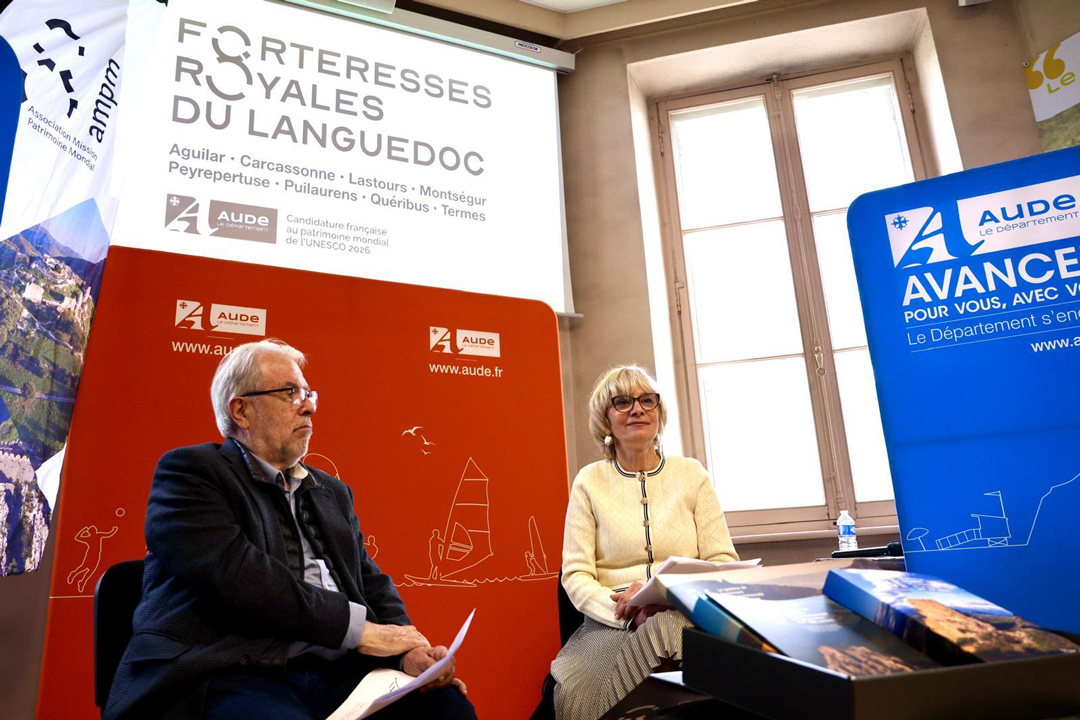
Hervé Baro, président délégué de l’Association Mission Patrimoine Mondial, et Hélène Sandragné, présidente du conseil départemental de l’Aude, ont annoncé le dépôt officiel de la candidature, le 31 janvier 2025.
 Accueil > Actualités >
 After twelve years of preparation, France officially submitted the nomination of the “Fortress System of the Seneschalty of Carcassonne” to UNESCO → on January 31, 2025. The project, now titled “Royal Fortresses of Languedoc”, is accompanied by a new visual identity.
8 emblematic fortresses of military architecture in Southern France
Led by the Aude Departmental Council and the World Heritage Mission Association (AMPM), the nomination concerns eight major sites located between Aude and Ariège:
These fortresses bear witness to the military architecture that royal power developed in the 13th century, following the Albigensian Crusade.
For Hélène Sandragné, President of the Department, it was essential to give this project an accessible and meaningful name. “The designation “Royal Fortresses of Languedoc” faithfully reflects history while facilitating public engagement with the project.”
Fortresses, Symbols of Power
In the 13th century, the King of France established a seneschalty in the region to consolidate his authority. Carcassonne became a military and administrative center, surrounded by a network of strategically positioned castles to protect the border with the Kingdom of Aragon. These structures, once fortified villages or strongholds of local lords, were entirely redeveloped for defensive and symbolic purposes.
Royal Fortress: A Name Rooted in History
The term “Languedoc” appeared at the end of the 13th century, designating the territories recently integrated into the Kingdom of France, west of the Rhône. Today, it evokes a region rich in culture, diverse landscapes, and history, nestled between the Mediterranean, Corbières, and Pyrenees.
A Meaningful Visual Identity
The new logo intertwines the two “O”s from “forteresses” and “royales” to form the number 8, recalling the eight sites of the project. Its irregular design evokes the authenticity and uniqueness of the monuments.
Towards Global Recognition by UNESCO in 2026
The nomination of the Royal Fortresses of Languedoc now enters an 18-month evaluation phase by ICOMOS →, an expert body to UNESCO. The final decision is expected in summer 2026. Hervé Baro, delegated president of the World Heritage Mission Association →, is confident: “The dossier has been praised for its quality and benefits from strong support from the French State.”
A Project Serving the Territory and the People of Aude
Beyond symbolic recognition, the inscription of the Royal Fortresses of Languedoc on the UNESCO list would allow, through a rigorous and multi-partner management plan, to:
• Protect these historical monuments
• Enhance their tourist appeal
• Promote balanced territorial development
• Preserve landscapes and local quality of life
This project highlights an exceptional heritage and is part of an effort to transmit it to future generations.

