Unesco Express: Aude Department Staff Take on the Royal Fortresses!

Unesco Express: Aude Department Staff Take on the Royal Fortresses!
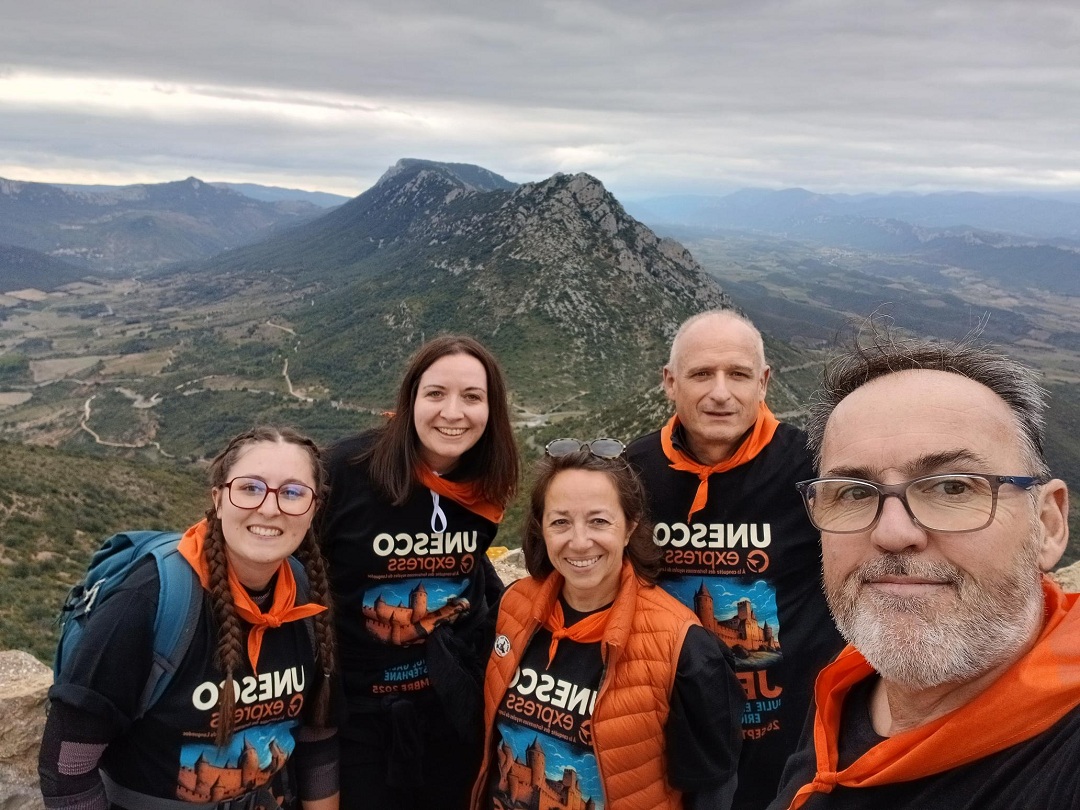
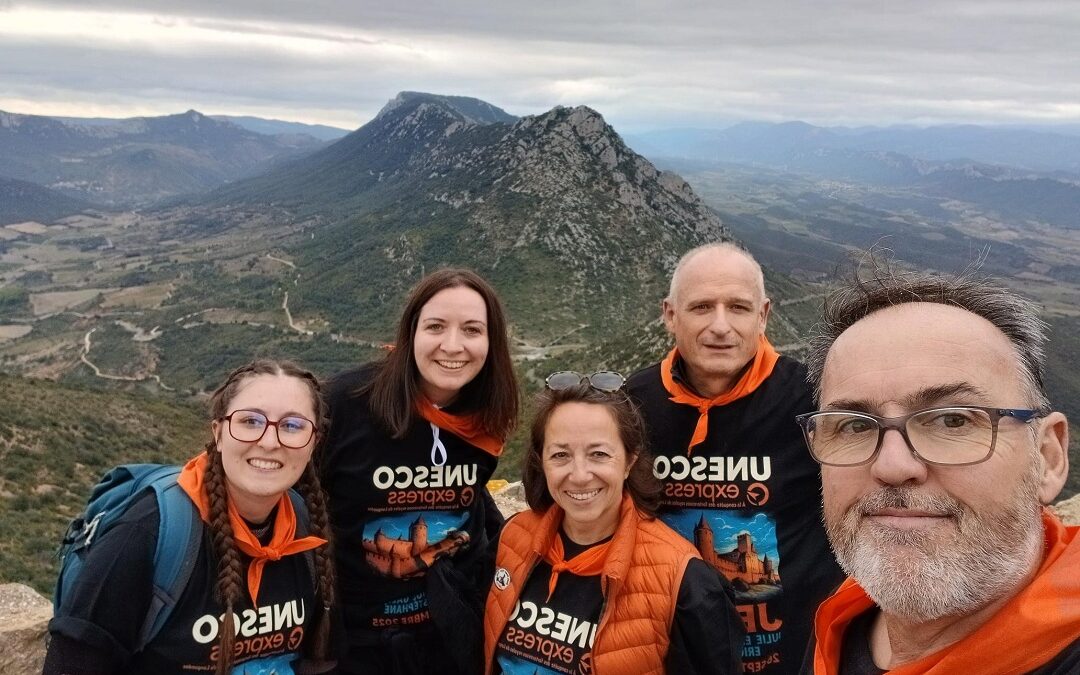
The Jégés, one of the 18 teams that participated in the Unesco Express in connection with the Unesco World Heritage candidacy of the Royal Fortresses of Languedoc.

Les Jégés, l'une des 18 équipes qui ont participé à l'Unesco Express en lien avec la candidature au patrimoine mondial de l'Unesco des forteresses royales du Languedoc.

On September 26, nearly 90 Aude Department staff members embarked on a unique collective adventure inspired by a famous television show: the Unesco Express. A cultural and sporting challenge conceived by the local authority’s internal communications department to (re)discover the Royal Fortresses of Languedoc, heritage jewels vying for inscription on the Unesco World Heritage list.

A Sporting, Convivial, and Meaningful Adventure

Divided into 18 teams representing all assistant general directorates, the participants set off in the morning from the Departmental Headquarters in Carcassonne, ready to take on all challenges!

Three routes were therefore offered, all converging towards two mythical sites: Peyrepertuse Castle and Quéribus Castle. Throughout the course, the teams had to solve riddles, find markers, and complete several sporting challenges. Five riddles, five stages, and one single objective: to promote the Unesco candidacy of the Royal Fortresses of Languedoc.

The day was also an opportunity for participants to meet local producers, artisans, and businesses, who, like them, are ambassadors for the Unesco candidacy.

The Staff, Primary Ambassadors of the Unesco Candidacy

More than just a challenge, the Unesco Express allowed each participant to become, for a day, an ambassador for the candidacy of the Royal Fortresses of Languedoc. Through their enthusiasm, curiosity, and team spirit, they embodied the values of commitment and cohesion that constitute the strength of the Department.

Between moments of sharing, personal achievement, and cultural discovery, this experience will remain a significant memory for many — that of a day where work is synonymous with passion and collective action finds its full meaning!
The national press at the heart of the Royal Fortresses of Languedoc

The national press at the heart of the Royal Fortresses of Languedoc

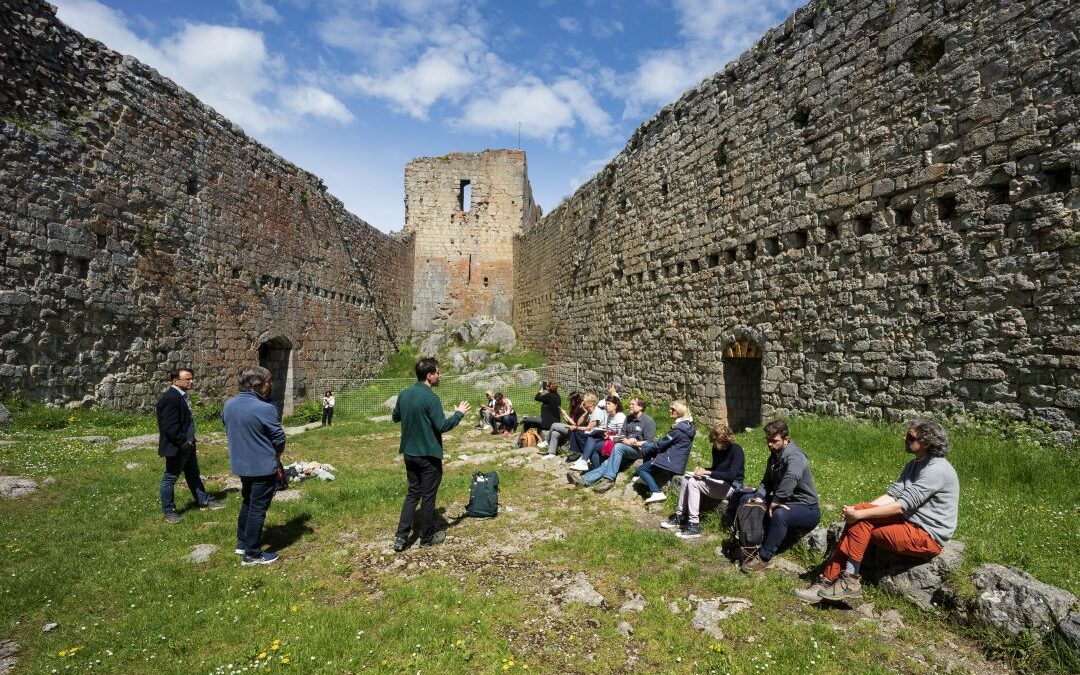
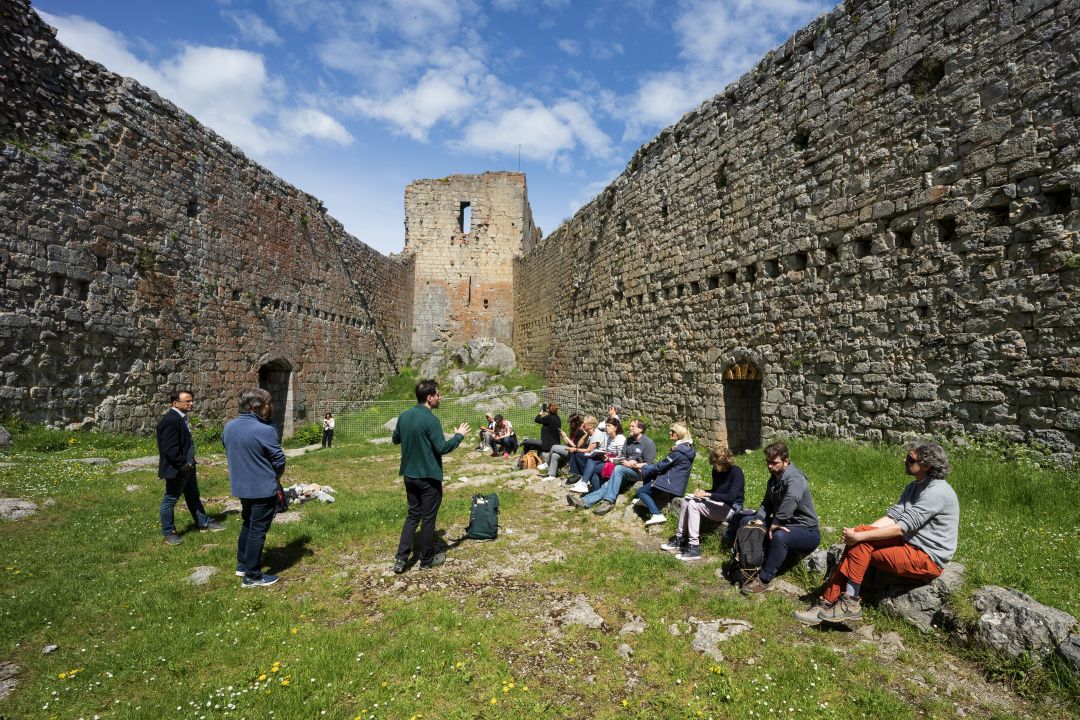
Press trip to discover the Royal Fortresses of Languedoc, candidates for inscription on the UNESCO World Heritage list. Journalists visit Montségur.

Première étape du voyage de presse, la découverte de Montségur.

On May 13 and 14, 2025, eight journalists from national press outlets were invited to discover the Royal Fortresses of Languedoc as part of a press trip organized by the Aude Department and the World Heritage Mission Association.

First introduction to the UNESCO candidacy

Over two days, this immersive journey allowed them to explore the fortress territory, visit five emblematic sites – Montségur, Lastours, the ramparts of Carcassonne, Peyrepertuse and Quéribus – and meet several stakeholders involved in promoting the property. A rich program, punctuated by heritage discoveries and some historical stair climbs.

The first day began in Toulouse, the meeting point for the journalists, where they were welcomed by Anaïs Monrozier, project manager at AMPM. The bus journey to Montségur provided an initial introduction to the candidacy and the serial property.

Upon their arrival, the participants were received at the castle’s reception building by Hélène Sandragné, President of the Aude Department, and Didier Trémolières, municipal councilor of Montségur. After reaching the site, they took a guided tour led by Fabrice Chambon, the town’s cultural attaché, enhanced by a presentation of ongoing consolidation and enhancement work, given by Simon Petot-Bottin, heritage architect. They also learned about the Grand Site de France labeling project, supported by the Pays d’Olmes community of communes and presented by Benoît Combes, head of the Project division.

Their role in the history of Languedoc

In the afternoon, the group continued its discovery in Lastours with a meeting with Max Brail, the town’s mayor. From the viewpoint, the journalists discovered the location of the four castles of Lastours and their role in the history of Languedoc, presented by the tour guide Agnès Despratx.

At the end of the day, the delegation reached the City of Carcassonne for a tour of the ramparts, accompanied by historical insights provided by Nicolas Faucherre, a member of the candidacy’s scientific committee, as part of a visit organized by the Centre des monuments nationaux. The evening concluded with a dinner at the Hôtel de la Cité.

Understanding the challenges of biodiversity preservation

The next day, the journalists visited Peyrepertuse castle, guided by David Maso, architecture and archaeology project manager at AMPM, and Agnès Daubrège, tour guide. A discussion with naturalist Christophe Savon then allowed them to address the challenges of biodiversity preservation and the actions taken in this regard. The last stage of the trip led them to Cucugnan, where the mayor, André Doumenc, received them before a visit to Quéribus castle and a presentation by Elisabeth Limorthé, site manager, on the mediation tools implemented to promote this exceptional heritage.

The nomination of the Royal Fortresses of Languedoc submitted by France to UNESCO

The nomination of the Royal Fortresses of Languedoc submitted by France to UNESCO

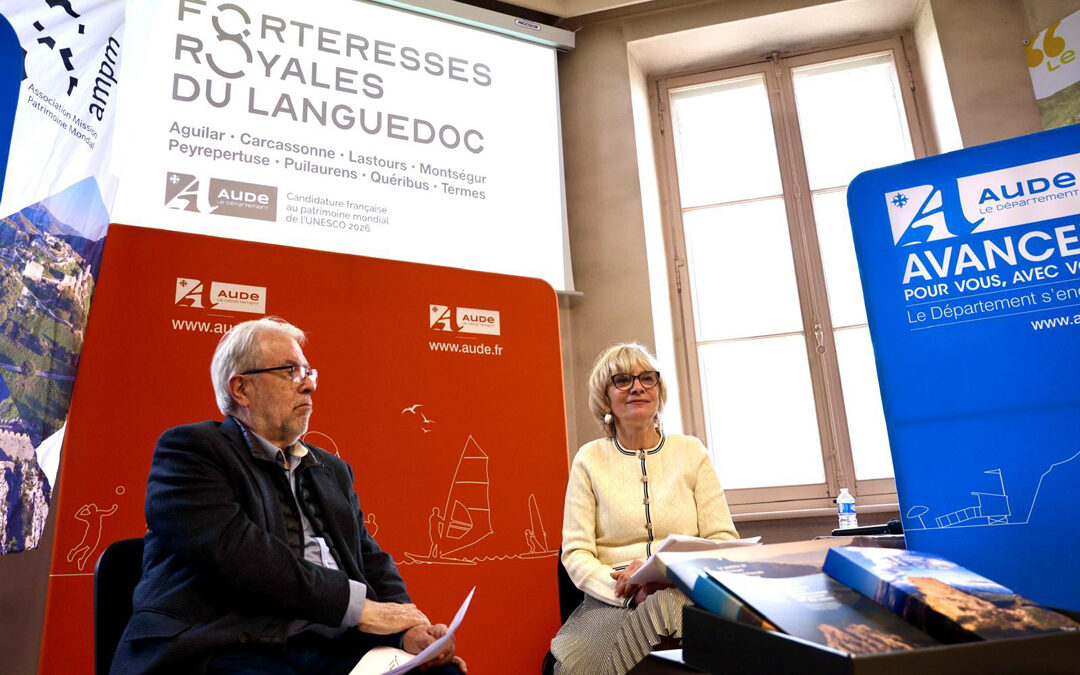
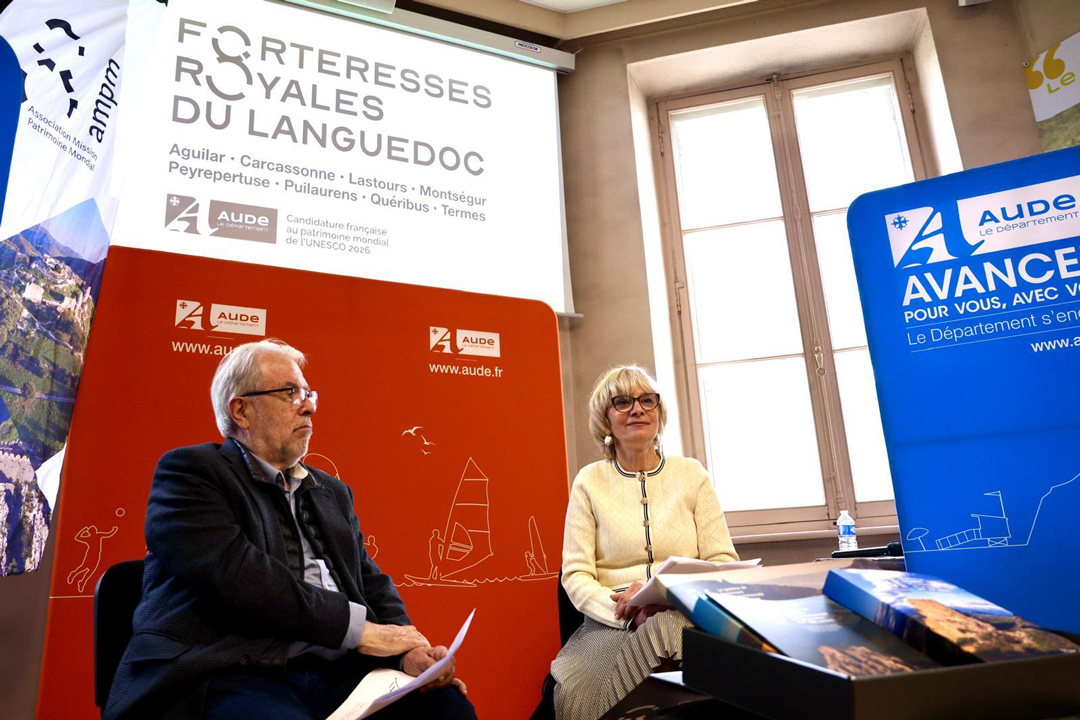
Hervé Baro, président délégué de l’Association Mission Patrimoine Mondial, et Hélène Sandragné, présidente du conseil départemental de l’Aude, ont annoncé le dépôt officiel de la candidature, le 31 janvier 2025.

After twelve years of preparation, France officially submitted the nomination of the “Fortress System of the Seneschalty of Carcassonne” to UNESCO → on January 31, 2025. The project, now titled “Royal Fortresses of Languedoc”, is accompanied by a new visual identity.

8 emblematic fortresses of military architecture in Southern France

Led by the Aude Departmental Council and the World Heritage Mission Association (AMPM), the nomination concerns eight major sites located between Aude and Ariège:

These fortresses bear witness to the military architecture that royal power developed in the 13th century, following the Albigensian Crusade.

For Hélène Sandragné, President of the Department, it was essential to give this project an accessible and meaningful name. “The designation “Royal Fortresses of Languedoc” faithfully reflects history while facilitating public engagement with the project.”


Fortresses, Symbols of Power

In the 13th century, the King of France established a seneschalty in the region to consolidate his authority. Carcassonne became a military and administrative center, surrounded by a network of strategically positioned castles to protect the border with the Kingdom of Aragon. These structures, once fortified villages or strongholds of local lords, were entirely redeveloped for defensive and symbolic purposes.


Royal Fortress: A Name Rooted in History

The term “Languedoc” appeared at the end of the 13th century, designating the territories recently integrated into the Kingdom of France, west of the Rhône. Today, it evokes a region rich in culture, diverse landscapes, and history, nestled between the Mediterranean, Corbières, and Pyrenees.


A Meaningful Visual Identity

The new logo intertwines the two “O”s from “forteresses” and “royales” to form the number 8, recalling the eight sites of the project. Its irregular design evokes the authenticity and uniqueness of the monuments.

Towards Global Recognition by UNESCO in 2026

The nomination of the Royal Fortresses of Languedoc now enters an 18-month evaluation phase by ICOMOS →, an expert body to UNESCO. The final decision is expected in summer 2026. Hervé Baro, delegated president of the World Heritage Mission Association →, is confident: “The dossier has been praised for its quality and benefits from strong support from the French State.”


A Project Serving the Territory and the People of Aude

Beyond symbolic recognition, the inscription of the Royal Fortresses of Languedoc on the UNESCO list would allow, through a rigorous and multi-partner management plan, to:

• Protect these historical monuments

• Enhance their tourist appeal

• Promote balanced territorial development

• Preserve landscapes and local quality of life

This project highlights an exceptional heritage and is part of an effort to transmit it to future generations.

Pin It on Pinterest

Logo Forteresses Royales du Languedoc noir
Privacy Overview

This website uses cookies so that we can provide you with the best user experience possible. Cookie information is stored in your browser and performs functions such as recognising you when you return to our website and helping our team to understand which sections of the website you find most interesting and useful.