
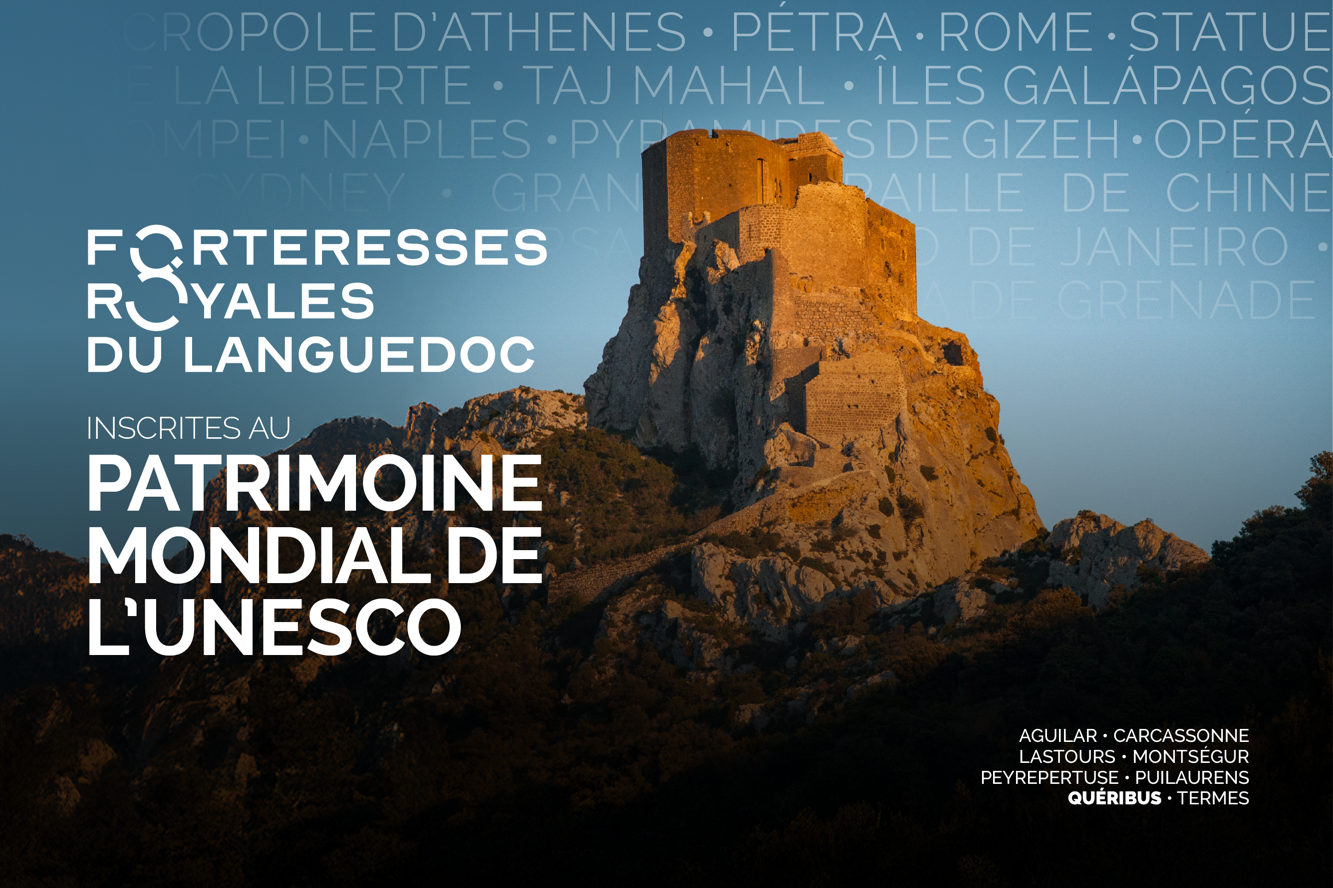
UNESCO adds the Royal Fortresses of Languedoc to the World Heritage List!

UNESCO banner
Meeting this Sunday 26 July in Busan (Republic of Korea) for its 48th session, UNESCO’s World Heritage Committee added the Royal Fortresses of Languedoc to the World Heritage List. The Committee thus recognises the Outstanding Universal Value of this serial property of eight sites, spanning more than 9,400 hectares between Aude and Ariège. This recognition marks the culmination of a project carried for 13 years by an entire region and its inhabitants, and represents the starting point for new heritage, cultural, tourism and economic development.

The Royal Fortresses of Languedoc on the UNESCO list alongside prestigious sites

A treasure for humanity. Since this Sunday 26 July 2026, the Royal Fortresses of Languedoc have now become part of UNESCO World Heritage. With this listing, they join the UNESCO list alongside exceptional and internationally renowned sites such as the Taj Mahal, the Acropolis of Athens, the Great Wall of China… Recognised as a serial property, these fortresses comprise eight monuments: the fortifications of Carcassonne and the castles of Lastours, Termes, Aguilar, Peyrepertuse, Quéribus, Puilaurens and Montségur. Designed as a coherent defensive system, this ensemble illustrates a major stage in the political, military and territorial history of medieval Europe, giving it Outstanding Universal Value.
Overlooking the rugged relief of the Corbières and the Montagne Noire, these fortresses bear witness to the exceptional adaptation of military architecture to topographical constraints and to the emergence of new forms of territorial organisation by the French monarchy.

The reward for 13 years of scientific, heritage and collective work carried out in Aude and Ariège

UNESCO’s recognition pays tribute to the scientific, heritage and collective work led by the Aude Department and AMPM (Association Mission Patrimoine Mondial) and carried out since 2013 with all the partners involved in this nomination: the State, local authorities (six communities of communes and eight municipalities), the owners of the monuments, scientific teams, site managers and the many stakeholders who work every day to conserve and pass them on.

This recognition marks a new stage in preserving the Royal Fortresses of Languedoc and commits present and future generations

Inscription on UNESCO’s World Heritage List will make it possible to recognise and protect the sites for present and future generations. It commits Member States to preserving these emblematic places while promoting their sustainable management, restoration and intact transmission over time. It will also play a major role in developing responsible tourism, boosting local economies and raising public awareness of the importance of cultural diversity.
“Yesterday, a symbol of royalty seeking to assert its authority over a newly conquered people, tomorrow they will become assets for a rural land in perpetual motion,” rejoiced the President of the Department, Hélène Sandragné, this Sunday on hearing the UNESCO decision. “To inscribe them on the World Heritage List is to recognise the prowess of their builders and their role in the singular history of the construction of the French state. But above all, it is to give them a far more important role in a territory made up of willing women and men who see in these castles far more than ruins to be protected. They are projects to be brought to fruition and values to be passed on. By a fitting turn of History, these fortresses that broke the rebellious fervour of the people of Languedoc will tomorrow give them fresh momentum.”

By virtue of their Outstanding Universal Value, these monuments indeed tell a story shared by European peoples: that of borders, their construction, their evolution and the exchanges they have witnessed over the centuries.

Being included on the UNESCO list represents a new stage: strengthening cooperation between the various site managers. This recognition will indeed foster the development of research programmes, encourage outreach activities for audiences and contribute to tourism development that respects the monuments, landscapes and local residents.
“This listing is not an end in itself for our region, but the beginning of a fine and long adventure of renewed local development”, the President of the Department, Hélène Sandragné, has already announced.

A fortified system with no equivalent anywhere else in the world

By joining UNESCO’s World Heritage List, these monuments become part of a network of properties recognised for their exceptional contribution to the history of humanity and for the collective responsibility they embody in protecting and passing on heritage.


Pin It on Pinterest

Share This
Logo Forteresses Royales du Languedoc noir
Privacy Overview

This website uses cookies so that we can provide you with the best user experience possible. Cookie information is stored in your browser and performs functions such as recognising you when you return to our website and helping our team to understand which sections of the website you find most interesting and useful.